


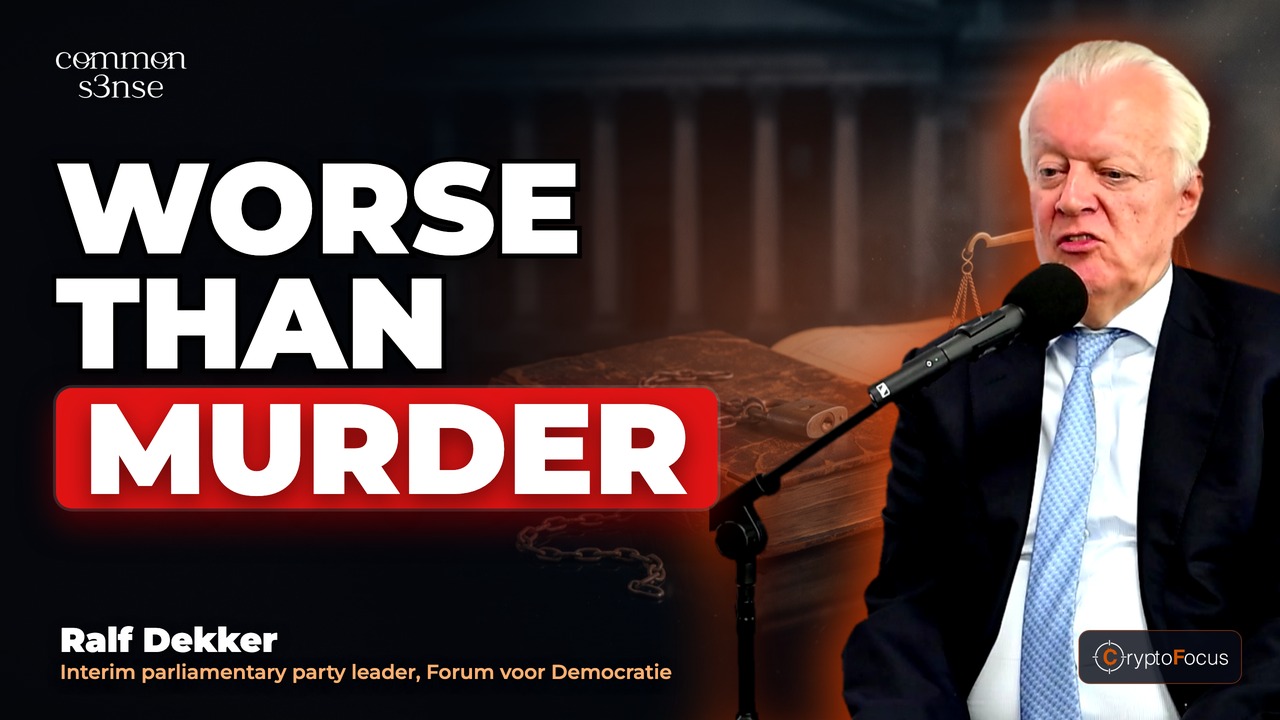
I asked a sitting member of the Dutch parliament why crypto gets so little trust in The Hague, and he answered with a line about murder. Ralf Dekker chairs the Tweede Kamer committee for Digital Affairs and currently leads the Forum voor Democratie group in the House. He was the only MP on the programme at a conference built around privacy and self custody, and he spent our twenty minutes explaining his colleagues to me rather than defending them.
| What you need to know |
|---|
| 1Dekker chairs the standing committee for Digital Affairs in the Tweede Kamer and has led the Forum voor Democratie group there since 6 August 2026, standing in for Lidewij de Vos. Before politics he spent more than thirty years at Rabobank, part of it on the executive board. |
| 2He was the only sitting MP on the programme at Common S3nse, the privacy conference CryptoCanal ran at De Hallen Studio's on 4 and 5 September 2026, where the guest wifi was named "taxation is theft, fiat is a scam". |
| 3His explanation for Dutch policy is cultural rather than technical. Tax avoidance is treated as a sin here, so crypto reads to officials as the vehicle for it. On money itself he told me fiat is "completely based on trust" and that he has always been in favor of experimenting with alternatives. |
| 4My read: the value here is a committee chair saying on camera that the knowledge in parliament is missing, that the reflex is control, and that the decisions keep getting pushed up to Brussels anyway. An MP saying warm things about bitcoin would be worth a great deal less. |
The full conversation runs twenty-one minutes.
The only MP in the room
Politicians talk about crypto when there is a campaign on. Very few of them turn up at a two day event where the wifi password is a slogan about theft, and fewer still sit on a panel there. Dekker did both, so I started with the obvious question: what is a parliamentarian doing here? He called it an honour, then immediately made it about his own trade.
Most politicians, certainly politicians of my generation, are not very attached to this whole subject. They are proud that they can use a computer, but that’s about it.
Ralf Dekker, Forum voor Democratie
Dekker was born in 1957, so he is describing his own cohort. It lands harder because of where he sits. The committee he chairs is the one that handles digital identity, algorithms, online security and the Dutch position on European tech files, and it is staffed by the same generation he has just described. He does not treat that as a joke.
And I think developments in this field are going unbelievably fast, and also the societal effects are being underestimated.
Ralf Dekker
His pitch for why the Netherlands should care is historical. The internet was built in the United States, he said, and adopted and expanded here early, in Amsterdam in particular, and he wants that connection to new technology kept alive rather than remembered. Amsterdam still carries the physical evidence of it in AMS-IX, one of the largest internet exchanges in the world.
Why Ralf Dekker says Dutch officials read crypto as tax evasion
I put it to him that the room he had just walked into sees his side as the opponent, and asked why the mistrust runs the other way too. His answer had nothing to do with technology and everything to do with what the Dutch state considers a moral failure.
In the Netherlands, not paying your taxes is being seen as worse than murder. It’s a sin. It’s a true sin, whereas in other countries, it’s a bit of a sport. Let’s see if we catch you.
Ralf Dekker
Then he closed the loop to the sector. If evasion is the cardinal sin, anything that looks like a route around the tax office inherits the guilt, and so does anyone standing next to it.
So these crypto environments are seen as a vehicle to be able to circumvent that, to not pay taxes. And when you’re a white washer, you’re a criminal, you’re a bad person, and that’s where it comes from.
Ralf Dekker
He said “white washer” because the Dutch word for money laundering is witwassen, and the English came out of it sideways. The point survives the translation. Think about what that framing does to a policy debate: an official who starts from laundering is not weighing a technology against its uses, they are deciding how tightly to hold something they already read as suspect. That is a very different starting position from the one a builder in that room imagines they are arguing with.
He is sympathetic to the complaint that produced the wifi name, and he was specific about where. He pointed at box three, the Dutch levy on savings and investments, and at inheritance tax, and said that taxing money you have already been taxed on feels like theft to him. Box three is the file that has been in trouble for years: the Hoge Raad ruled against the deemed return system, a counter proof scheme has been running since 2025, and a replacement law is still being written.
The state has better tools than it used to
The most cypherpunk thing said in twenty one minutes came from the man with the parliamentary pass. He set up a tension he clearly thinks his own institution has not resolved.
Governments tend to be focused on controlling society. And as we briefly discussed beforehand, the digital world gives excellent tools to be used by the government to control. And that’s exactly what we’re trying to prevent here.
Ralf Dekker
He called it a strange dichotomy, and it is. Every argument for digitising a public service is an argument for a faster, cheaper, more complete record of the person using it.
The freer the flow of information, the easier it is to spy on us and to keep us under control, also in the financial sector.
Ralf Dekker
That last clause is why this event exists. The regulation shaping the room is Article 79 of the EU anti money laundering regulation, which from 10 July 2027 bars crypto service providers from keeping anonymity enhancing coins and anonymous accounts, while recital 160 leaves the makers of hardware, software and self custody wallets outside the perimeter. Dekker is describing the pressure that produced that split, and his answer to it is a counterweight rather than a veto: build technologies whose own design limits how much can be watched.
He also thinks his colleagues are more reachable on this than the sector assumes. He chairs a committee that runs from the far left to the far right of the House, and told me digital risk has barely been a party political fight there, with broad awareness of what a central bank digital currency would mean for privacy. What is missing, in his account, is not goodwill.
So I think the politics is broadly open to all sorts of solutions, but there’s a lack of knowledge clearly, and there’s of course a push from the existing parties, for instance in the financial field, inclusive of the regulators.
Ralf Dekker
Fiat runs on trust, and he says so
The second half of the wifi slogan was harder for him, and he did not pretend otherwise. He spent three decades inside a bank, which makes his answer on money worth more than most.
It’s completely based on trust. It’s based on nothing else. That’s for sure.
Ralf Dekker
Then came the part that separates him from a campaign quote. He did not promise a replacement.
I’ve always been in favor of experimenting with alternatives. So the Bitcoin, the stablecoin, these sorts of structures, I think are attractive to play with and to try and see how that works out, really give us an alternative world for the existing BIS driven, SWIFT based international banking systems.
Ralf Dekker
Note what he is actually describing: not a better coin, but a second set of rails alongside the correspondent banking system that runs through SWIFT and the standards work at the Bank for International Settlements. Then he said he sees no short term solution, and left it there. That refusal to forecast was the most convincing minute of the interview.
Overreacting and underreacting at the same time
I asked why a country that leads in chip equipment and internet infrastructure treats artificial intelligence as a threat to be contained. He put the fear in the plainest possible terms, and he did not distance himself from it.
It’s a reflex to say, wait a minute, here we have Elon Musk or Bill Gates or whoever determining what logic is there inside AI and hence determining the way we are fed with information or even worse, the way our unmanned vehicles are being steered.
Ralf Dekker
His own preference is the opposite of containment. This is an area where you should compete, he said, where you build your own algorithms and try to influence the field rather than keep it out. Then he gave the most honest description of a legislature meeting a technology it cannot model that I have heard from someone still in office.
So for politicians, that is one of the scariest things in the world. You want to know where you need to influence in order to make things go your way. And when you don’t know that, it’s a scary environment.
Ralf Dekker
His verdict on the result is the line I would put on the committee room wall. We tend to overreact on the one hand and underreact on the other hand, he told me, and anyone who has watched a Dutch algorithm debate turn into either a moral panic or a shrug will recognise both halves.
We are all followers today
I asked how the Netherlands avoids being ten years behind the United States and China by the time it decides anything. He did not defend the record.
We’re all followers today. You see a tendency to push decision-making a way up. So here in the Netherlands, and I think that’s all across Europe, we tend to leave that to the EU because we can’t diverge from the way France or Germany or any other country is dealing with this stuff.
Ralf Dekker
He called organising it at EU level even worse, and described the pattern that follows: comply with the new rules, criticise them afterwards, follow them anyway. Whatever you make of the politics, the mechanism is real and it is where the files that matter to this sector are decided. The anti money laundering package, the markets in crypto assets regulation and the digital euro proposal were all written in Brussels, and a Dutch committee gets an opinion rather than a pen.
The last thing he wanted was aimed straight at the people in the room. Successful founders here go and live in Dubai or spend their money in Singapore, he said, and he wants them to do something else with it.
Wait a minute, you’re Dutch, you’re part of Dutch country and the Dutch community. Why not set something up in the Netherlands that is lasting, as the old industrialists did?
Ralf Dekker
The industrialists he means built quarters of cities and schools, and he contrasted that with buying a castle somewhere in France and redecorating it. It is an odd ask to hear at a conference about exit and sovereign individuals, and it is the reason he was worth twenty minutes. He is not selling the room a policy. He is asking it to stay.
Frequently asked questions
Who is Ralf Dekker?
He is a member of the Tweede Kamer for Forum voor Democratie, chairs the standing committee for Digital Affairs, and has led the FVD parliamentary group on an interim basis since 6 August 2026 while Lidewij de Vos is on maternity leave. He was born in 1957, worked at Rabobank for more than thirty years including a seat on the executive board, chairs the party’s Renaissance Instituut and has sat in the Noord-Holland provincial council since 2019.
What does the Tweede Kamer committee for Digital Affairs actually do?
It is the standing committee that scrutinises digital policy across departments, covering digital identity, algorithms and artificial intelligence, online security and the Dutch position on European technology files. It questions ministers and produces reports and motions. It does not write European regulation, which is the constraint Dekker keeps returning to.
Why do Dutch regulators treat crypto as a money laundering question first?
Dekker’s explanation is cultural: not paying tax is treated in the Netherlands as a moral failure rather than a game, so anything that looks like a route around the tax office arrives already suspected. The legal machinery points the same way. The EU anti money laundering regulation of 2024 bans anonymous crypto accounts and anonymity enhancing coins at service providers from 10 July 2027, and Dutch supervision of crypto firms sits with De Nederlandsche Bank and the AFM under that frame.
Does he support bitcoin?
He supports experimenting rather than replacing. In his words he has always been in favor of trying alternatives such as bitcoin and stablecoins to see whether they can offer a real alternative to the BIS driven, SWIFT based banking system, and in the same breath he said he sees no short term solution and that replacing fiat is far more complex than the complaints about it.
Read next
Every interview we recorded at the event, updated as they go live: the Common S3nse 2026 interview hub.
The other Dutch builder we spoke to on the same day: Olaf van Wijk of Nihilium on what self custody actually costs you. The woman who put an MP on the same stage as the cypherpunks: CryptoCanal founder Eleonore Blanc on building the event. And for the other end of the political spectrum on show, Liberland president Vit Jedlicka.
Our preview of the programme: what Common S3nse set out to do in Amsterdam, and the speakers we flagged before the doors opened.
Primary sources: Dekker’s member page at the Tweede Kamer, his party profile, his biography at Parlement.com, and the text of Regulation (EU) 2024/1624 for the 2027 anonymity rules. He is on X as @ralfdkkr; the party is @fvdemocratie. The event programme and speaker list is at Common S3nse, run by CryptoCanal.
Recorded at Common S3nse 2026, De Hallen Studio’s, Amsterdam, on 5 September 2026, during Cypherpunk Week. Quotes are verbatim from the recording with filler removed. Cryptofocus is a media partner of Common S3nse. Nothing here is financial advice.


