



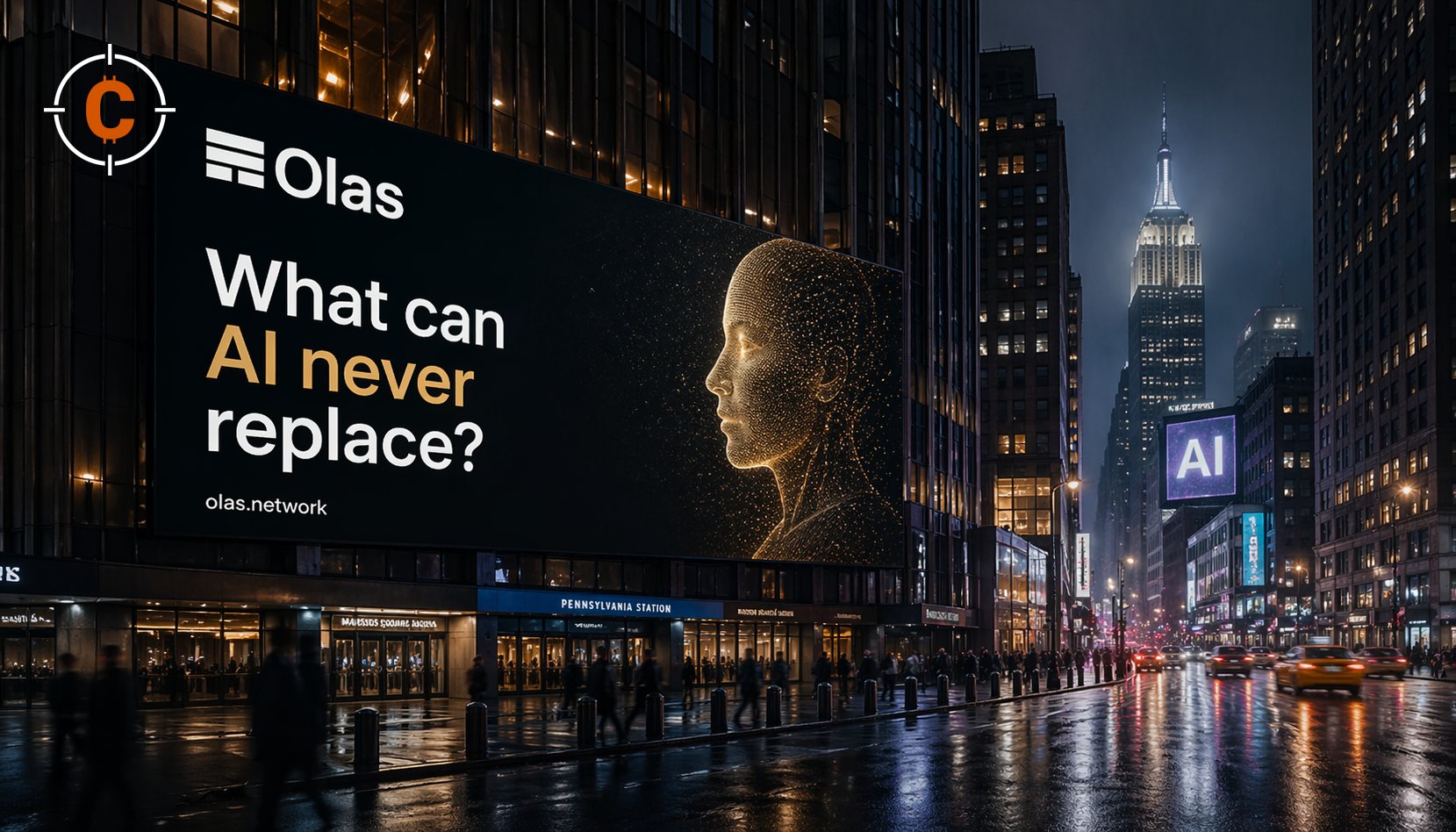

While most AI companies are busy telling you what their technology can do, Olas is plastering New York City bus shelters with a different question: “AI could never…” The campaign, launched this week across high-traffic neighborhoods, invites passersby to fill in the blank. People pause mid-commute to photograph the signs and post their own answers.
What makes you irreplaceable?
The premise is open-ended by design. Creativity. A gut feeling. A bad joke told at exactly the right moment. Olas doesn’t finish the sentence; that job belongs to whoever’s reading it. In a city that filters out most of what it sees, that’s deliberate, and it seems to be working.
David Minarsch, CEO of Valory and founding member of Olas, said: “We’re at a point where AI can do more than ever before, but that doesn’t mean it should own more of our lives. This campaign is a visible reminder that there are still things that can’t be replicated, and more importantly, shouldn’t be.”
Trust in AI companies is a genuine public concern. Larger players have leaned into in-person events and community-building to win people over, while still giving users limited say over their data. Olas is pushing a harder position: ownership is what trust actually looks like, not curated experiences.
Owning your AI agents, not just using them
Through Pearl, their AI agent app store, users own their agents outright rather than renting access from a corporation. The platform has processed over 16 million agentic transactions, with agents running prediction markets, asset management, and influencer automation autonomously. The OLAS token powers access and coordinates interactions across what Olas calls the agent economy.
What comes next for Olas and Pearl
Olas is also mid-transition. They’re shutting down Quickstart, a command-line tool built for early technical users, and going all-in on Pearl. Simpler setup, multi-agent support, no terminal required. If you want regular people to own AI agents, your platform can’t require a command line.
And I’ll be honest: it’s rare to see an AI company ask what AI shouldn’t do, rather than just hyping what it can. The ownership model still has to prove itself. But it’s a better question than most companies in this space are bothering to ask.


