



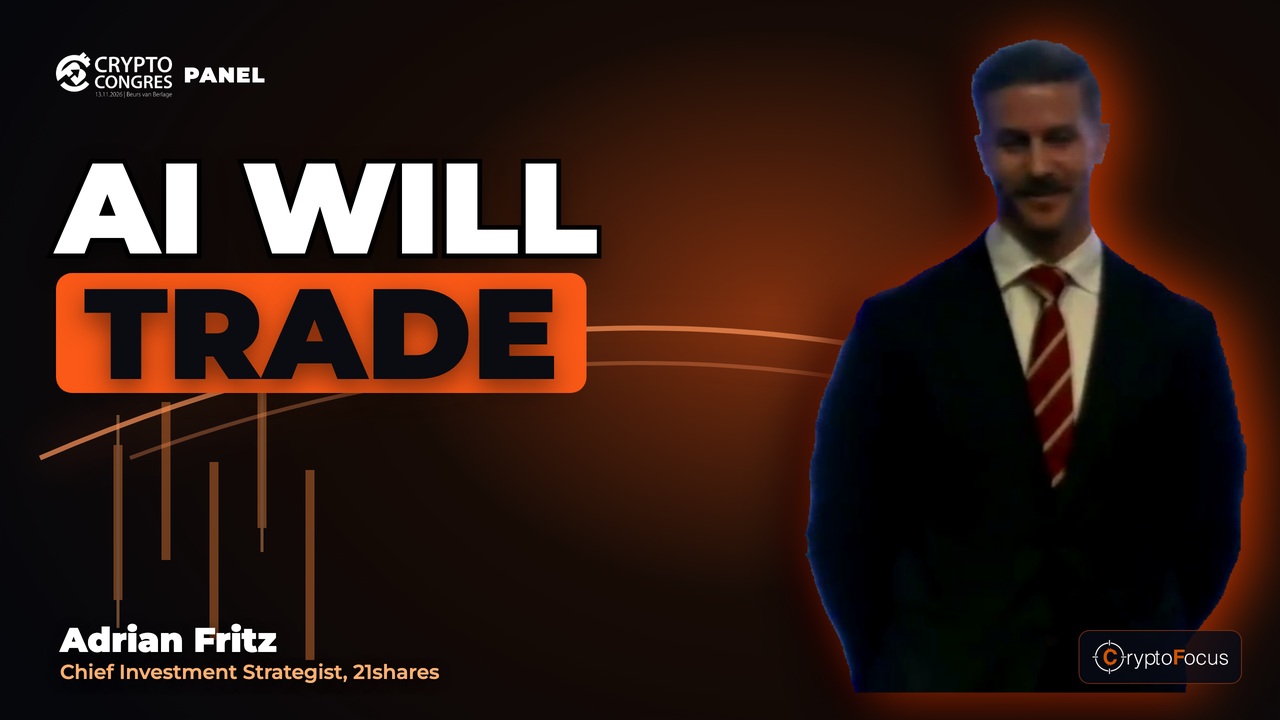
When Adrian Fritz, Chief Investment Strategist at 21shares, told the Crypto Congres audience that in the future most trading volume will be done by AI agents, I repeated his last three words back to the room: “Not by humans.” His answer came on the last audience question of the panel I moderated. I had tailored that question to each guest, so Ellen Lindenbergh of Ellinde and Lucas Wensing of Amdax answered for their own businesses: Ellen with her partners’ quarterly reports, Lucas with how an agent will pay.
| What you need to know |
|---|
| 1The AI question was the last audience question, sent in on Slido, at the panel I moderated at Crypto Congres 2026 in Amsterdam on 13 November. |
| 2Adrian Fritz (21shares) expects most trading volume to be done by AI agents in the future, and expects more hacks and smart contract exploits as the two technologies converge. |
| 3Ellen Lindenbergh (Ellinde) used to spend her weekends on her investment partners' quarterly reports, which AI now gets to her more easily. Lucas Wensing (Amdax) expects agents to start making payments. |
| 4My read: Adrian answered who will do most of the trading and Ellen who still makes the decision, and for an investor today hers is the answer closer to daily work. |
The full panel is below, and the AI round starts here.
Adrian Fritz expects agents to do most trading
I opened the round by telling the panel, “I’m going to tailor this last question to all of you because you’re different when it comes to your companies.” Adrian went first. I asked him how AI will affect the way he does business, and then: “How will it affect your approach to cryptocurrency?” He opened with the downside.
I think there will be a convergence between the two technologies in the good and the bad. We will see more hacks and smart contract exploits, for instance.
Adrian Fritz, Chief Investment Strategist, 21shares
Then he turned to the upside.
In the good, I would say that the technologies work nicely together. Obviously, blockchains and crypto protocols are based on code, and that’s where AI agents are very comfortable as well. What they can help with is just abstracting away from the technical aspect of this asset class and help the user experience.
Adrian Fritz
He went a step further.
And on top of that, I think, in the future, the majority of trading volume will actually be done by AI agents and not by humans.
Adrian Fritz
He named the exploits before the convenience. The reason he gave for the upside, that crypto runs on code and code is where agents are comfortable, reads to me as the reason for the downside too: software that can hide a protocol’s complexity from a user can also read that protocol line by line, so the agents that make crypto easier to use can also make it easier to attack.
What AI changed in a traditional investor’s week
I turned to Ellen next: “Ellen, from your perspective and the way you do business, how will that affect it?” (her answer) At the start of the panel she had introduced herself as a traditional investor: Ellinde invests in Dutch manufacturing companies, and in blockchain and crypto as well. On AI, she drew a line before she said a word about speed.
I still have to make my own decisions. But I use AI to make my decisions quicker. So my tactical approach is quicker.
Ellen Lindenbergh, Investor & Principal, Ellinde
Then she described where the hours used to go.
So all my investment partners, they sent me quarterly reports. I used to spend all the weekends reading those reports. I mean, it’s almost like a seven-day work week.
Ellen Lindenbergh
With AI, she said, those reports now reach her more easily.
Adrian’s line was about who will do most of the trading. Ellen’s, right after it, was about who decides, and in her answer that is still her.
Can a bank trust an agent that pays?
Lucas Wensing, founder and CEO of Amdax, went last (from here), and I asked him to build on the other two: “You’ve already discussed how AI is going to speed things up, but how will it affect you personally and your business?” He took it to payments.
It’s in line with the AI involvement of agents that I see as well, and agents will start making payments.
Lucas Wensing, founder and CEO, Amdax
To make those payments, he said, agents will probably need a crypto stablecoin or a new project that handles payments on crypto rails for them. Then he listed what still has to be solved.
And there’s still some work to be done with regards to the innovation on how you can do this securely, know which agent is actually paying, how a bank can trust the agent that is requesting a payment or making a payment, how a company can accept the payment from an agent, while there’s tech being built as we speak to facilitate all this.
Lucas Wensing
There is a public standards effort for agent payments too. On 14 July 2026 the Linux Foundation announced the operational launch of the x402 Foundation, which stewards x402, a protocol contributed by Coinbase that builds payments into web interactions for AI agents, APIs and applications. Forty organisations had joined by then, and the premier members include Circle, Stripe, Visa, Mastercard and Amsterdam-based Adyen.
Lucas’s conclusion was that AI and crypto will lead to different forms of payment, and that those payments will grow faster in crypto than on traditional finance rails.
Crypto is much better equipped to facilitate agent payment models than traditional payment models.
Lucas Wensing
I closed the round with my own line, echoing Adrian: payments, I said, “are not going to be done by humans.”
The open problems on his list, which agent is paying and whether a bank will trust it, read to me as questions of identity and liability, and I expect them to decide whether anyone accepts a payment from software. I followed the same question in my look at agentic fintech ahead of Amsterdam Fintech Event in October.
Read next: The Crypto Congres vote on companies or coins split 50/50: 21shares, Amdax and Ellinde on next-cycle returns covers the rest of this panel, from the opening Slido poll to the closing takeaways. Earlier in the same panel, Adrian explained why he would treat Bitcoin and crypto differently in a portfolio. A card on how to keep up with crypto and AI was among the Slido questions the panel did not reach, which we answer separately. In my interview with Lucas Wensing, he explains why he is personally more interested in the technology side of crypto than in the coin. The BeleggersFair section lists the rest of our coverage, including our Dutch preview of Crypto Congres 2026.
Recorded on 13 November 2026 at Crypto Congres 2026, held with BeleggersFair 2026 at the Beurs van Berlage in Amsterdam, during the panel I moderated. Quotes are verbatim, with filler removed. Cryptofocus was media partner of Crypto Congres 2026. Nothing here is investment advice.


