



Forty-six votes came in on the first statement I put to the room at Crypto Congres, held with BeleggersFair, which I called “traditionally a TradFi type event” from the stage. They split exactly 50/50. On stage with me at the Beurs van Berlage in Amsterdam on 13 November were Adrian Fritz of 21shares, Ellen Lindenbergh of Ellinde and Lucas Wensing of Amdax. The statement read: “The biggest returns of the next market cycle will come from companies, not cryptocurrencies.” None of the three took it at face value.
| What you need to know |
|---|
| 1The opening Slido statement drew 46 votes and split exactly 50/50. A large majority of those who voted agreed with each of the next two statements. |
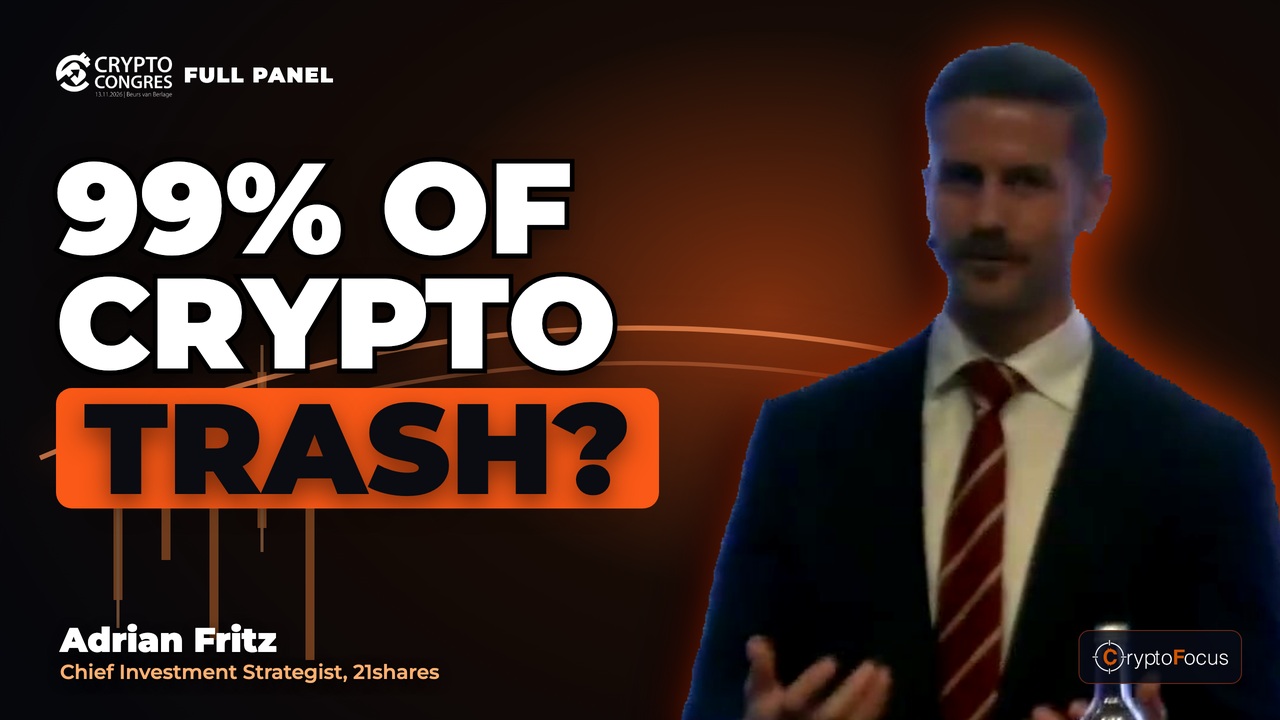
| 2Adrian Fritz, Chief Investment Strategist at 21shares, said "99% of all the crypto projects out there are complete trash". Ellen Lindenbergh of Ellinde called that "maybe a bit too harsh" and put the biggest returns "in both". |
| 3On Box 3, Lucas Wensing, founder and CEO of Amdax, said investing through a beleggings-bv can become interesting once investments reach about 200,000 to 300,000 euros. On 3 November the cabinet proposed starting the new Box 3 system on 1 January 2029 instead of 2028, according to Rijksoverheid; this is not tax advice. |
| 4My read: the vote asked companies or coins, and the panel kept answering a more practical question, who should do the choosing, which is a decision every investor in the room gets to make. |
The full panel runs about 43 minutes.
Three answers to a 50/50 Slido vote
I put the statement to Ellen first. She introduced herself as a traditional investor, and in her words Ellinde invests in “good old Dutch manufacturing companies, but also in blockchain and crypto” (watch the statement and Ellen’s answer).
I would answer this question with, I do not agree, because I think that the biggest returns are in both, maybe. Shorter term I think there are opportunities in cryptocurrencies. It’s volatile but it’s liquid. And there are also big opportunities in venture companies for the longer term.
Ellen Lindenbergh, Investor & Principal, Ellinde
Lucas started from a line he admitted he sometimes thinks himself.
I get remarks and once in a while I think the same that crypto in itself is dead. And what I mean by that is that there is just an overload of cryptos, way too many to make an adequate selection in.
Lucas Wensing, founder and CEO, Amdax
With that overload, he said, a company with the expertise to make those selections could be the winner. He also sees crypto projects that run as businesses, a decentralized derivatives exchange among them, and “a meaningful crypto project acting as a company with actual returns can be a good selection for you as an investor.”
After I read out the result, Adrian said he would disagree with a nuance: the statement says biggest returns, and risk-adjusted returns would be a different story.
I would say we definitely see the return of fundamentals. I would say 99% of all the crypto projects out there are complete trash and they will cease to exist.
Adrian Fritz, Chief Investment Strategist, 21shares
The exception he pointed to was the derivatives space, which Lucas had also mentioned. His example was Hyperliquid, which he called a derivatives platform built on top of blockchain technology. He was “not suggesting it will be the big winner”, but in his words Hyperliquid “makes around a billion in revenue and does that with 11 people and therefore makes it the most profitable entity worldwide.” Ellen found 99% “maybe a bit too harsh”. Her answer, which she came back to three more times during the panel, was to find a specialized fund manager, because those managers know what they do.
The overload Lucas described and Adrian’s 99% point at the same crowded field. What differs is who does the choosing in it: Lucas points to crypto projects that act as companies with actual returns, and Ellen hands the choice to a specialist manager.
Is a decade too long to plan for?
The second statement said the best investment opportunities of the next decade may not be publicly listed yet, and a large majority of those who voted on Slido agreed. Adrian did not know whether Hyperliquid would still be relevant by then, but he expected the underlying technology and what it enables to stay relevant (watch the second statement).
When we talk about AI, when we talk about space, bio-editing, blockchain technology, if you put that all together, I truly believe that the biggest investment opportunity of the next decade is not yet public.
Adrian Fritz
Lucas objected to one word: “I think the issue is with the word decade.” His evidence was Amdax, which has used AI in many of its software development processes since last November. “We can do much more with much less people and that’s only a year out so how can I say what happens in 10 years,” he said. He would narrow it to the coming three years, and even then “we’re probably all way off”. I could see Ellen thinking it through, so I asked her why.
I think you need to think back in the days of e-commerce, when logistics payments and e-commerce came together, then the real next move came. So I think that’s where we are now.
Ellen Lindenbergh
She would not put a date on it (“I don’t have a crystal ball”), so I summed up for the room: “We’re not looking at a decade anymore. We’re looking at a significant change in the next three years.” That line was mine. It shortened the horizon Adrian had just set out, and the two views can both be true.
What a diversified portfolio is missing
The third statement read: “A portfolio can own stocks, bonds, crypto, and private markets and still not be truly diversified.” Asked what was missing, Adrian said “Bitcoin is missing” and that he would treat Bitcoin and crypto separately, in different portfolio buckets (watch Adrian on what is missing). That exchange, and his case for holding Bitcoin and gold together, has its own write-up.
Lucas called crypto a niche market in Dutch portfolios, citing some 3.2 billion euros; my interview with him after the panel sets that figure next to DNB’s count for shares, funds and bonds. The change he expects is in the plumbing. He called it odd that crypto settles instantly while a stock bought through a broker settles at T plus one.
I think a client will not accept anymore in the very near future that they have to go to two brokers to buy stock versus crypto, right? That just makes no sense.
Lucas Wensing
Those rails were the subject of my morning panel with Flow Traders, Euronext and Bybit EU. I then asked the room for a show of hands on whether crypto is still a niche, and put the diversification question to Ellen. She said crypto should be part of a diversified portfolio because digital assets are here to stay, but that you have to start small.
Like I always say, you don’t have to know how to lay an egg to enjoy the omelette. So just put your toe in the water, try it and enjoy the omelette.
Ellen Lindenbergh
She also took diversification past asset labels: “you can have a long time horizon, low risk and still be in digital assets.” Both rules of thumb are hers, and neither is investment advice from us.
Who should do the choosing, and when?
One Slido question went straight at the case for specialist managers: “Why would you use a fund when funds do not outperform Bitcoin?” Lucas stepped out of the category (“we are not a fund, we’re a discretionary asset manager”) and said funds “can also be structured in such a way that you can be closed into that position for a longer time”. I put the follow-up bluntly: “How do you guys mitigate that feeling of you guys have no idea what you’re doing?” Lucas answered with transparency about a manager’s selections, Ellen with a checklist (watch the fund question).
I think investing in a fund, if you’re new to this digital asset class, I think it’s a good way. But look closely to if it’s an open-end or closed-end fund. Look at the liquidity and look at the prospectus very closely on the fees and the structure.
Ellen Lindenbergh
For the Dutch market Lucas added that it is, “for a typical investor, not always easy to see the quality of a fund.” His warning about being closed into a position and Ellen’s open-end or closed-end check come down to the same line in a prospectus: when you can get your money out. Trust was also the thread of my booth interview with Lucas after the panel, about what Amdax clients forgive and what they do not.
I had seen a Slido question on timing earlier and went back to it for Ellen. Timing matters, she said, but traditional equity holds that it is impossible (watch Ellen on timing). “But what you can do is invest over time. So every month a little bit.” Adrian turned that into a rule for small positions.
Once people add it to a portfolio they invest their emotions as well and that’s the wrong approach. If you have a small allocation make sure you have quarterly or semi-annual rebalancing and with that approach you automatically sell when it’s in profit and you buy when it’s in a weak phase of the market.
Adrian Fritz
On his logic, a fixed schedule makes the decisions that emotions would otherwise make. It is his rule, and none of it is investment advice.
Box 3: a direction, but nothing fixed yet
The hardest Slido question asked what role education plays, looking at Box 3 and the different tax moments for ETPs. I handed it to Lucas with an apology. “It looks like we found a direction, but nothing is fixed yet,” he said, and a lot of Amdax investors make sure they keep their options open (watch Lucas on Box 3).
Investing from box two compared to box three can become interesting as of 200, 300k of investments so setting up a beleggers BV can be a good idea for a lot of our investors.
Lucas Wensing
“It’s not a puzzle that you need to solve today. There’s no acute risk there,” he added, though he expects it to change how people invest, with more of them moving to a beleggings-bv.
A beleggings-bv is a private company that holds the investments. The company pays corporate income tax on its profit, and an owner with at least 5% of the shares pays box 2 tax on dividends and on gains from selling them, according to the Belastingdienst pages on corporate income tax and box 2. On 3 November the cabinet proposed starting the new Box 3 system on 1 January 2029 instead of 1 January 2028, according to the Rijksoverheid timeline. The Tweede Kamer adopted the novelle that amends the Box 3 bill on 12 November, the day before the panel, and it now sits with the Eerste Kamer. This is not tax advice; our Dutch-language guide to Box 3 and crypto has the details.
What would make crypto ordinary?
One audience question put global crypto adoption at around 8% and asked whether it would grow over the next three years. Ellen expected growth in acceptance as well as in adoption. I then asked all three for one sentence on what would help adoption most. Adrian said it is still education, Ellen pointed to real-world examples, and Lucas gave the test I found most useful (watch the adoption round).
As soon as you see that crypto is being part of your daily operation without noticing that crypto is involved, then I would say that crypto is a success in general.
Lucas Wensing
His test cuts against counting users: the better crypto does by it, the less people notice they are using it.
On AI, the last audience question, Adrian expects AI agents to do the majority of trading volume, and Lucas expects agents to start making payments on crypto rails. That round has its own piece, including how Ellen uses AI.
Before we closed I asked each of them for one takeaway, and Adrian kept his to three words: “Fundamentals and patience.” When Ellen had gone back to her omelette, I asked Lucas to wrap us up (watch the takeaways).
I think that the innovation in crypto is happening so fast and it’s being part of the traditional finance so quickly and so in the near future that not being invested in crypto is just the wrong answer.
Lucas Wensing
In the same answer he put it more simply: “see crypto as disruptive technology instead of a coin.” None of these takeaways is investment advice.
We ran out of time well before the Slido queue ran out of questions, and on stage I promised to answer all of them in the comments once the video is up. The Cryptofocus team answers the questions we did not reach in a separate piece, and those answers are our own.
Read next: what Euronext, Flow Traders and Bybit EU said about trading stocks around the clock, from my morning panel; the media panel I moderated at Bitcoin Amsterdam, on how Bitcoin creators answer propaganda; and our Dutch preview of Crypto Congres 2026, with the rest of our coverage on our BeleggersFair page.
Recorded at the Crypto Congres plenary “Where will tomorrow’s returns come from?”, held with BeleggersFair 2026 at the Beurs van Berlage in Amsterdam on 13 November 2026, where I moderated the panel. Quotes are verbatim, with filler words removed. Cryptofocus was media partner of Crypto Congres 2026. Nothing in this article is investment or tax advice.


