



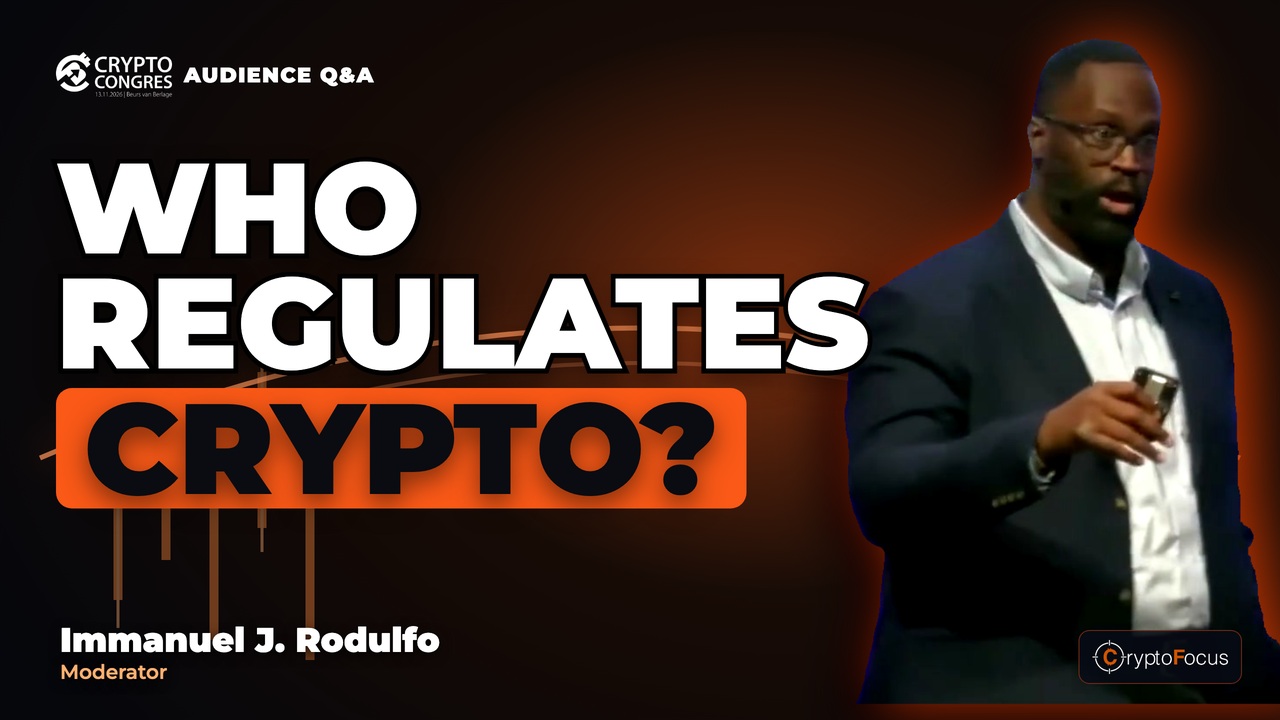
The most-liked question the panel I moderated at Crypto Congres never reached was six words long: “Who are the regulators of Crypto?” I promised the room at the Beurs van Berlage in Amsterdam on 13 November 2026, on stage with Adrian Fritz of 21shares, Ellen Lindenbergh of Ellinde and Lucas Wensing of Amdax, that we would answer the rest. For the Netherlands that answer is short: the AFM licenses crypto service providers under the EU’s MiCA rules, and DNB supervises stablecoin issuers.
| What you need to know |
|---|
| 1At its peak the Slido counter on the wall showed 28 entries. Ten questions were answered on stage; at least seven more never got an answer. |
| 2In the Netherlands the AFM licenses crypto service providers under MiCA and DNB supervises stablecoin issuers. The transition period for firms with an old DNB registration ended on 30 June 2025. |
| 3Listed shares get a buyback safe harbour in Article 5 of the Market Abuse Regulation, with conditions such as full disclosure before trading starts. MiCA has no such exemption, and its market abuse bans apply to tokens admitted to trading. |
| 4My read: a MiCA licence tells you who supervises the firm and leaves the value of the coin to you, and most of the questions we did not reach run into that line. |
The full panel runs about 43 minutes.
I made the promise just before the closing round (watch the moment):
Ladies and gentlemen, you guys have a lot of questions, and I’m certain once we load the video, we’re going to make sure to answer all of them in the comments.
Immanuel J. Rodulfo, moderator
With about 20 minutes left I had opened the Slido queue to the hall, and questions arrived faster than the panel could answer them, most of them anonymous. Zita Chengadu, programme manager of Crypto Congres, started that format of live polls and questions from the floor about two years ago. When I interviewed her at the end of the day, we talked about the visitor who will not put a hand up in a full room. A YouTube comment is too small for the answers, so they are here.
Ten questions got an answer on stage, including Bitcoin against gold and what AI will do to the industry. Most of those answers are in my write-up of the panel and the follow-up on Bitcoin and gold. I left out cards the panelists hid too far to read, and cards about picking coins, shares or funds or about US politics, because we don’t make those calls.
Who regulates crypto in the Netherlands?
The regulators card collected four likes, more than any other question we did not reach. The rulebook is European: MiCA has applied in full since 30 December 2024, and each member state names its own supervisors under it. According to DNB’s MiCAR page, the AFM licenses crypto-asset service providers and does most of the ongoing supervision, while DNB supervises stablecoin issuers and the prudential side of licensed crypto firms.
Before MiCA, exchanges and wallet providers here needed only a DNB registration under the anti-money-laundering act. The Dutch implementing decree in Staatsblad 2024, 404 gave those firms a transition period that ended on 30 June 2025 (our Dutch piece on the licence deadline). Since then a firm needs a MiCA licence or, if it is a bank, investment firm or other regulated institution, a notification (Article 60). That can come from the AFM or from a supervisor elsewhere in the EU: under Article 65 a licensed firm can serve clients across the Union once it has notified its home supervisor. The AFM keeps a public register of crypto firms.
Above the national level, EBA supervises stablecoin issuers whose tokens are classified as significant (Article 117). That split may still change: on 4 December 2025 the European Commission proposed moving direct supervision of crypto-asset service providers to ESMA, which ESMA welcomed the same day. As of 21 November 2026, the European Parliament’s procedure file shows it still awaiting a committee vote.
A licence covers the firm and the service; the value of the coin stays the holder’s risk. The white paper for a crypto-asset other than a stablecoin must itself say that the token may lose its value in part or in full and is not covered by investor compensation or deposit guarantee schemes (Article 6(5)). ESMA lists those white papers in its weekly MiCA register, next to licensed firms and firms flagged as non-compliant, and notes that no competent authority has reviewed or approved them. Our guide shows how to check a provider in that register.
A partly hidden card asked how to keep up with crypto and AI. For the rules, my answer is the AFM’s register and ESMA’s, because they change when a licence does.
Do ETPs and active managers still have a role?
The card read: “Do you see a future for ETP’s as everything will be running on blockchain soon anyways? (Tokenisation of RWA’s)”.
EU law sorts an asset by what it is, on a blockchain or off it. MiCA does not apply to crypto-assets that qualify as financial instruments (Article 2(4)). A crypto ETP is a security, with a prospectus and, for retail investors, a key information document under the PRIIPs Regulation. A tokenised share stays a share; since 23 March 2023 the DLT Pilot Regime has let supervised operators trade and settle tokenised shares, bonds and fund units on blockchain infrastructure.
Tokenisation changes the plumbing under an investment. An ETP meets another need: it fits in an ordinary securities account, and the paperwork follows securities law. In a physically backed ETP the issuer also arranges custody of the coins. When the audience at the morning panel asked about ETPs, I said that question ran straight into the 24/7 debate: if you want to trade around the clock, you would not be using ETPs. If brokers start holding tokenised assets for ordinary clients directly, the ETP’s convenience edge narrows. The securities rules still travel with the asset.
Late in the session a card asked about “the pros and cons of active versus passive investing in crypto”. The panel had already offered a passive rule on a timing question: for a small allocation, Adrian said, rebalance every quarter or half year, and you automatically sell when it is in profit and buy in a weak phase of the market (his answer).
Hand your crypto to an active manager in the EU and MiCA says what you are owed. Portfolio management is a licensed service; the manager must check that it suits you, including your ability to bear losses (Article 81(1)), and must publish its pricing, costs and fees policies prominently on its website (Article 66(4)). Fund units are financial instruments and fall under fund rules instead. For a fund, Ellen’s advice was to read the prospectus very closely on the fees and the structure (her answer). None of this is investment advice.
Can token buybacks steady a token’s price?
One card asked: “How do you see recurring token buybacks, funded by real protocol revenue, contributing to long-term price stability and market confidence?” Another, partly hidden, asked whether buybacks can create a self-reinforcing cycle for a token.
For listed shares, Article 5 of the Market Abuse Regulation exempts a buyback programme from the market abuse bans only if, among other conditions, its full details are disclosed before trading starts, the trades are reported and its sole purpose is one the regulation lists, such as reducing capital. Steadying the share price is not on that list. MiCA has no such exemption. For tokens admitted to trading in the EU, its market abuse bans, including the ban on market manipulation (Article 91), apply to any person (Article 86).
The cycle runs both ways, as I see it. Protocol revenue tends to rise with trading activity, and activity with prices, so a buyback is largest when the market needs it least and shrinks in a downturn. Before counting on one, I would ask four things, and none of them is investment advice: where the money comes from, whether the buyback is fixed in code or a governance vote that can be reversed, whether bought tokens are burned or can be sold later, and how the amount compares with new tokens unlocked into supply.
Why we won’t call the bottom
Two cards asked for a forecast. “Do you think the bottom is in?” sat second on the popular list when the panel ended. Another asked: “Do you think Bitcoin still has significant growth potential in 2027?”
We don’t publish price calls in our own voice. Nobody in our newsroom knows where a bottom is until well after it has passed, and a forecast from a news site carries a weight a guess has not earned. Nothing here is investment advice. On the timing question the panel did answer, Ellen said that what you can do is invest over time, a little every month (watch her answer).
Read next: from the panel’s AI round, how Ellen uses AI on her investment partners’ quarterly reports, and our Dutch preview of Crypto Congres 2026, with the rest of our coverage on our BeleggersFair page.
The questions come from stills of the Slido wall in the recording of the Crypto Congres plenary “Where will tomorrow’s returns come from?”, held with BeleggersFair 2026 at the Beurs van Berlage in Amsterdam on 13 November 2026. I moderated the panel, and the audience members who sent questions stay anonymous. Slido questions are quoted as they appeared on the wall; spoken quotes are verbatim, with filler words removed. Cryptofocus was media partner of Crypto Congres 2026. Nothing in this article is investment advice.


