



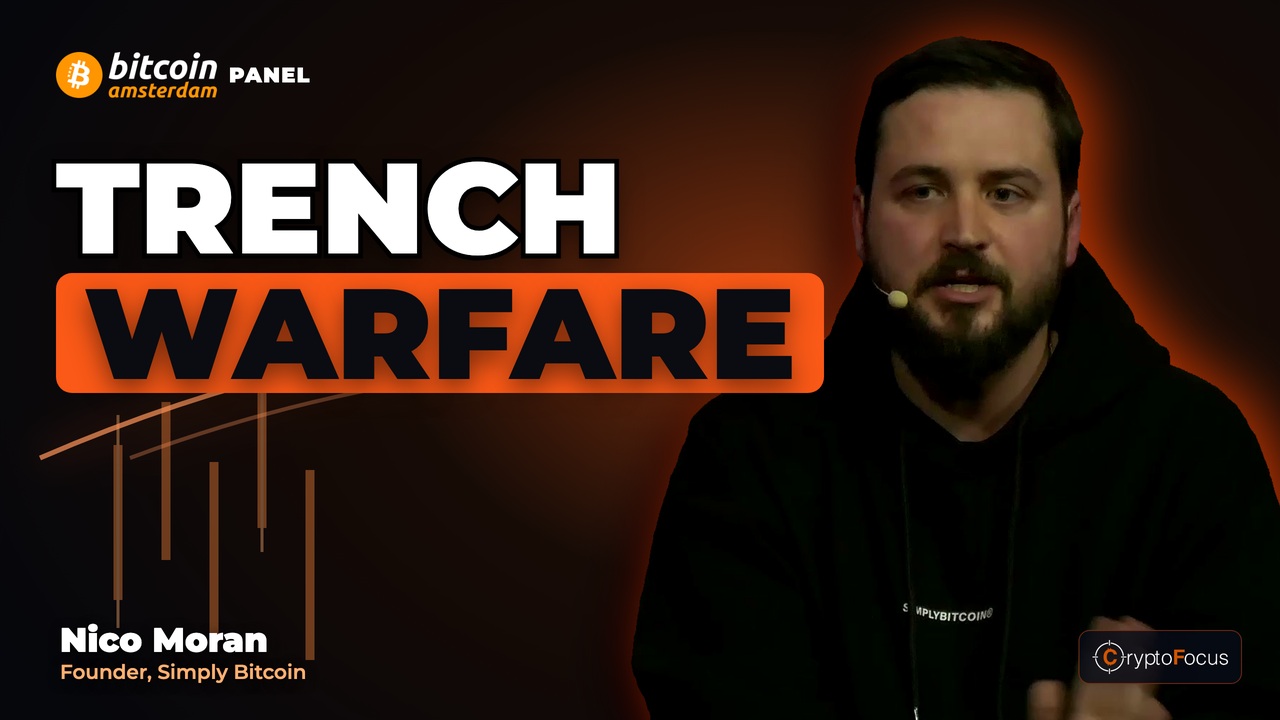

Max DeMarco of 21c Studios gave the panel I moderated at Bitcoin Amsterdam its sharpest line. With Nico Moran of Simply Bitcoin and El The Freedom Fairy of Women in Bitcoin Sydney on the same stage, he described a propaganda machine on each side and drew his line: “our propaganda machine, if we want to coin it, is rooted in truth.” I had asked how Bitcoin media fights legacy-media narratives. My next questions built on his answer, starting with how Nico would root his own channel’s coverage in that truth.
| What you need to know |
|---|
| 1On Thursday 5 November I moderated How Media & Propaganda Primed us for Bitcoin on the Orange Stage at Bitcoin Amsterdam 2026, with Max DeMarco (21c Studios), Nico Moran (Simply Bitcoin) and El The Freedom Fairy (Women in Bitcoin Sydney). |
| 2Nico Moran calls the fight with legacy media "narrative trench warfare" and says his number one goal is views, which then carry the Bitcoin message. Max DeMarco says his side's propaganda machine, "if we want to coin it", "is rooted in truth". |
| 3El The Freedom Fairy wants Bitcoin media held "to the same standard that we would hold the mainstream media", and she separates marketing from propaganda by whether you keep telling the truth. |
| 4My read: Max and Nico were open about working with clicks and the algorithm, Max "at least to a certain degree", and El's "Bitcoin is built on verifiable truth" gives any channel, this one included, a test: can the viewer verify what is being said? |
The full panel runs about 26 minutes.
I opened with Nico, whose Simply Bitcoin channel has been deplatformed by YouTube more than once by his count, and asked how he responded to losing what I called his number one source of traffic. What he did the first time, and why he stays on YouTube anyway, is in a separate piece on how Nico Moran handles being deplatformed.
Authority, for El, comes from knowing her subject
Next I pointed at our own line-up. “But when you look at the stage, you see two men and a woman,” I said, and I asked El how she gets taken seriously for what she knows:
You are actually trying to create a narrative where, hey, people need to take me seriously because of the content and because of my knowledge. How are you making that work?
My question to El The Freedom Fairy
She started with what she wants to present:
I think I approach it with a lot of freedom because I don’t really care what people choose to see me as. I want to present a really authentic narrative, and that is I am a woman who is interested in Bitcoin because I believe that money should be separated from the state and Bitcoin is a fantastic mechanism to do so.
El The Freedom Fairy, founder and host, Women in Bitcoin Sydney
She has been “perceived as perhaps a grifter or a woman who’s wanting to capitalize on a male-dominated space,” she said, and her way through is to be authentic and to know her subject. Then she set out what it takes to get past those narratives:
And I think as long as you are honest in how you approach that, you answer the tough questions. And of course, you do consider to a certain extent how you present yourself in person and online, then you can overcome those narratives.
El The Freedom Fairy
When I followed up about a Crypto Women Collective event she had been in the room for, her takeaway was that she was “so happy to see a lot more women really interested in Bitcoin”. The founders of that community, Laura Peijs and Lisanne Drost, told me at Bitcoin Amsterdam why a trusted conversation beats a thousand ads.
A 14-year-old changed how Max DeMarco shows bitcoin
Moving over to Max DeMarco, who films people who use bitcoin in different parts of the world, I asked how people respond to what he brings to the screen. As a content creator, he said, “we have a lot of responsibility on how we actually talk about Bitcoin in general”. Coming from Germany, he had read all the books and thought he understood what bitcoin is for. Then he went to South Africa to make a documentary about bitcoin as an inflation hedge.
But I met this kid, I remember this kid very vividly. He was 14. And I was asking him why he uses Bitcoin and what Bitcoin actually means for him. And he told me, yeah, I don’t care about the 21 million. I actually don’t really care about it being an inflation hedge.
Max DeMarco, co-founder, 21c Studios
The boy’s reason was closer to home: when he kept cash in the house, Max said, his very poor parents took it from under his bed to buy things. Max’s lesson from the trip is that he wants “to stop imposing what Bitcoin is for somebody else” and show what it can be for different people around the world.
Nico had already laid out the panel’s main charge against legacy media, so I put it to Max:
The way Nico presented it, the propaganda machine portrays Bitcoin through a lot of filmmakers as a means for doing illegal activities. You’re trying to present it from a different side. How do you make sure that what you’re saying actually remains relevant?
My question to Max DeMarco
He called it “a pretty easy sell because what is the percentage that actually uses Bitcoin illegally, right?” For scale, Chainalysis, which traces illicit flows on public blockchains, estimated in its January 2026 crypto crime report that the illicit share of all attributed crypto transaction volume remained below 1 percent in 2025, a figure that covers all crypto assets together.
Creators still have less reach than traditional media, he said, though he thinks “it’s kind of flipping nowadays”, and the aim is that people “get rid of their thinking or their perception, which currently is like Bitcoin is for criminals.” His method is the one he learned in South Africa: show the person, and let the viewer decide which part of bitcoin matters to them.
Nico Moran answers legacy media with a counter narrative
In his first answer Nico had described the fight with traditional media as a battle fought on the internet, so I put an open question to all three:
From your global perspective and the way you actually see how the media, the propaganda, play a heavy role in narrative for Bitcoin, how do you plan to fight that? Because you just told us, let’s pick up arms. We’re in the middle of a battle. How do we do that?
My open question to the panel
Nico went first and called it “narrative trench warfare” again. “When they come up with a narrative, you provide a counter narrative,” he said, and his example was a Bloomberg article on El Salvador, which he called a hit piece.
Right when that happened, we had Max [Keiser] and Stacy [Herbert] come on the show. They debunked the article. And then the next day you had President Bukele reposting the show, right? That’s an example of how you combat the misinformation.
Nico Moran, founder, Simply Bitcoin
In his view the traditional outlets are “riding on the coattails of the legitimacy that they’ve built over the last hundred years”, now that the internet competes with them. His impression of a newsroom under that pressure:
Let’s be even more bombastic. Let’s forget about our journalistic standards. Let’s polarize people more so we can get the clicks, right?
Nico Moran
Bitcoiners, as he sees it, are “the front line” against that, and “it takes consistent action on a daily basis.”
El holds Bitcoin media to the same standard
When I took the same open question to El, she aimed it at her own camp:
I also would like to say I think it’s really important that as educators, influencers, media personalities and what have you, that we hold ourselves in the Bitcoin space to the same standard that we would hold the mainstream media.
El The Freedom Fairy
She accepted the panel’s premise that the mainstream media is full of propaganda narratives, and then went one step further: everyone “is prone to being influenced by this. And it can happen anywhere, including our own spaces.” I summed it up on stage as “Holding ourselves accountable” and handed the same question to Max.
Max DeMarco did not claim his side works without narrative:
Yes, we might be able to construct narratives and storytelling and so on to kind of do the propaganda on our side. But I think there’s a major difference because our propaganda machine, if we want to coin it, is rooted in truth. And I think this is the major thing which will actually prevail over time.
Max DeMarco
He said “there is clickbait happening in YouTube”, and that to combat a very big propaganda machine “we might or we need to play at least to a certain degree” with its rules and the algorithm. The content can be true while the packaging follows the algorithm.
So I took Max’s phrase to Nico, tied it to a news story and ended on this question:
From your perspective, for example, Nico, how would you have rooted your response from your propaganda in the truth?
My question to Nico Moran
He answered without spin. “My number one goal is to get as many views as possible,” he said, because more views carry the message his channel repeats every day. He went on to describe how a trending story becomes a video:
So I actually take advantage of the news cycle to hit those trending topics, to make sure that those videos are going to get clicks. But when those videos do get clicks, we still hammer them with the message that Bitcoin is the solution.
Nico Moran
He laid out his own method in public, on a panel about propaganda, which is what makes the answer useful.
El draws the line at verifiable truth
Asked how she would push the narrative forward herself, El started with community outreach in real life, then picked up Max’s two propaganda machines:
I think there is an important difference to draw between propaganda and marketing. And I think propaganda is the deliberate way that people use to change how someone thinks about something.
El The Freedom Fairy
Marketing, in her view, has its place:
In Bitcoin we can have marketing, we can have slogans and this is fantastic but by continuing to tell the truth we steer clear of being accused of propagandising the people who we speak to.
El The Freedom Fairy
She also wants Bitcoin media to “cover the topics that are less palatable”, and she ended on this:
Bitcoin is built on verifiable truth. And that’s a value that I want to be able to impart to anyone who I speak to about Bitcoin.
El The Freedom Fairy
“Verifiable truth,” I repeated, and moved on to Nico. My own reading of her line: a slogan stays marketing for as long as the viewer can check the claim underneath it.
Read next
- Nico Moran on being deplatformed from YouTube, the exchange that opened this panel, in full.
- My interview with Nico Moran, recorded after the panel, on why he keeps bitcoin apart from crypto.
- The two panels I moderated at Crypto Congres on 13 November: internet capital markets and 24/7 trading, and where the next cycle’s returns come from.
- All Bitcoin Amsterdam 2026 coverage from the SugarFactory.
- Simply Bitcoin is at simplybitcoin.com and Nico Moran is on X. Max DeMarco is on X. El The Freedom Fairy is @El_FreedomFairy on X and hosts Women in Bitcoin Sydney.
I moderated this panel, How Media & Propaganda Primed us for Bitcoin, on the Orange Stage at Bitcoin Amsterdam 2026, at the SugarFactory in Halfweg, on 5 November 2026. Quotes are verbatim, with filler removed. Cryptofocus is a media partner of Bitcoin Amsterdam 2026. Nothing here is investment advice.


