



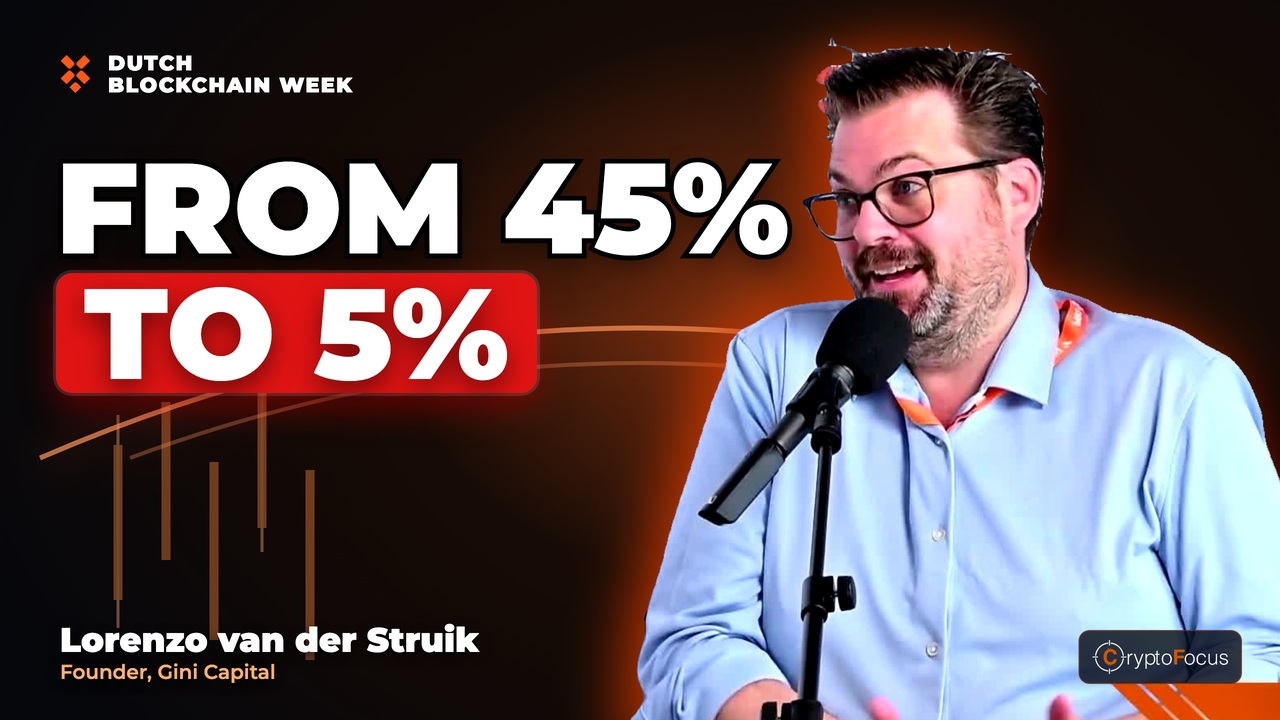

“At the height, when Bitcoin was really going up, our fund was about 40 to 45% crypto. At the moment, I have to be honest, a little bit less. I think it’s about 5%.” That is the line I kept turning over after I sat down with Lorenzo van der Struik at Dutch Blockchain Week. He runs Gini Capital, a Dutch boutique fund, and he had just told me he rotated most of his crypto allocation into AI, quantum and space without losing any faith in blockchain.
Lorenzo is a traditional finance guy. Fourteen years in fund management, the suits and the tight collars, the whole world crypto likes to mock. Then he dipped a toe into blockchain, and the welcome surprised him. I wanted to understand how someone trained to be careful with other people’s money ends up backing the most volatile corner of finance, and why he stays so calm about a market that scares almost everyone else.
| What you need to know |
|---|
| 1Lorenzo van der Struik built Gini Capital to give risk-shy Dutch investors a guided way into blockchain, AI and quantum. |
| 2He cut the fund's crypto allocation from 40-45% at the Bitcoin peak to about 5%, rotating into AI, quantum and space. |
| 3His thesis is that technology always advances, no matter who holds political power, so he keeps investing through the noise. |
| 4He welcomes MiCA and tighter rules, arguing that regulation makes the sector more mature and gives everyone a fair playing field. |
The fund that holds your hand
Gini Capital exists for a specific person: the Dutch investor with money to put to work and no idea where to start. “We have a lot of people, especially in the Netherlands, who have money and want to invest, but they don’t know where to start,” Lorenzo told me. “And they find it quite scary to just jump into blockchain.” His answer was the Digital Future Fund. “It did AI, it did quantum, it did blockchain. A little bit of everything, because that’s the new niche to be in.”
The trick was meeting people where they already felt safe. “They know how to open an account with their bank, they know how to do the traditional finance,” he said. “And blockchain was one of the easy ways to get them to come over.” The pitch has held up: while crypto prices wobble, the fund keeps finding opportunity in the infrastructure underneath rather than chasing the tokens on top.
From 45% to 5%, and why that isn’t bearish
The rotation is the part that makes crypto people flinch, so I asked him to walk me through it. “On the height, when Bitcoin was really going up, our fund consisted of about 40, 45% of crypto and blockchain allocation,” he said. “At the moment it’s about 5%. We have way more invested in AI and quantum and space.” That is a brutal-sounding cut, until he explains the discipline behind it. “We try to rebalance them as much as we can, but only when there’s a return on investment, because on a monthly basis, I have to pay the bills.”
Crypto did not get cut because he stopped believing in it. It got cut because something else ran hotter, and he refuses to fall in love with one asset class. “Blockchain stays one constant that we couldn’t get rid of,” he told me. “It’s going to be interesting all the time. It will probably be a big factor for years to come.” For a guest at a blockchain summit, that honesty is rare. He is not here to tell you crypto only goes up. He is here to tell you how a professional actually allocates around it.
“Technology always wins”
When I pushed him on the macro picture, the part where a minister sneezes or a president fires off a post and a portfolio bleeds, he did not flinch. “My thesis is we will always improve through technology. It has always happened before, not depending on who’s the president, who’s the minister of anything,” he said. “We will always try to find new technology to make our lives better, easier, cheaper, faster.” Politics, to him, is noise on top of a signal that never changes.
He made it concrete with the obvious example. “With the whole Trump thing, I didn’t care if it was her or him. We’re going to need more computers anyway. We’re going to need more AI. So let’s start investing.” That is also why he is buying into space and energy: not as a theme, but as a limit. “We’re going into space just because the room on earth is limited. The energy is limited. So we’re going to need it anyway.” It is a long-game stance, the same one driving exchanges to bolt traditional assets onto crypto rails. “This is a long-term game,” he said. “This is not a one-month return.”
Why a finance guy loves regulation
Here is where Lorenzo splits from the crypto-native crowd. He wants more rules, not fewer. “Coming from a really regulated place, I know regulation. I like it,” he said. “I like the AFM being here. I like authorities, because it makes it a more mature sector to be in.” The timing is pointed: MiCA is days from biting, and he sees it as a feature, not a threat.
He is clear-eyed about what that costs. “The Wild West was an amazing time, but not for everyone,” he said. “So having more regulation makes sure that everybody has a fair playing field.” It is the same reckoning the whole industry is living through, from the firms racing to get licensed before the deadline to the advisors expecting a merger wave once the music stops. Lorenzo’s version is simpler. “Regulation makes for a more mature playing field,” he said. “Making money requires maturity, requires reliability, requires security.”
What it means for investors
Lorenzo van der Struik is a useful voice precisely because he is not a believer. He is an allocator. He treats blockchain like he treats AI, quantum, energy and space: as one engine in a portfolio that has to pay the bills every month. For the cautious Dutch investor he keeps describing, that is reassuring in a way no moonshot pitch ever is. The story he tells is not “crypto will make you rich.” It is “technology keeps moving, professionals keep rebalancing, and good rules let the serious players stay.” Coming from a man who walked in wearing the tight collar, it might be the most grown-up case for crypto I heard all week.
This is one of more than thirty conversations I recorded at Dutch Blockchain Week 2026, pulling out what each builder and investor said so you can learn from the people actually moving this industry. Watch the full interview above, and follow Cryptofocus for the rest of the series.


