





| Wat je moet weten |
|---|
| 1Bitcoin is still up for July, despite Friday's slide below $63,000. |
| 2Bitfinex analysts told CoinDesk that June already flushed out much leveraged selling. |
| 3Binance BTC open interest is about $6.89 billion, or 5.35 times spot turnover. |
| 4The next test is U.S. jobs data, real yields and whether spot ETF demand returns. |
Market context at 03:04 Amsterdam time. Bitcoin trades at $62,954.67 on Binance, 3.75% below its 24-hour high. Binance spot turnover is about $1.29 billion, while BTC futures open interest is about $6.89 billion. The latest funding rate is 0.00404%. Sources: Binance spot and futures APIs, CoinGecko Global API.
August starts with less liquidation fuel
CoinDesk’s report frames the July close as a positioning story, not a simple price dip. BTC fell about 3% on Friday, but still held a monthly gain near 7.5%.
The important line came from Bitfinex analysts. They argued that crypto had already lost much forced-selling fuel during the late-June selloff. BTC briefly dropped below $58,000 then.
That matters because forced selling changes market behavior. A crowded leverage stack can turn one macro shock into a liquidation spiral. A cleaner stack usually creates a slower range trade.
The live map still shows leverage
The cleaner positioning argument does not mean leverage is gone. Binance BTC futures open interest stands near 109,482 BTC, worth about $6.89 billion at the live spot price.
That is 5.35 times Binance BTC spot turnover over the same 24-hour window. It is also about 10.56% of live global crypto volume, based on CoinGecko’s global market feed.
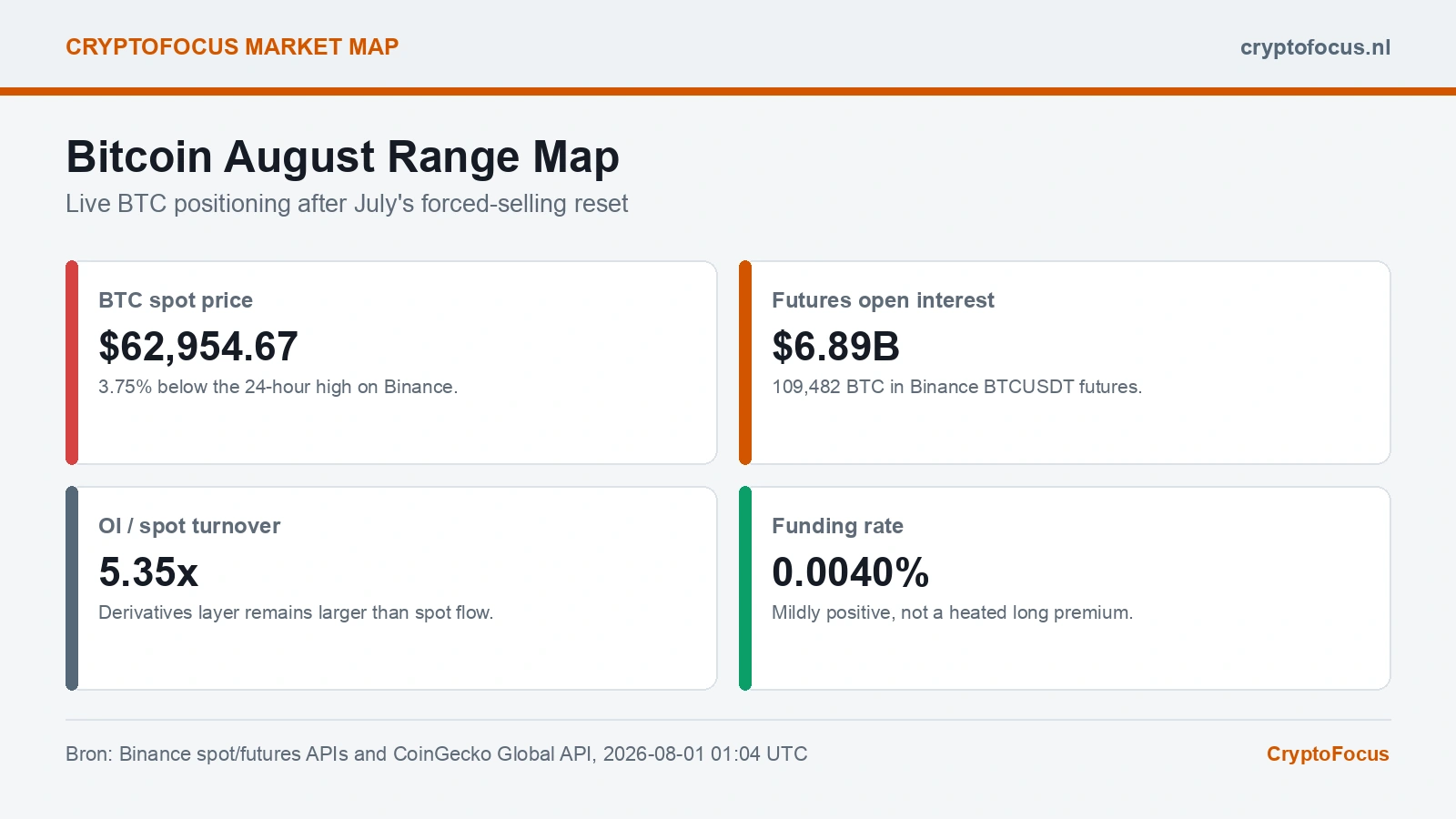
The gap is the useful signal. Traders may have less immediate liquidation fuel than in June. Still, derivatives remain large enough to amplify a break below nearby support.
Why ETF demand matters more now
CoinDesk cited analysts watching whether spot bitcoin ETF inflows return after the Federal Reserve shock. That is the right question for August.
If forced selling is mostly spent, the market needs a buyer rather than fewer sellers. ETF demand is one visible channel for that buyer, especially when macro data keeps rates uncertain.
The other channel is real yields. Higher real yields make cash and bonds harder to ignore. Lower real yields usually give long-duration assets, including BTC, more room to breathe.
What this means for global and EU investors
For Dutch and EU investors, the practical point is risk sizing. MiCA changes exchange oversight, but it does not remove weekend gap risk, leverage risk or ETF-flow sensitivity.
A holder using a regulated European exchange still owns the same market exposure. The August trigger list is concrete: U.S. jobs data, the dollar, real yields, ETF flows and $62,466, the current Binance 24-hour low.
That makes the risk different from July’s rebound trade. A break lower would test whether the market is truly cleaner. A reclaim of the 24-hour high near $65,410 would test whether buyers are back.
The next clean signal
The reader hook is simple: do not watch only the headline BTC price. Watch whether open interest rises while spot turnover fades.
If that happens before the jobs report, the forced-selling reset becomes fragile. If spot turnover improves with mild funding, August can stay choppy without becoming disorderly.
| August trigger map |
|---|
| 1ETF demand returning would be the clearest buyer-side signal. |
| 2Open interest rising while spot turnover fades would make the range weaker. |
| 3The current 24-hour low near $62,466 is the nearest live stress level. |
| 4The jobs report is the next macro test for the dollar and real yields. |
This article is for information only and is not investment advice. The next hard datapoint is the U.S. jobs report and the first ETF-flow read after it.


