





| What changed |
|---|
| 1Reuters, carried by CNA and The Block, reported that Tether's Uruguay mining buildout collapsed after a dispute over power pricing and arrears. |
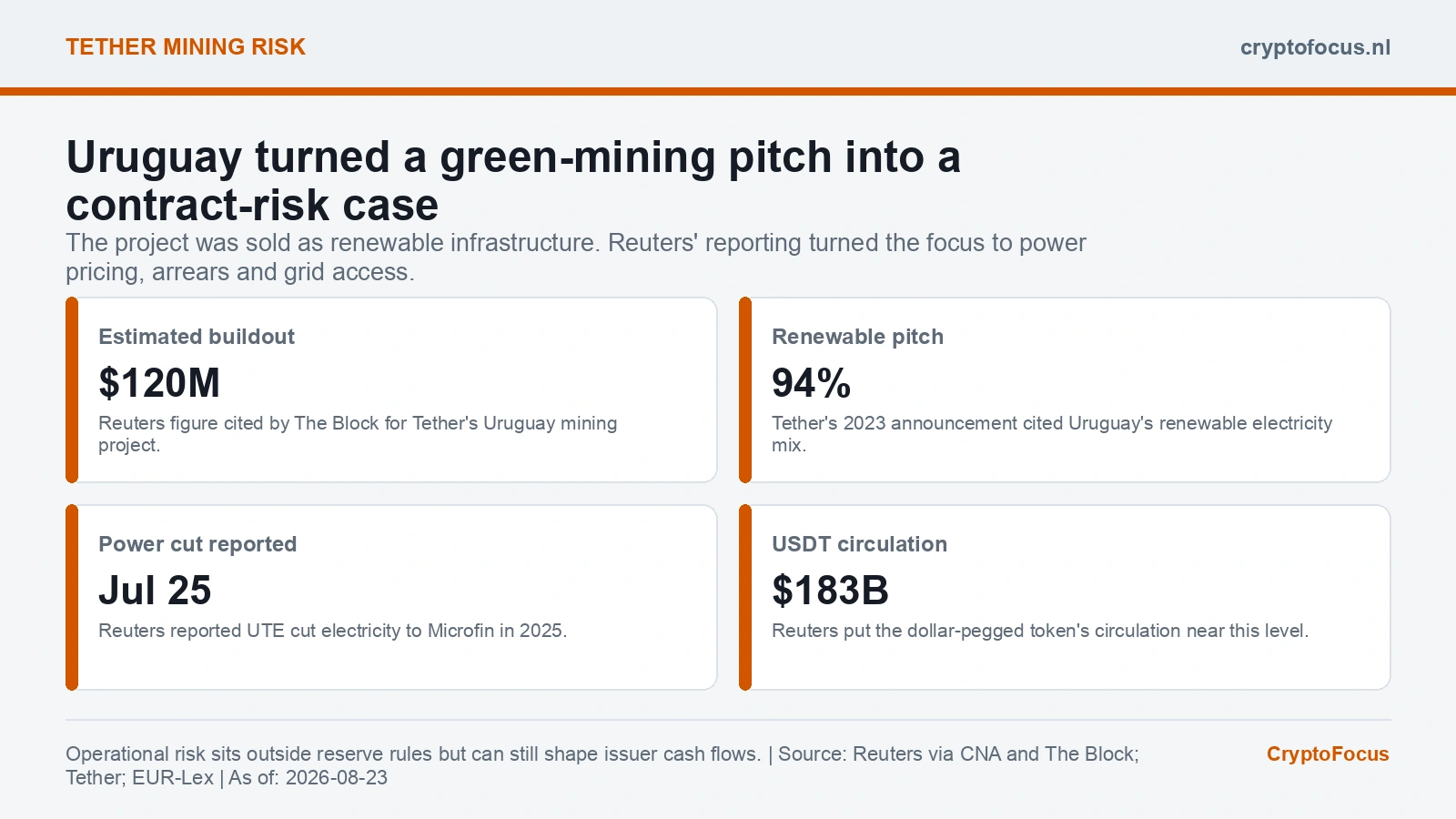
| 2The Block put the project size at about $120 million and said the state utility cut power to Microfin on 25 July 2025. |
| 3Tether's 2023 launch announcement had framed Uruguay as a renewable-energy base for bitcoin mining. |
| 4The EU investor angle is issuer resilience: MiCA reserve and redemption rules do not erase operating risk in non-reserve infrastructure bets. |
Source context checked 23 August 2026, 21:25 CEST. This draft uses Reuters coverage via CNA and The Block, Tether’s 2023 Uruguay announcement, Tether’s public Power page, Tether’s later mining explainer, and the official MiCA text on EUR-Lex. It is written as a queue draft for the English night shift, not as a live publication.
A renewable mining pitch met a fixed grid contract
Tether announced its Uruguay move in May 2023 as a step into energy production and sustainable bitcoin mining. The company said Uruguay generated 94% of its electricity from renewable sources and described the country as a strong platform for energy-intensive mining. That original Tether announcement mattered because it tied USDT profits to a second business line: not only stablecoin issuance and Treasury-bill income, but physical data centers, power contracts and local execution.
The new Reuters account changes the center of gravity. Through CNA, Reuters reported that Tether’s local partner Microfin stopped paying for electricity months after a government change, and that Uruguay’s state utility UTE cut power on 25 July 2025. The Block’s version of the same Reuters story put the estimated project cost near $120 million. Those are not token-market numbers. They are infrastructure numbers, with suppliers, tariffs, labor notices and negotiated utility terms.
This is contract risk, not a reserve verdict
The clean distinction for readers is that a failed mining project is not the same as a failed stablecoin. Reuters and The Block did not report a redemption failure, a de-peg or a missing reserve asset. The reported failure is an operating problem around a power contract. That still matters for USDT holders because Tether’s surplus profits have become a strategic asset: they fund bitcoin purchases, mining ventures, AI infrastructure and other investments outside the simple act of issuing a dollar token.
That distinction also prevents the story from being oversold. A $120 million project is small next to Tether’s reported $183 billion token circulation in the Reuters account. Yet the lesson is not the size alone. The lesson is that renewable power can be abundant at country level and still become expensive or unavailable at project level. A mining farm lives or dies on the exact contract, the tariff, the counterparty and the legal path when a bill is disputed.
Tether’s public copy now lags the reporting
Tether’s Power page still presents Uruguay and El Salvador as successful deployments in its public infrastructure story. Its broader mining explainer says Tether’s farms prioritize local electricity needs and can help stabilize grids by using excess generation. That company framing is useful source material, but it now sits beside a very different independent report from Reuters. A reader should treat both as claims with different incentives.
That source gap is the CryptoFocus value-add. The company statement explains what Tether wanted the project to prove in 2023. The Reuters account explains where the operating model reportedly broke in 2025. Put together, the story is less about whether Uruguay has enough renewable energy and more about whether a private miner can secure a tariff that survives politics, arrears and grid-operator pressure.
The EU angle is issuer resilience
For European readers, the regulatory question is narrower than the headline risk suggests. The EU’s Markets in Crypto-Assets Regulation sets rules for asset-referenced tokens and e-money tokens, including reserve assets and redemption rights. The official EUR-Lex MiCA text is aimed at token obligations, disclosures and supervision. It does not make a power-purchase agreement in Uruguay profitable, enforceable or immune to political change.
That matters because Tether is no longer judged only by whether USDT trades near one dollar on an exchange. Investors, regulators and counterparties also watch how the issuer deploys retained earnings. Mining can make strategic sense when power is cheap and stable. It can also become a cash drain when the supplier, the tariff or the local political bargain moves against the operator.
The next documents decide the damage
The next useful evidence is not another slogan about green mining. It is the paper trail: a settlement with UTE, a court filing, a labor-authority record, an impairment line in company disclosures, or a Tether update that explains whether the equipment moves to another site. Until those documents appear, the hard fact is limited to the reported collapse of the Uruguay operation and the unresolved accounting around it.
The practical takeaway is simple. Treat Tether’s mining program as an operating business with operating risk, not as a side note that automatically strengthens USDT. The company can still earn large profits from reserves while one infrastructure bet disappoints. But after the reported 25 July 2025 power cut, the diligence question is sharper: who controls the socket, at what price, and what happens when the bill becomes political?
This article is informational and is not financial advice. Crypto-assets and stablecoins carry market, issuer, liquidity and regulatory risk. Always check primary documents and your own risk tolerance before making investment decisions.


