





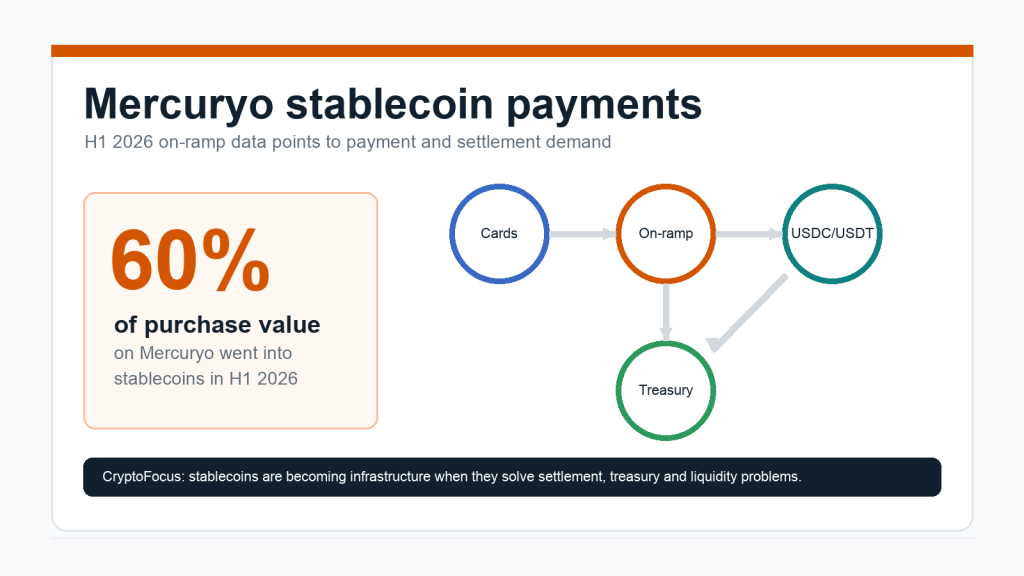
Mercuryo has published new on-ramp data showing stablecoins made up 60% of crypto purchase value on its platform in the first half of 2026, up from 43% in the second half of 2025. The CryptoFocus read: stablecoins are no longer only a volatility shelter for traders. They are moving deeper into payment, treasury, and settlement workflows where speed, liquidity and always-on access matter.
For crypto readers, the useful signal is the shift from speculation to infrastructure. Mercuryo says neobanks, businesses, and payment providers are using stablecoin rails for international transfers, multi-currency accounts, treasury rebalancing and supplier settlement. That does not remove the need for banks, cards or local payment methods, but it does make stablecoins harder to dismiss as a crypto-only product.
What happened
| What happened |
|---|
| 1Mercuryo released new H1 2026 on-ramp data through PRNewswire UK on July 24, 2026. |
| 2Stablecoins accounted for 60% of total crypto purchase value on Mercuryo in H1 2026, up from 43% in H2 2025. |
| 3Stablecoins represented 47% of first-time crypto purchases, up from 33% in the previous half-year period. |
| 4Average stablecoin order size rose about 28%, while overall average purchase size rose 16%. |
| 5Mercuryo says the trend is tied to payments, treasury movement, supplier settlement and neobank integrations. |
| 6The company points to USDC settlement examples from Visa, tokenized treasury-fund liquidity, and PayPal's PYUSD use in Xoom as wider market context. |
Why the stablecoin data matters
The 60% figure matters because it changes what an on-ramp can mean. If most value entering a crypto payment platform goes into stablecoins, the on-ramp is not only a speculative access point. It becomes a bridge into dollar-denominated balances that can be moved, held or spent with fewer timing restrictions than conventional bank rails.
Mercuryo frames this as part of a broader change in financial plumbing. Businesses can use stablecoins to move working capital across jurisdictions, rebalance treasury positions and settle supplier invoices outside normal banking hours. Consumers can use stablecoins as a payment balance when online checkout, remittance or card-linked spending products make the user experience simple enough.
The caveat is important. Mercuryo’s data comes from activity on its own on-ramp infrastructure, so it should not be read as a full-market measurement of all crypto purchases. It is still a useful platform-level signal because Mercuryo works with wallets, payment products and Web3 services where stablecoin demand is close to the point of use.
The market context
Mercuryo’s own H1 2026 report says stablecoins crossed the majority line while Bitcoin, Ethereum, and other assets lost volume share on its platform. The company also says cards drove 66% of volume from 42% of purchases, while nine in ten purchases came from mobile devices. That combination points to payment behaviour rather than a purely trading-led story.
The PRNewswire release also connects Mercuryo’s data to examples already visible in the market. Visa announced stablecoin settlement work with USDC over Solana and Ethereum in 2023. PayPal added PYUSD support to Xoom for eligible U.S. cross-border transfers in 2024. BlackRock and Circle have also pushed tokenized treasury and USDC liquidity into institutional workflows. These are different use cases, but they all point in the same direction: stablecoins are being tested as settlement assets inside more conventional financial products.
For CryptoFocus readers, the question is not whether stablecoins can move value. That is already clear. The harder question is where stablecoins improve the economics enough to survive compliance, consumer-protection, liquidity and operational tests.
What still needs proof
The strongest part of the Mercuryo release is the data point. The weaker part is that it blends several adoption stories into one broad payments narrative. On-ramp purchases, business treasury movement, card-network settlement and remittance products are related, but they are not the same market.
Stablecoins still need clear answers on reserve transparency, jurisdictional compliance, wallet safety, consumer recourse, bank connectivity and liquidity during stress. Payment firms also need to prove that stablecoin rails reduce cost or settlement friction after compliance, hedging, and off-ramp costs are included.
That is why the most credible stablecoin stories are now operational. The useful proof points are not slogans about replacing banks. They are transaction mix, average order size, first-time-user behaviour, merchant settlement speed, failed-payment rates, compliance outcomes and whether treasury teams actually keep using the product after launch.
What to watch next
| What to watch next |
|---|
| 1Whether Mercuryo's 60% stablecoin volume share holds through the second half of 2026. |
| 2Whether first-time buyers keep choosing stablecoins at elevated rates after market volatility changes. |
| 3How much of the volume is payment-led versus users temporarily parking value in stablecoins. |
| 4Whether neobank and merchant integrations convert stablecoin balances into repeat payment behaviour. |
| 5How regulators in the EU, UK and other markets treat stablecoin payment products as adoption broadens. |
| 6Whether card networks and payment firms publish more settlement-cost, speed or uptime data. |
FAQ
What did Mercuryo announce?
Mercuryo published H1 2026 on-ramp data showing that stablecoins accounted for 60% of crypto purchase value on its platform, compared with 43% in the second half of 2025.
Why is the 60% stablecoin figure important?
It suggests stablecoins are becoming a major entry point for users and businesses, not only a defensive asset for traders during volatile markets.
Does this prove stablecoins are replacing bank payments?
No. The data shows strong activity on Mercuryo’s on-ramp infrastructure. It supports the case for stablecoins as an additional payment and settlement rail, not a full replacement for banks, cards, or local payment systems.
Which stablecoin use cases does Mercuryo highlight?
The release highlights international transfers, multi-currency account services, business treasury rebalancing, working-capital movement and supplier invoice settlement.
What should payment firms verify before using stablecoin rails?
They should verify compliance coverage, reserve and issuer risk, off-ramp reliability, liquidity, consumer recourse, wallet security and total cost after FX, hedging and operational controls.
Source note
This article is based on Mercuryo’s July 24, 2026 PRNewswire release, Mercuryo’s H1 2026 on-ramp trend report, Mercuryo company materials and the cited payments-market examples in the release. Company figures are attributed to Mercuryo. CryptoFocus analysis separates those claims from broader stablecoin payment-market implications.
Sources: PRNewswire Mercuryo release; Mercuryo H1 2026 on-ramp trends report; Mercuryo company site; Visa stablecoin settlement announcement; PYMNTS coverage of PayPal Xoom and PYUSD.


