




| Key OKX data points |
|---|
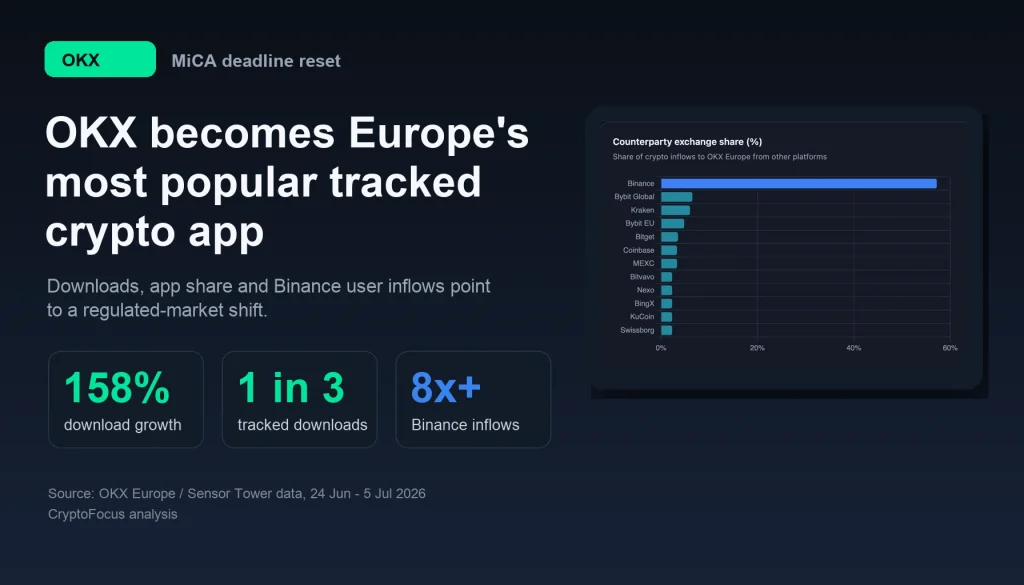
| 1OKX downloads increased 158% in the 12 days after the 24 June announcement that the largest non-MiCA-regulated exchange would no longer operate normally in Europe. |
| 2The 158% increase was more than double the 70% average growth across 10 leading MiCA-regulated European exchanges tracked by OKX Europe. |
| 3OKX accounted for 1 in every 3 crypto app downloads across the tracked platforms. |
| 4Inflows from Binance users migrating to OKX increased by more than 8x compared with the preceding 12-day period. |
| 5The methodology note says the download comparison uses EU App Store and Google Play data and a representative set of MiCA-licensed EU exchanges. |
The numbers matter because MiCA is no longer a policy deadline sitting in the background. It is now changing user behaviour. European crypto users are moving from platforms that built scale under fragmented national rules toward exchanges that can prove they have a licensed European entity, segregated client assets, local oversight and a product suite that still works after the deadline.
That shift gives OKX a stronger position in Europe at the exact moment the market is being redrawn. The company is already a CryptoFocus partner, so the commercial context is clear. The important point for readers is still neutral: if users really are moving from unlicensed venues to regulated platforms at this speed, MiCA has started to reward the exchanges that did the regulatory work early.
MiCA Turned Compliance Into Distribution
The deeper story is not that one app had a strong download week. The deeper story is that MiCA has turned compliance into distribution. A crypto exchange with a MiCA authorisation can use passporting to serve users across the European Economic Area through one regulated entity. A platform without that authorisation now has to restrict, wind down or redesign its European operations.
ESMA describes MiCA as a uniform EU rulebook for crypto-assets, covering transparency, disclosure, authorisation and supervision. The framework entered into force in June 2023 and moved into full application for crypto-asset service providers after the transitional period. ESMA’s MiCA page says the grandfathering period allowed eligible providers to continue until 1 July 2026, or until they were granted or refused authorisation.
That deadline changes the exchange market in a practical way. Before MiCA, many European users chose a platform based on liquidity, fees, coin listings or brand familiarity. After MiCA, the first question becomes simpler: can the exchange legally serve you through a licensed European entity? If the answer is unclear, users have a reason to move before they are forced to move.
CryptoFocus has been tracking that shift for weeks. We covered OKX’s pre-deadline deposit push in OKX Europe Deposit Bonus Hits 8 Percent Before MiCA Cutoff, and we also looked at the user-side risk in the Binance MiCA blockade for Dutch investors. The new OKX data suggests that those stories are now turning into measurable migration.
Why OKX Benefits From The Deadline
OKX Europe Limited received its full MiCA licence from the Malta Financial Services Authority on 27 January 2025. OKX said at the time that the licence would allow it to passport regulated products and services from Malta across all 30 EEA member states. In a later MiCA explainer, OKX said its European entity serves users under MiCA and holds client assets in segregated accounts.
Licensing gets an exchange into the post-deadline market. Product depth decides whether users stay. OKX’s partner-supplied release points to a regulated product suite across spot, derivatives, earn and payments. The company has also highlighted its MiFID II route for derivatives and a European Payment Institution licence for stablecoin-based payment services. OKX framed the payments licence as part of a plan to move stablecoins closer to everyday financial utility, rather than leaving them as trading collateral.
This is where OKX’s position looks stronger than a simple app-ranking story. A user leaving an unlicensed venue needs more than a place to buy Bitcoin. Many active users need euro rails, stablecoins, custody, spot markets, derivatives access, yield products, card or payment features and clear withdrawal rules. The exchanges that can keep more of that activity inside one regulated European stack will have a better chance of turning a migration spike into lasting market share.
Binance Created The Immediate Catalyst
The timing is important. On 24 June, Reuters reported that Binance’s attempt to secure an EU licence through Greece had failed, with the exchange saying it intended to remain in Europe through another route. Reuters also reported that Binance faced resistance from several regulators and that firms had until the end of June to obtain authorisation in one member state to serve customers across the bloc.
Two days later, CoinDesk reported that Binance told EU users it would suspend some services because it would not have a MiCA licence by the 1 July deadline. CoinDesk said Binance had halted new registrations in the bloc and told users their assets would remain accessible during the wind-down of unlicensed EU activities.
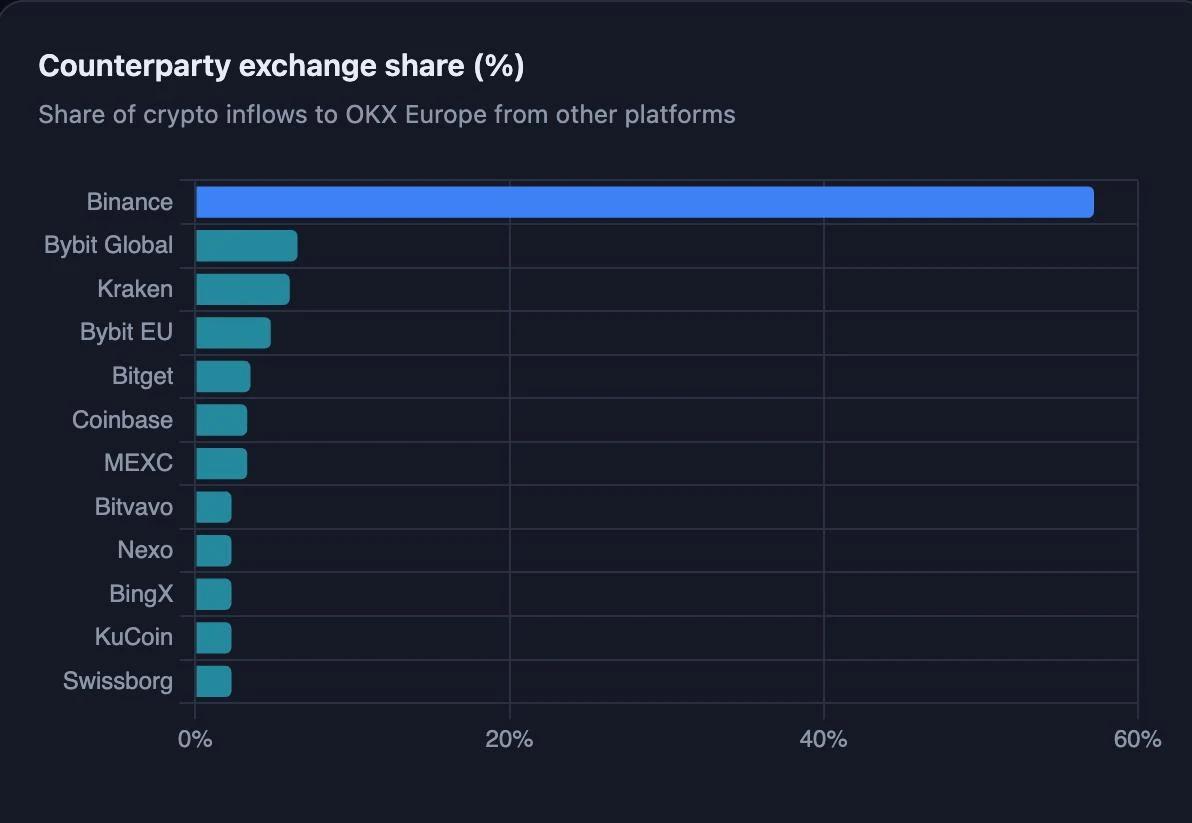
OKX’s new data captures the market reaction to that shock. Downloads rose. Binance-linked inflows rose. OKX’s share of tracked app downloads reached one in three. The chart supplied in the document shows Binance as the largest counterparty source of inflows to OKX Europe between 24 June and 5 July, far ahead of other named platforms.
That does not mean every Binance user has moved to OKX. It also does not prove that OKX now leads every European crypto metric. Downloads are not the same as funded accounts, trading volume or retained users. But app downloads are a useful early signal when a regulatory event forces users to choose a new home. In that narrow but important window, OKX appears to have captured a large share of attention and migration flow.
What Users Are Really Buying
For retail users, the regulated-exchange pitch can sound dry. AML controls, capital requirements, client-asset segregation and fit-and-proper tests do not look as exciting as lower fees or a new token listing. But those requirements become visible when a platform loses access, freezes a product, changes an onboarding flow or cannot offer the same services anymore.
Erald Ghoos, CEO of OKX Europe, made that point in the supplied release. He said MiCA licensing meant meeting requirements such as AML controls, segregated client funds, capital requirements and fit-and-proper tests for leadership. He added that the download and inflow data showed users prioritising a regulated product suite across spot, derivatives, earn and payments.
That is the right frame. Users are buying continuity through the app. They want a platform that still works after 1 July, still supports the products they use, and still gives them a path to euros, stablecoins, custody and withdrawals. The competitive advantage is trust, but trust here is operational. It means fewer surprises when a regulator draws a line.
MiCA does not remove market risk. Bitcoin can still fall. Altcoins can still collapse. Stablecoins can still carry issuer and liquidity risk. What MiCA can reduce is platform risk: the risk that your exchange is not properly authorised, does not segregate assets, handles complaints poorly, hides conflicts or runs outside the EU’s disclosure regime. That distinction should stay central in any partnerlike but honest article about regulated exchanges.
The Stablecoin And Payments Angle
The OKX story also fits the broader stablecoin shift in Europe. MiCA made stablecoin rules stricter, especially around which tokens can be offered to European users and under what framework. CryptoFocus has already argued that MiCA makes stablecoin access safer but harder to explain. The user experience now depends on whether an exchange can translate regulation into simple product choices.
That is why payments matter. If OKX can combine a MiCA CASP licence, MiFID II-linked derivatives access and a Payment Institution licence, it can present itself as more than a trading venue. It can position as a regulated crypto financial app for European users who want trading, payments and asset movement in one place. That is a stronger partner story than “we got more downloads this week.”
It also raises the bar for rivals. A regulated exchange can no longer win Europe with compliance alone. Users still expect liquidity, a clean app, fast deposits, transparent fees, relevant euro pairs, stablecoin access and support that works in local markets. MiCA narrows the field. Product quality decides who keeps the users after the first migration wave.
What To Watch Next
| Signal to watch |
|---|
| 1Download growth after the first migration spike. The key question is whether OKX can hold momentum beyond the 12-day post-announcement window. |
| 2Funded-account conversion. App installs matter most if new users complete onboarding, deposit assets and keep using the platform. |
| 3Binance-linked inflows. Continued migration would suggest users are not waiting for a future Binance authorisation. |
| 4EUR and stablecoin rails. European users will judge regulated platforms by deposits, withdrawals, stablecoin access and local currency experience. |
| 5Product continuity. The winners should be platforms that can offer spot, custody, payments, earn products and derivatives under clear European rules. |
| 6Regulatory consistency. MiCA only reshapes the market if national regulators enforce authorisation requirements in a predictable way. |
The first signal is retention. A regulatory shock can create downloads, but only a useful product creates habit. If OKX keeps a large share of new users active after the deadline news fades, this becomes a structural market-share story. If activity drops, it remains a successful migration campaign.
The second signal is depth. OKX’s strongest argument is not that users can move there. It is that users can move more of their crypto life there. Spot, derivatives, earn, payments and stablecoin tools inside a licensed European framework create a wider moat than a single welcome bonus.
The third signal is enforcement. MiCA’s promise is a single market with common rules. If regulators allow unlicensed access to continue through workarounds, licensed exchanges lose part of their advantage. If enforcement is consistent, the market will keep shifting toward firms that secured authorisation early.
FAQ
Is OKX the most popular crypto app in Europe?
According to OKX Europe data based on Sensor Tower downloads, OKX accounted for one in every three crypto app downloads across the tracked platforms after the MiCA deadline catalyst. The clean wording is that OKX became the most popular tracked crypto app in Europe during that period.
Why did OKX downloads rise after the MiCA deadline?
OKX downloads rose after Binance’s MiCA licensing setback pushed EU users to look for regulated alternatives. OKX Europe says its downloads increased 158% in the 12 days after the 24 June announcement, while inflows from Binance users rose more than 8x.
What does MiCA change for European crypto users?
MiCA requires crypto-asset service providers serving European users to operate under authorisation, disclosure, supervision and client-protection rules. For users, the main difference is that exchange access now depends more directly on whether the platform has a licensed European entity.
Does a MiCA licence make crypto safe?
No. A MiCA licence can reduce platform and conduct risk, but it does not remove market risk. Crypto prices can still fall, and users still need to understand volatility, custody choices, stablecoin risk and product terms.
Source note: the download and inflow figures in this article come from OKX Europe data supplied to CryptoFocus and attributed to Sensor Tower for app downloads. External context comes from ESMA, Reuters, CoinDesk and OKX public licence and product materials. The download data is useful as an early migration signal, but it should not be read as a complete measure of European exchange market share, trading volume or retained users.


