



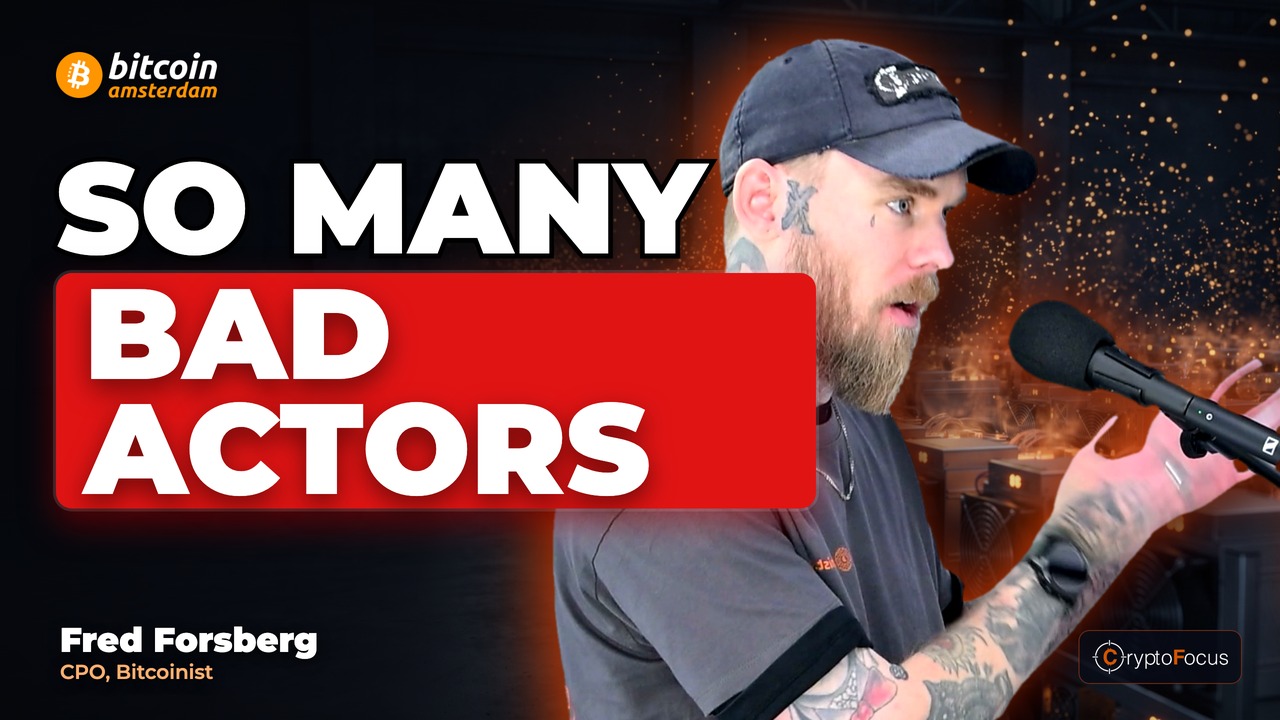
Fred Forsberg, the CPO of Bitcoinist, gave me the reason his team came to Bitcoin Amsterdam in one sentence: meeting people face to face matters “primarily in an industry like Bitcoin mining, because there’s so many bad actors.” Bitcoinist is an iPhone app that rents out hash power on remote mining machines and pays the sats to the user’s own wallet. I sat down with him on day one at the SugarFactory in Halfweg, just outside Amsterdam, and asked what everyone wonders about a mining app that says you can start for free.
| What you need to know |
|---|
| 1Bitcoinist rents out hash power on remote ASIC machines, so the phone itself does not mine. Fred says users can mine with everyone through the OCEAN pool or hunt for a full block in a pool of their own, and move their miners between the two. |
| 2Fred says the app is free to start: Bitcoin education videos and ads earn in-app points called diamonds, which rent hash power. The company's site adds that new accounts get two miners free for 24 hours and that diamonds cannot be cashed out. |
| 3Fred says Bitcoinist is non-custodial and earns its revenue from renting out hash power. Its site lists automatic payouts from 7,000 sats to the user's own bitcoin address, with no Bitcoinist pool fee or payout commission. |
| 4My read: the strongest trust signal in this conversation was a small one. In a business where, in Fred's words, there are so many bad actors, the CPO of a very small company still answers the support tickets himself. |
The full conversation runs just under nine minutes.
One thing to know before you search for it: the app lives at bitcoinist.app, and the company says it is not affiliated with the news site bitcoinist.com. It is listed on the App Store for iPhone.
What free means inside the app
My first question was the one I assumed every viewer would have: when a mining app says free, is it free, or free with strings attached? Fred answered it head on.
No strings attached. You can watch Bitcoin educational videos or you can watch ads inside of our app. And this will reward you with points that we call diamonds inside of the app.
Fred Forsberg, CPO, Bitcoinist
Those diamonds drive the whole loop. Later he listed the ways to grow your hash power: take a subscription, watch ads and “rent hash power with the diamonds”, or invite friends. The company’s FAQ fills in the mechanics. Diamonds are in-app points that cannot be withdrawn or redeemed for bitcoin or cash, new accounts get two miners free for 24 hours, one in each pool mode, and paid rentals and subscriptions run through Apple’s in-app purchases. A newcomer can see exactly where the free part ends.
Where he wants that newcomer to start suits the room he was in.
the first steps I would recommend is to go through our Bitcoin Academy, where we explain Bitcoin from first principles. Why you should get into Bitcoin, why it’s different than crypto.
Fred Forsberg
At a bitcoin-only conference that line lands well, and it is also the commercial logic of the app. The Academy pays out diamonds, so learning is the first way to earn hash power. In his words, “we reward you for every step along the way so that you can mine while doing it at the same time.”
Read the thread on X
Where the sats come from
The question I care most about with any mining product is who holds the coins, and Fred answered it in four short sentences.
You get Satoshi paid out to your own wallet. We’re non-custodial. We don’t touch any Bitcoin. We simply earn revenue from renting out hash power.
Fred Forsberg
Put together, that is the business model: Bitcoinist supplies the machines and the hash power, and the bitcoin goes to an address the user controls. The company’s site sets the payout floor at 7,000 sats to an external bitcoin address and says it charges no pool fee or payout commission of its own.
The public pool behind the app is OCEAN. Its TIDES payout system splits each block reward, transaction fees included, across roughly the last eight blocks’ worth of submitted work, and OCEAN designed it to pay miners straight from the block itself where possible, without the pool holding their coins. If you do not have a wallet of your own yet, that is the step before any of this, and our interview with Tangem’s David Wulschner covers when to move coins off an exchange and onto a hardware wallet.
Two pools, two very different payouts
When I asked what sets Bitcoinist apart from other mining apps, he described two pool types.
One is a public pool where you mine together with everyone. We are now using Ocean. You get small amounts of Satoshis paid to your wallet continuously, small amounts. But you can also run your own pool alone or together with friends and hunt for the full block reward.
Fred Forsberg
Asked what he would tell someone with zero understanding of mining, he was frank about the trade-off.
the solo pool is hunting for full blocks and that might take some time, but when it happens, you get the full block reward. The ocean mining is paying you out incrementally, smaller amounts all the time.
Fred Forsberg
It is the oldest trade-off in mining, put plainly. A shared pool turns the reward into a steady trickle, while a private pool waits for a whole block and keeps all of it when one lands. Bitcoinist lets you split your miners and run both at once, and its site explains how a private pool shares a win: any disclosed organiser fee comes off first, and the rest is divided by the eligible time each miner worked over the previous 24 hours.
Private pools are also where the app turns social. Bring friends in with their hash power and, as he put it, “you share the block reward together with them.” He was open that the app is built to keep people coming back, with leaderboards, avatars and what he called “a very gamified Bitcoin experience”.
Why a mining app shows up in person
Bitcoinist is not a Dutch company. Fred is from Sweden, the company is based in the UAE, and the operator behind the app, BFM Company Limited, is registered in the Ras Al Khaimah Digital Assets Oasis, according to the company’s site. So I asked him why the team had come to a bitcoin conference outside Amsterdam. The bad actors line was his answer, and he kept going.
We want to meet people, give them a face, explain to them in person. We’re a very small company. I personally sit down and reply to Zendesk tickets, support tickets.
Fred Forsberg
That was the least polished answer of the conversation, and to me the most convincing. A CPO who reads the support queue himself hears every confused first-time miner directly, and in a team that small the people who build the app are the people who answer for it.
He has the background for that job. The company’s team page says he has led product and design at JAN3 and Foundation, and the company is run by its CEO, Fouad Jamil. Fred closed with the two goals the team sets for every user.
One is become a Bitcoin miner in Bitcoinist. The other one is become a Bitcoiner, a Bitcoin maxi.
Fred Forsberg
At Bitcoin Amsterdam the second goal is the one the room already shares. If you want to try the first, start where Fred would: run the free miners in both pool types side by side, and check the payout floor in the FAQ, so you know how many sats you need before anything reaches your wallet.
Read next
- All our Bitcoin Amsterdam 2026 interviews and coverage, updated as each conversation goes live.
- When to leave your exchange for a hardware wallet: Tangem’s David Wulschner on the wallet a payout should land in.
- In Dutch, on the energy side of mining: Ethiopië zet bitcoinminers op 23 procent van stroomcontract.
- Bitcoinist: bitcoinist.app and @bitcoinistapp on X. Fred Forsberg on X: @fred_bitcoinist.
I recorded the interview with Fred Forsberg at Bitcoin Amsterdam 2026, at the SugarFactory in Halfweg, on 5 November 2026. Quotes are verbatim, with filler removed. Cryptofocus is a media partner of Bitcoin Amsterdam 2026; I sit on a panel there on 5 November and am the MC of the Orange Stage on 6 November. Nothing here is financial advice.


