



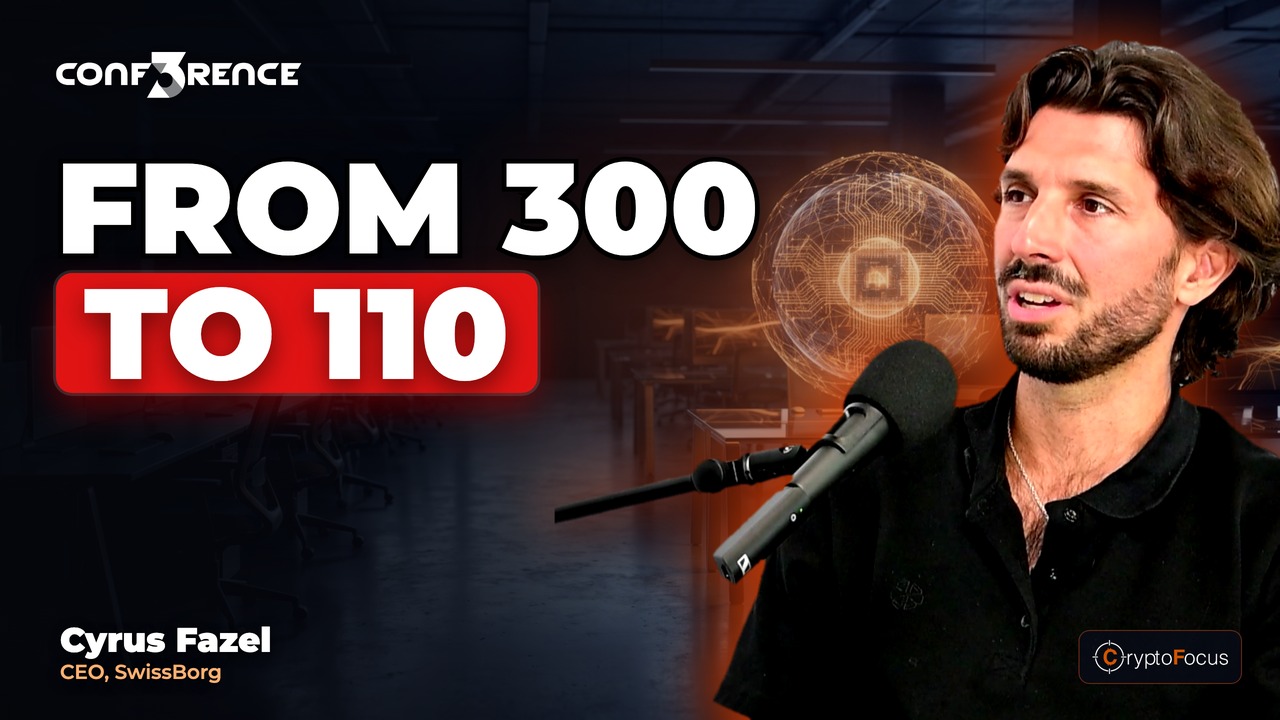

I asked Cyrus Fazel how SwissBorg keeps its product good while the company grows, and he answered with a headcount. SwissBorg had 300 people and now has 110, and its CEO and co-founder told me productivity has never been higher. We sat down at Kokerei Hansa in Dortmund during CONF3RENCE, the day before his keynote. Over 17 minutes he explained how AI now runs through SwissBorg’s work and what he wants investors to do differently in the next cycle.
| What you need to know |
|---|
| 1Fazel told me SwissBorg went from 300 people to 110 and credits AI for productivity that has never been higher. On 15 September, the company's website listed 920,100 verified users and 1.231 billion dollars in user crypto assets. |
| 2SwissBorg runs its app under MiCA licence number A2026-011 in France, held by BlockNodes SAS, which the French AMF authorised in March 2026. Fazel named Germany as the market to grow now, with the Netherlands after it. |
| 3His Bitcoin scenarios for the 2027 to 2028 cycle run from about 150,000 dollars to between 250,000 and 280,000 dollars. For the big market moves he watches liquidity more closely than regulation. |
| 4My read: SwissBorg now wants to give its users the same lift it says AI gave its own team of 110. |
The full conversation runs just over 17 minutes.
300 people then, 110 now
Growth tends to cost a product its polish, so I asked Fazel how SwissBorg protects its quality as it expands. His answer began with the company itself.
The real truth is AI. I mean, we were 300 in our company and today we’re 110.
Cyrus Fazel, CEO and co-founder, SwissBorg
What he stressed was the result: “the productivity has never been as high as today”. The second half of his answer explains how a smaller team gets there. SwissBorg does not build every component itself. It plugs in decentralised exchanges, and he mentioned lending protocols such as Kamino or Aave as possible additions, then puts a single front end on top.
So you really want to have one stop shop where you have a very nice secure interface, very Apple-like, where you feel trusted, it speaks your language.
Cyrus Fazel
Earlier in our conversation he had described what that means for a trader: orders routed across centralised exchanges and around 50 multi-chain DEXs, where “within one click we’re able to actually aggregate that”. His comparison for the old plumbing was short: “the Swift protocol is 50 years old”.
That model changes staffing too. A company that connects protocols built by others needs people for the connections, the licence and the interface, and he says AI is taking over in every aspect of the work around them. The headcount follows from the architecture.
Read the thread on X
Germany now, the Netherlands next
I asked how SwissBorg has handled the changes in Europe. Fazel described MiCA as the start of a new market, one where “most of the offshore exchanges have been kicked out, for the good reasons, by the way”. SwissBorg already counts Switzerland, France, the UK and Belgium among its big markets, and the licence is what lets it go after Germany now.
So Germany, for me, is one of the most important. Netherlands after.
Cyrus Fazel
The licence is recent. On 12 March 2026 SwissBorg announced that BlockNodes SAS, a French company in its group, had secured MiCA authorisation from the French AMF, covering custody, order execution, transfer, placing, portfolio management and advice on crypto-assets. The SwissBorg website gives the licence number as A2026-011. An authorisation granted in one member state can be passported to the rest of the EU, which is how a French licence becomes a German launch. ESMA publishes the interim MiCA registers of authorised providers for anyone who wants to look a firm up.
For readers of this site, the second name on his list matters most. He put the Netherlands directly after Germany, followed by the wider DACH region, starting with Austria.
Why banks lose out when deposits become stablecoins
I brought up the Digital Asset Market Clarity Act, the market structure bill for crypto in the United States, and the push for stablecoins in Europe. He went straight to how banks earn their money.
People don’t realize banks make all their money on custody of assets of others. You deposit your money with them, they start trading with it, right? Doing margin lending, whatever they want.
Cyrus Fazel
His point about stablecoins follows from that. “Now, if you put this into stablecoins, well, they don’t have the possibility to do that anymore.” Holders get rewards on top, he said, well above the 0% he says most banks pay. Money parked in a stablecoin is money a bank cannot lend against.
Then he made a point I did not expect from the head of a newly licensed company. Regulation, in his view, is the tactical layer of the market.
For me, the main catalyst with all these different crazy swings happens with liquidity injection. And it’s never about the tactical regulatory play.
Cyrus Fazel
“The real big waves comes with liquidity,” he added, and in his reading fresh liquidity in whatever form sends more people into crypto. That is a useful way to hold two stories apart. Rules decide who may serve a market. Liquidity decides how much money arrives in it.
Three Bitcoin scenarios and the tokens that last
I asked whether Bitcoin could climb back to its old highs within six months. He answered with scenarios for the cycle he dates to 2027 and 2028: about 150,000 dollars in the lowest one, around 200,000 dollars in the middle and 250,000 to 280,000 dollars in the most optimistic. He added straight away that “every cycle is different”.
More interesting to me was what he said about everything beyond Bitcoin. He expects other crypto-assets to do better, above all tokens tied to a business with real use, and he pointed to history.
If you look at the last five different cycles, it’s always pretty much the same categories of tokens that win
Cyrus Fazel
His categories are layer ones, the tokens of decentralised and centralised exchanges, and DeFi protocols built around yield and lending, with AI agents as the newer entry. He acknowledged the meme frenzy on Robinhood Chain and said “the real value I think will be captured in these more serious projects that have a real token usage”.
An AI coach for the investor
AI agents had come up in his market answer, so I asked how far SwissBorg wants to take them. He went back to the company’s origins in the Cyborg Advisor idea and said “that has been our game for the last 10 years or more”.
The new version draws on SwissBorg’s own history: eight years of user trades, roughly 2.3 billion of them, he said, some very good and some very bad. Agents in the roles of portfolio analyst, risk manager and behaviour coach place users in one of four profiles, from active opportunists to long-term builders, and compare them with their peers.
they’re not gonna say like you should trade this and that. This is more a behavior coach
Cyrus Fazel
The coach might suggest automatic investing through DCA, or ask whether a user’s core holding is still large enough for their risk profile. His analogy was the gym.
It’s like going to the gym, you know, if you’re by yourself, it could be cool, but if you’re with friends, it’s even better.
Cyrus Fazel
The reason he gave for building it is the part I would show any retail investor.
If retail starts really competing with only robots, bots in general, then eventually you’re going to be outpaced. It’s going to be a very difficult game.
Cyrus Fazel
Here the two halves of the interview meet. The productivity gain he describes inside SwissBorg is the gain he wants to hand to users, as a second opinion on their own habits while more of the market automates its trading. The coach’s job is smaller and harder than trading: stopping a user from repeating the same mistake.
What he wants people to take into the next cycle
Fazel came to Dortmund on a colleague’s word. Per, from SwissBorg’s business team, is friends with the organisers and told him CONF3RENCE is “the best conference we have in Germany”. Fazel’s response, as he told it: “So I didn’t do more due diligence.” He flew in from Zurich a day early to meet people.
His keynote was about what he calls the super cycle, so I asked him to explain it. He went back to 2015, when he got into crypto, and to the ICO SwissBorg ran in 2017, which he counts among the biggest of that year.
Back then we had this hope that the world of TradFi and DeFi would mix together. And it did.
Cyrus Fazel
It took more time than they thought, he said, but traditional players are embracing the technology while crypto natives start treating wealth as every asset class. His examples were Lombard loans against stocks or crypto, and “swapping one stock to a crypto within a fraction of a second”.
His message for the keynote audience was the bluntest thing he said on camera. In his view many people made costly mistakes in the last cycle, and the crash of 10 October 2025 caught the market unprepared. Every cycle, he said, you “have to learn to plan your journey into what’s going to be the next battle plan”. He wants AI agents in that plan “because they’ll help you to analyze what you’re doing”.
And you need to be investing into cryptos that make sense and not just look for the 50x stupid returns.
Cyrus Fazel
The question I would put to him a year from now is whether the AI coach changes the results of SwissBorg’s weakest group of traders. With eight years of trades to compare against, that is something the company can measure.
Read next
- Where the risk sits: CONF3RENCE 2026 in thirteen interviews, our complete article on the thread connecting all thirteen conversations.
- All our CONF3RENCE 2026 interviews, added as each conversation from Kokerei Hansa goes live.
- CoinJar Europe’s Niall Carson on the bar MiCA sets, for what a licence like SwissBorg’s demands.
- Tradevest’s Marcel Uhlmann on why DeFi is not the bad guy anymore, the view from a licensed financial institution on the same shift.
- Tangem’s David Wulschner on stealth self-custody, another retail-facing company at the event.
- Our CONF3RENCE 2026 preview, written before the doors opened.
- Cyrus Fazel on X, and SwissBorg at swissborg.com.
Recorded at CONF3RENCE 2026, Kokerei Hansa, Dortmund, on 15 September 2026. Quotes are verbatim from the recording with filler removed. Cryptofocus is a media partner of CONF3RENCE. Nothing here is financial advice.


