



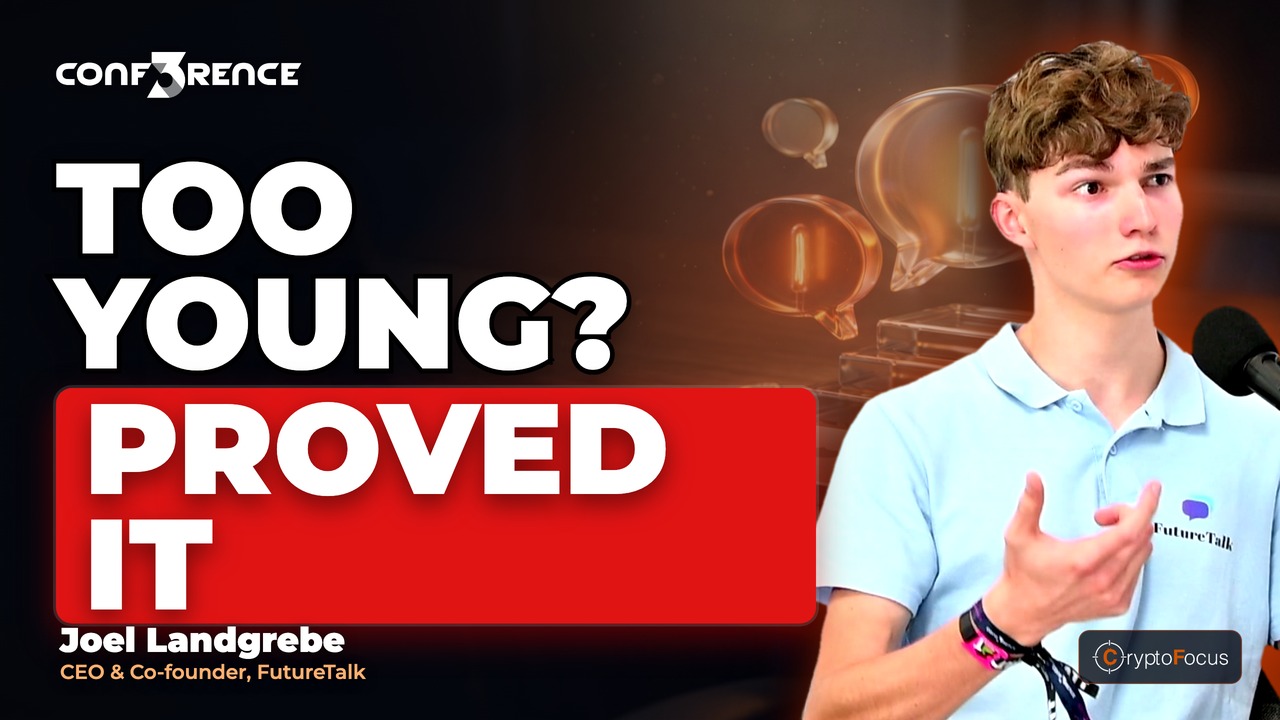

Joel Landgrebe founded his company at 16, became its CEO at 18 and is still at school. When I sat down with him at CONF3RENCE in Dortmund, I asked how he gets banks to take him seriously. He did not dodge it. The banks he pitched workshops to told him he was too young and had no experience, and he kept going until they booked him anyway. His company, FutureTalk, runs on a similar stubbornness about the future.
| What you need to know |
|---|
| 1FutureTalk is a social app where users post ideas and opinions on future topics and vote on each other's posts in competitions. |
| 2Each competition gives you two upvotes and one downvote; a ranking decides how a prize pool paid in cryptocurrency is divided. |
| 3Landgrebe started programming at 11 and got into crypto at 12. FutureTalk operates in Germany, Austria and Switzerland today. |
| 4My read: the most interesting thing about FutureTalk is that its best ideas so far tell people to spend less time on their phones. |
The full conversation runs 11 minutes.
“Oh, you’re too young”
Next to running FutureTalk, Landgrebe gives workshops and talks on crypto and blockchain for companies, banks and private individuals. Walking into a bank at that age to offer training is not an easy sell, and he described the first reaction plainly.
first they always say, oh you’re too young, you don’t have any experience, but then I proved them.
Joel Landgrebe, CEO and co-founder, FutureTalk
His argument for why they should listen is about supply. He has spent six years in the space, and he says there are not many people in Germany with that kind of hands-on experience. That gives a young trainer a real opening, provided he can hold a room full of bankers.
I’m always the opinion that age doesn’t matter if you’re committed to something
Joel Landgrebe
He applies the same rule to hiring. Several of the people filming and helping at his booth were his own age, and he told me his media team consists of two people aged 17 and 18. He picks people for what they can do.
Read the thread on X
Coding at 11, crypto at 12
The six years add up once you hear where he started.
I started programming when I was 11. And then with 12, I started with the crypto and blockchain space.
Joel Landgrebe
FutureTalk grew out of that. He admitted he had not expected it to get this far: “At the first when I got the idea of FutureTalk I never thought that it could be that big.” Events like CONF3RENCE are where he checks that instinct, and he said every conversation there tells him he is doing the right thing. His ambition reaches past the app. Whatever happens with FutureTalk, he wants to stay in crypto and blockchain and help people find their way into it.
A social app that asks you to create
I asked why he built a platform around the future. His answer starts with what he dislikes about the feeds most of us open every day.
in the traditional social media, you just scroll, you’re consuming. But we try to motivate the people to also talk about what they think, what their ideas are, what their opinion is on different future topics.
Joel Landgrebe
The mechanism is a competition. Each competition has a topic, users post their ideas or opinions, and then everyone votes. You get two upvotes and one downvote per competition, so you have to choose which two posts deserve to rise and which one does not. In his words, “you can vote two posts as good and one post as bad and then there’s a ranking list.” The ranking decides how the prize pool is split, and the prize pool is paid in cryptocurrency.
That single downvote is the clever part. It forces a judgment call on every user, which is closer to a debate than a like button. The app is available on Google Play and in the App Store, and Landgrebe also runs a weekly German-language podcast, The FutureTalk, about crypto, digitalisation and building the company.
Visitors at the booth gave him the same reason to sign up again and again. They had always wanted to share ideas about the future, “but Instagram and TikTok isn’t the space where I want to share my ideas.”
The best idea so far: put the phone down
I pushed him to name the one idea from the platform that made him think: this is why I built it. He hesitated, then gave an answer I did not expect from the founder of a social app.
most people are addicted to their phones and just scrolling but the people realize that this isn’t good for them
Joel Landgrebe
The ideas that win, he said, are the ones that say “we need to talk with the people outside of the internet”: meet up, organise conferences, interact in real life. A platform whose users vote for spending less time on platforms says something honest about what younger users want. It also explains why a founder who builds an app spends his days at a booth, talking to people face to face.
Germany, and the countries further ahead
FutureTalk is only active in the DACH region for now: Germany, Austria and Switzerland. Europe and the rest of the world are the plan. When I asked about expanding, Landgrebe was frank about where his home market stands.
there are many countries who are much more forward with the crypto space and who are more open with that
Joel Landgrebe
In Germany, he said, you rarely meet someone who claims deep crypto knowledge. The typical story is “maybe 10 euros invested in bitcoin but not more.” That gap is exactly why banks and companies book his workshops. He even expects that by the time FutureTalk reaches the whole world, many countries will no longer need him. He still plans to go, because some people will always need someone to explain it to them.
That fits the room he was in. CONF3RENCE put banks, asset managers and crypto builders on the same campus for two days, and the people who fill the gap between them are often the ones who can explain the basics well. Landgrebe is building his company in that gap, one workshop and one competition at a time.
His message: be open for the future
I closed by asking what he wants people to remember after meeting him in Dortmund. He answered without a pause, and it was the most convincing minute of the interview.
be open be ready to get informations be ready to get knowledge be ready to expand yourself and your own opinions be ready for other opinions and to talk with them
Joel Landgrebe
Most people, he said, react to new technology with fear and would rather not think about it at all. His answer is to listen, compare opinions and see where they meet. Coming from someone who has already convinced banks that age is the wrong question, that advice carries more weight than it would from a slide deck.
Read next
- Where the risk sits: CONF3RENCE 2026 in thirteen interviews, our complete article on the thread connecting all thirteen conversations
- All CONF3RENCE 2026 interviews and coverage, from Dortmund
- Our CONF3RENCE 2026 preview: what the event is and who was on stage
- SwissBorg CEO Cyrus Fazel on what AI changed, another founder’s view from the same event
- CoinTracking’s Agnieszka Mojsiej on tracking every coin you own
- Joel Landgrebe on LinkedIn, and his interview on the Unternehmer Jam-Session podcast
- FutureTalk on X and YouTube; the event itself at conf3rence.com
Recorded at CONF3RENCE 2026, Kokerei Hansa, Dortmund, on 16 September 2026. Quotes are verbatim from the recording with filler removed. Cryptofocus is a media partner of CONF3RENCE. Nothing here is financial advice.


