



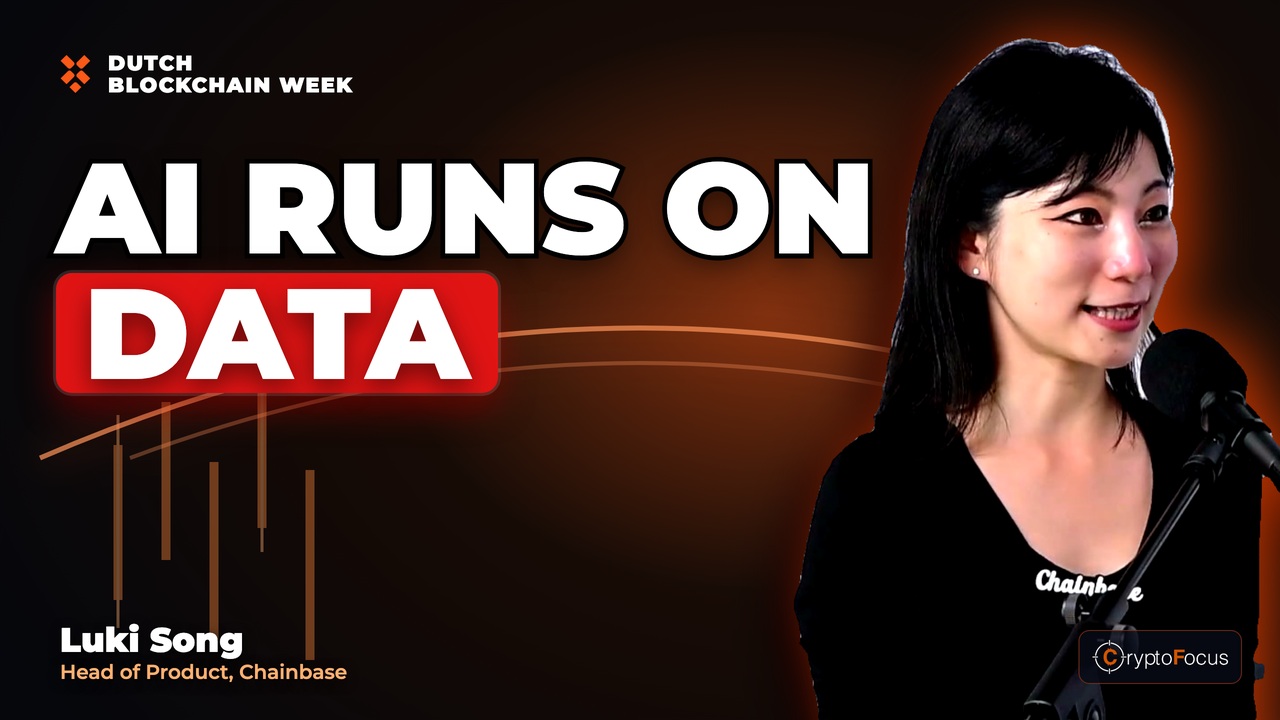

“We’re all building products right now because code is so cheap, with vibe coding,” Luki Song told me at Dutch Blockchain Week. “It’s easy to just ship something within the weekend. But now you have to understand whether the product is actually needed by people. That’s why product research is really important, and that’s the data you need from the internet.” Luki is Head of Product Strategy at Chainbase, and her point cuts against the loudest story in tech: if writing software is nearly free, the scarce thing is no longer code. It is data.
I run these interviews myself, and this one started by accident. Luki walked up to our booth and asked for the slot. Five minutes of talking convinced me it mattered, because she works on the exact layer everyone is now bumping into: how you feed an AI the live information it needs to be useful. Here is what she told me, in her own words.
| What you need to know |
|---|
| 1Chainbase began four years ago as crypto data infrastructure and now supplies live data to AI agents from blockchains, social platforms and web search. |
| 2Luki Song argues that with vibe coding making software cheap, the real moat is data and knowing which product people actually need. |
| 3She describes an "informational wall": ask ChatGPT or Gemini to research something live and it stalls, which is the gap her tooling is built to close. |
| 4Alongside her day job she founded Suisterhood, a women-in-leadership community for crypto and AI built with the Sui ecosystem. |
What Chainbase actually does
I asked for the elevator pitch. “Chainbase started as a crypto data infrastructure company a little more than four years ago,” Luki said. “We work with a lot of different blockchains. We index the data, we decode the data, because at the time it was very hard for builders to understand how to digest blockchain data.” Then AI changed the job. “Because of AI, it’s so easy for builders to build projects already. So we realized how hard it is to access data globally, not just crypto data. We integrated data from different social platforms, web search and crypto data together, to give users and builders a holistic view of what the data really means and how to use it.” That positions Chainbase squarely in what the company now calls a data access layer built for AI agents.
The informational wall
The most useful idea Luki gave me was a name for a problem everyone has felt. “Right now we’re still at a very early stage,” she said. “If you ask around, people are still just using ChatGPT, still just using a chatbot.” The limit shows up fast. “If you check the data on ChatGPT or Gemini and do some simple research, you hit the wall. You had the informational wall. So there’s got to be something you do to empower your AI agents.” Chainbase’s answer is a connector. “We have this tool for them to access data from the internet,” she explained. “It gives them that master key to open up their AI agents’ accessibility to internet information.” She kept returning to the plumbing that makes this work: “At the agentic level, CLI, MCP and APIs are the key.” That is the same standard Anthropic introduced as the Model Context Protocol, a now-common way to connect AI assistants to where data actually lives.
“AI is going to take my job”
I put the common fear to her directly. How does a company building more capable AI talk to people afraid it will make them irrelevant? She lit up. “I’m so glad you asked, because I just ran a workshop to demo how my own work uses AI to streamline the workflow so we can do other things,” she said. Her example was concrete: connect a CRM to an analytics tool through AI and you can see where your users are and what they actually need, which then shapes the product. The job, in her telling, does not vanish. It moves up a level, from doing the task to deciding which task is worth doing. That is the same human-first framing Humandone’s Valeryi Vysotski gave me when he argued design should run on data, not assumptions.
Why cheap code makes research priceless
This is the heart of it. Vibe coding, the AI-assisted style where you describe what you want and let the model write it, has collapsed the cost of shipping software. Luki’s response is not to celebrate the code but to ask the harder question. “Code is so cheap,” she repeated. “So it’s easy to ship something within the weekend. But you have to understand whether the product is actually needed by people.” Her own time goes into the research, “which is the data you need from the internet.” In a world where anyone can build anything over a weekend, knowing what to build, grounded in real data, becomes the only durable advantage.
Pricing an AI product when usage is unpredictable
For the operators in the audience, Luki was candid about getting the business model wrong before getting it right. “We had to do some iterations,” she said. “At the very beginning we gave free credits for early adoption. Then we did pay as you go, because we saw users probably don’t need a mass amount of credit.” Watching the data changed her mind again. “By analyzing how much they use, we’re switching to monthly fees, because that’s much easier than topping up every five or ten days.” Her takeaway for any product team shipping AI features: “You really need to see the usage pattern, what actually costs a lot of money, so you can shape the pricing to the best form.”
Suisterhood, and an industry growing up
The side project that makes her smile is Suisterhood. “It’s a women community that supports and nurtures the education of women in leadership in crypto and AI,” she said. “We built it with the Sui ecosystem, started a year ago, and we’ve been growing. We run workshops about crypto and AI, and we recently partnered with Lovable for a vibe coding session.” It connects to what she noticed about Dutch Blockchain Week itself. “It’s very professional and institutional,” she said. “I’ve attended a lot of crypto conferences where we always exchanged Telegrams. Here I see a lot of LinkedIn profiles and business cards. I came from a banking background, so it’s very pleasant to see the whole industry evolving into something more than just a digit.” That maturity, and the push to bring more women into it, echoes the case Laura Peijs of the Crypto Women Collective made to me about inclusion as simple math.
What it means
Strip away the jargon and Luki’s message is a useful correction to the AI hype. The models will keep improving and the code will keep getting cheaper, but neither is the bottleneck. The bottleneck is clean, live, structured data, and the judgment to know what people actually need. The teams that win the next phase will be the ones who treat data as the product, not the afterthought. It is a builder’s view of agentic AI, and it lines up with what OVHcloud’s Omar Abi Issa called the trillion-dollar problem nobody has solved yet.
That is why I sit down with the people building this. Watch the full conversation above, and subscribe to Cryptofocus for the rest of our Dutch Blockchain Week interviews.


