



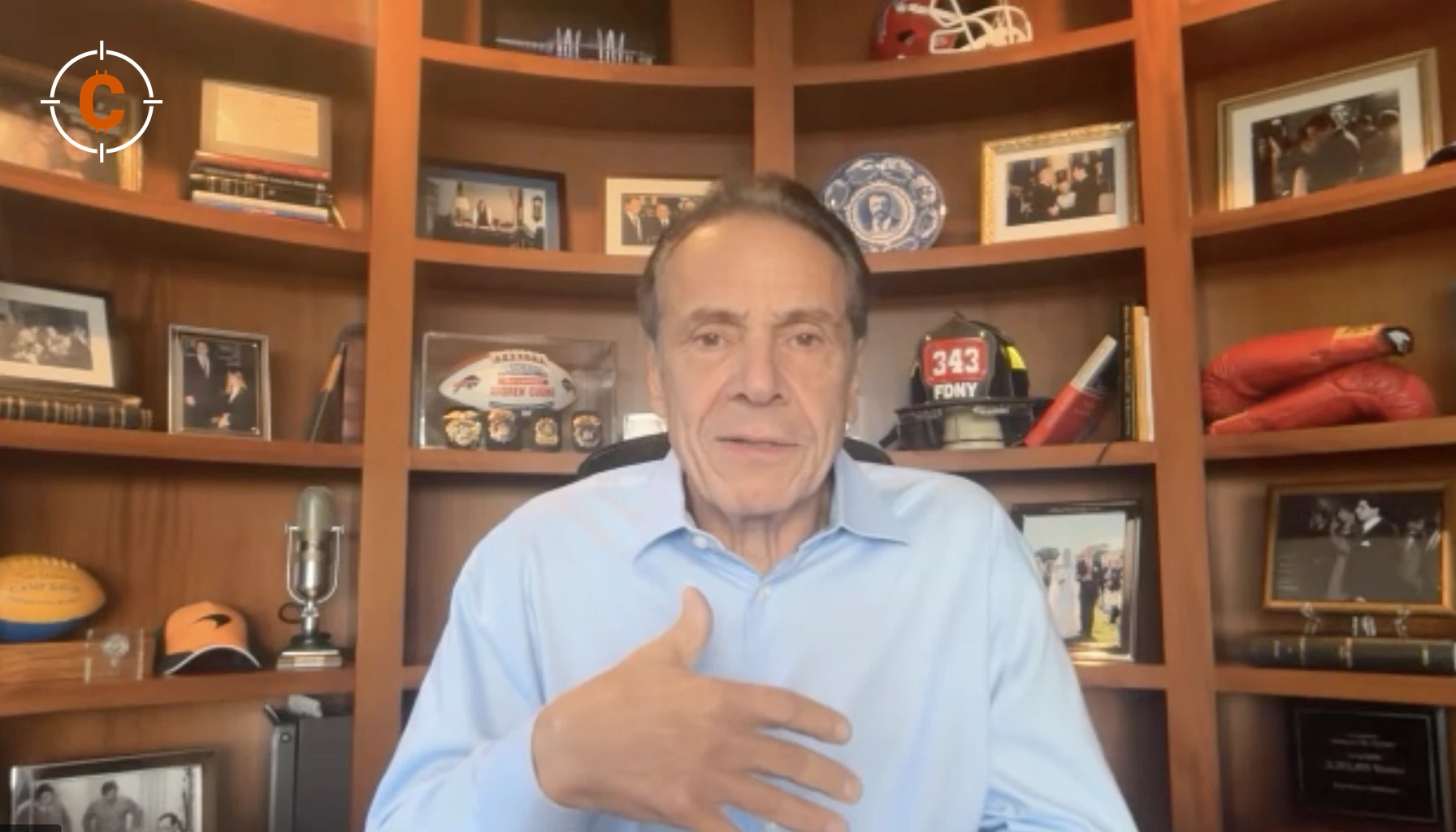

OKX is bringing its Shield account-protection programme to the United States, with a standard limit of $100,000 for eligible users and a ceiling of $500,000 for its highest qualifying VIP tiers. At an online press briefing attended by CryptoFocus on Tuesday, former New York governor and OKX board director Andrew Cuomo presented it as a way to earn customer trust. The important distinction for users is what happens before a loss: an account takeover and a payment made to a convincing fraudster are not the same event.
| What you need to know |
|---|
| OKX announced the US launch of Shield on 20 October 2026. |
| Eligible standard accounts have a $100,000 limit; VIP 1–3 have $250,000 and VIP 4+ have $500,000. |
| Users must activate the required security settings; there is no subscription or activation fee. |
| Shield concerns qualifying third-party account takeovers, not every loss involving a scam. |
“And trust has to be built. And trust has to be earned,” Cuomo said during the briefing. He was speaking for a company on whose board he serves, not offering an independent assessment of the product. His argument was that security instructions become more persuasive when the exchange puts its own money behind them.
That makes Shield worth examining as a change in the relationship between an exchange and its users. Instead of asking customers only to prevent a theft, OKX is setting out a process for considering reimbursement after a qualifying attack. Whether that builds lasting confidence will depend on how the process works when someone actually needs it.
The headline amount is not the standard limit
The US announcement sets three levels: up to $100,000 for eligible standard users, $250,000 for VIP levels 1–3 and $500,000 for VIP level 4 and above. The largest number is therefore not the amount an ordinary account should assume applies to it. Nor is any ceiling a promise that a particular claim will be paid in full.
OKX says there is no subscription or activation fee. Participation does require security measures, including a passkey, protection for large withdrawals, transaction verification and disabling web withdrawals. Device-security checks also matter. These are not decorations around the offer: the launch ties eligibility to the user taking the prescribed precautions.
For readers considering the offer, the useful next step is to check the account’s actual tier and security settings, not to treat the $500,000 figure as a reason to deposit more or trade more. A higher advertised ceiling says nothing by itself about whether taking additional investment risk makes sense.
The boundary runs through who authorised the transfer
The published US Shield terms describe a discretionary goodwill programme, not insurance, a deposit guarantee or an unconditional reimbursement commitment. Users must opt in. Its scope is the exchange account, not OKX Pay, the wallet or external DeFi services. A transfer the user personally authorises remains excluded even if deception persuaded them to make it. That is a crucial limit on the word “scam”.
The terms require a formal claim within 72 hours of the last unauthorised transfer, with supporting information within seven days, subject to stated exceptions. Evidence should be preserved. OKX generally aims to provide an assessment or timing update within 15 business days; that is not a guaranteed payment deadline. There is a one-approved-claim lifetime limit per person. Negligence and compliance with security requirements can affect the outcome, and mandatory legal rights remain.
The difference is familiar from the US Federal Trade Commission’s guidance on cryptocurrency scams. It describes impostors and supposed investment managers who persuade people to buy crypto and send it elsewhere. The victim may be operating their own account throughout. Preventing a stranger from taking control of an account does not, on its own, stop that kind of persuasion.
Trust will be tested after the application
“Talk about putting your money where your mouth is, right?” Cuomo said. It is a forceful sales argument. But a user deciding whether protection is meaningful needs to know more than the maximum amount: what evidence establishes an unauthorised takeover, how quickly a claim can be assembled and how a rejection is explained.
Those questions do not establish that Shield will disappoint. They identify what would make its performance measurable. Published figures for eligible claims, approvals, refusals and time to payment would be more informative than the size of the ceiling alone. This article does not independently audit OKX’s reserves or establish how future US claims will be decided.
For Dutch readers, today’s announcement concerns the US launch. It should not be used to infer the terms applicable to a Netherlands-based account. The immediate significance is operational rather than a forecast for crypto prices: OKX is asking users to connect stricter security habits with a defined route to seek reimbursement. The test of Cuomo’s trust argument begins when an eligible customer has to use that route.


