



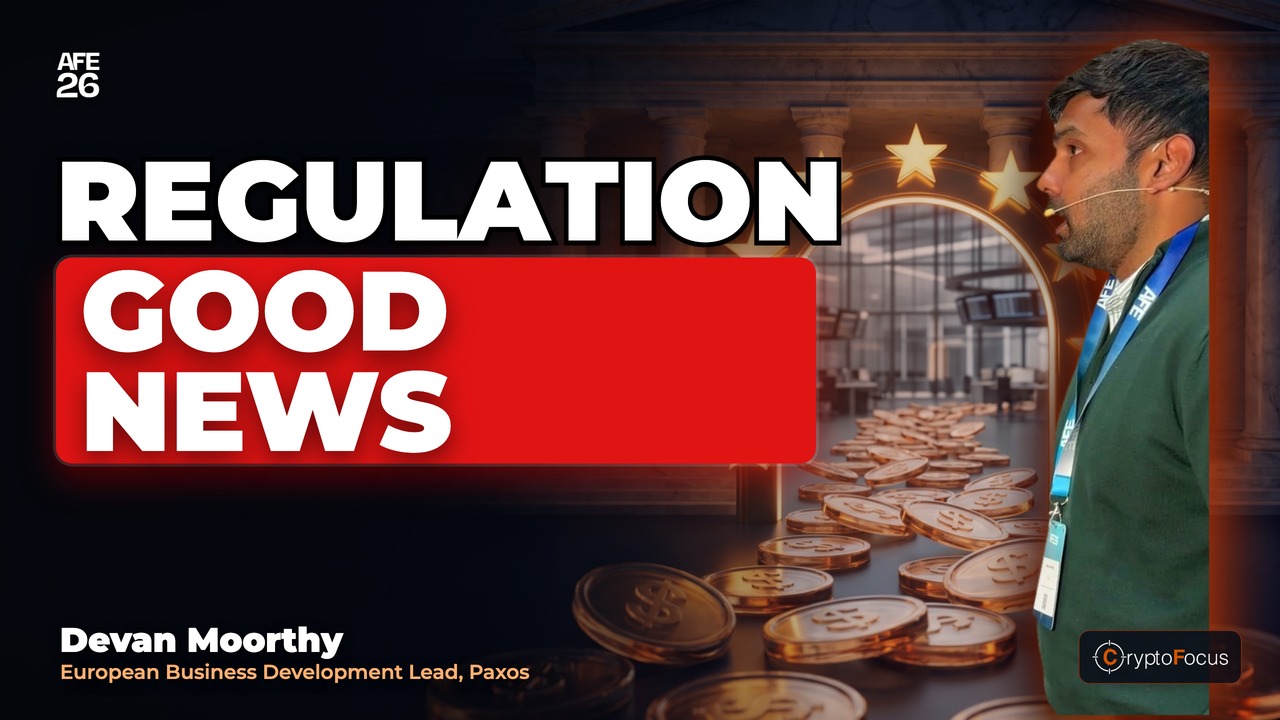

Devan Moorthy walked off the stablecoin panel at Amsterdam Fintech Event 2026 with one observation he wanted to share before anything else: nobody on that stage treated regulation as the obstacle. The European Business Development Lead at Paxos told me that the panel covered almost every layer of the stablecoin business, and that Europe’s largest institutions have moved past the pilot stage. “My main takeaway was that everyone saw regulation as a good thing,” he said.
| What you need to know |
|---|
| 1Moorthy spoke on "Panel: Scaling Stablecoin Use Cases in Europe" on day one, 10:05 to 10:50 in the Auditorium, with Alexandra Soroko of Visa and Mateusz Wlodarczyk of Bitvavo, moderated by Arthur van Lier of Mesh. |
| 2In the EU, Paxos issues the USDG stablecoin through Paxos Issuance Europe, supervised by the Finnish financial regulator FIN-FSA and in compliance with MiCA. |
| 3Paxos positions itself as neutral infrastructure: it does not serve end clients, so banks, payment firms and fintechs can build their own stablecoin products on top of it. |
| 4My read: when a stablecoin issuer says the inbound requests now arrive as formal RFPs from household names, the European market has moved from curiosity to procurement, and 2027 is when those projects will show up in products. |
The full conversation runs just under three minutes.
Every layer of the stack on one stage
I caught Moorthy minutes after the session ended and asked for his single takeaway. He started with who had been sitting next to him.
We had a massive payment network, global leading payment network like Visa. We had a leading retail focused institution like Bitvavo. We had a fintech like Mesh and we had infrastructure company like Paxos.
Devan Moorthy, European Business Development Lead, Paxos
That line-up is the point. A card network, a retail exchange, a payments fintech and an issuer each touch a different part of the same transaction, from the wallet a customer opens to the reserve that backs the token. On the event programme they shared one session, which says something about where the organisers think the European stablecoin conversation now sits.
That’s almost every layer of the stack and all of them are investing in innovating in Europe.
Devan Moorthy
Read the thread on X
Past the pilot, into business lines
I asked what Paxos is looking forward to most in the first quarter of 2027. Moorthy answered with what he has seen over the past six months.
The largest institutions across Europe are ready to invest in stablecoins and in actual stablecoin use cases. This is beyond the pilot and the proof of concept into how do we integrate this into actual business lines and drive real volume.
Devan Moorthy
A pilot proves the technology works. A business line needs a budget owner, a compliance sign-off and a revenue target, which is a much higher bar. Our preview of this event asked whether the euro stablecoin moment is finally here, and Moorthy’s answer from inside the procurement process is that the institutions have already made up their minds to try.
Why neutral infrastructure matters to a bank
He then explained why Paxos can talk to every kind of institution on that panel without competing with any of them.
Paxos is very neutral infrastructure. We don’t ever touch the end client. So it enables us to work with all types of institutions.
Devan Moorthy
For a bank that wants its own stablecoin offer, that matters. It can keep the customer relationship and buy the issuance and reserve management from a regulated provider. Paxos does this in Europe through USDG, which Paxos Issuance Europe issues under FIN-FSA supervision. The demand he described came in a very specific form.
The number of RFPs, number of RFIs, the number of messages that I get asking me about stablecoin things from very household names across Europe, I think we’re going to see some very exciting things in 2027.
Devan Moorthy
RFPs and RFIs are how large companies buy things. A request for information means a team has been asked to map the options; a request for proposal means someone has set aside money. He did not name the companies, and I did not expect him to.
Regulation as the thing that let banks move
My last question was what made him glad he came. His answer was the line he opened with, and he expanded on it.
It enabled the types of clients that everyone wanted to serve and the types of institutions that are going to bring distribution to the masses to play in the space.
Devan Moorthy
The mechanism is simple. Before the Markets in Crypto-Assets regulation applied in full, a compliance department at a large bank had no rulebook to approve a stablecoin product against. Interest was there. Permission was not.
Whereas before they were interested, they didn’t have the authority to move before this regulation came in place.
Devan Moorthy
He contrasted the mood in the room with the debate among more crypto-native people, where regulation is often discussed as a cost. On this stage, he said, everyone “saw regulation as an asset”. That is a fintech room speaking, and it is the room that controls distribution to millions of European customers. The thing to watch in 2027 is which of those household names puts a regulated stablecoin inside a product people already use, a card, a banking app or a merchant payout, because that is where his RFP pipeline turns into volume.
Read next
- All our Amsterdam Fintech Event 2026 coverage, interviews and previews in one place.
- One room, 300 visitors: how Cognito builds AFE26, the preview of the event itself.
- Is the euro stablecoin moment here?, the stablecoin question this interview builds on.
- Job Mantz on the Holland Fintech Association, the organiser’s view from day one.
- Devan Moorthy on X, and Paxos newsroom.
I recorded the interview with Devan Moorthy at the World Trade Center Amsterdam on 7 October 2026. Quotes are verbatim, with filler removed. Cryptofocus is a media partner of Amsterdam Fintech Event 2026. Nothing here is financial advice.


