



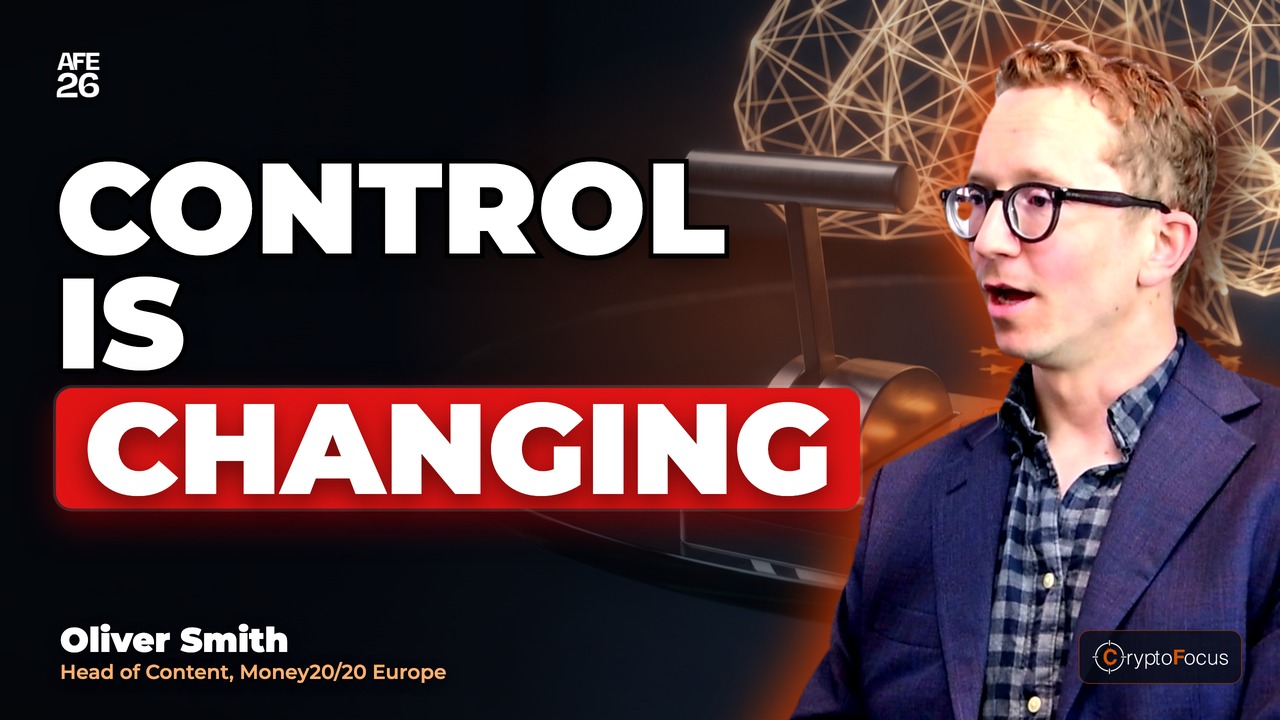

Oliver Smith programmes the stages of Money20/20 Europe, and he told me about a fintech event he attended about nine months before we spoke. In his account, banking executives there did not want to say the word Mythos out loud. He says that reluctance is gone. His team has picked “control is changing hands” as the theme for the 2027 show. I sat down with him at the Amsterdam Fintech Event 2026 to ask what the theme means, what sits under it, and why the content chief of a much larger show spends a day at this one.
| What you need to know |
|---|
| 1Oliver Smith is Head of Content at Money20/20 Europe. He told me he was a journalist for 12 years, joined just over a year ago, and that the 2026 edition was his first show cycle. |
| 2According to Smith, the theme for Money20/20 Europe 2027 is "control is changing hands", drawn from 53 research interviews his team held this year. The show's website lists 8 to 10 June 2027 at the RAI in Amsterdam. |
| 3He says five content pillars sit under the theme: the tokenized economy, new rails and new rules, building future foundations, the changing trust equation and banking reimagined. |
| 4My read: the part of the theme to watch is his closing question, who controls the data and AI layer under European finance, which he leaves open on purpose. |
The full conversation runs 22 minutes.
What “control is changing hands” is meant to say
Smith explained how the theme came about before he explained the theme. Every summer, once the show has closed, his team starts its research for the next one. He put a number on it:
this year we did 53 interviews with people across the fintech ecosystem everyone from banks to payment companies to crypto firms
Oliver Smith
He said those conversations came to 850 pages of transcripts, with a survey on top. Out of that came five content pillars and, for the first time for the European show in his telling, a single theme that sits above them. Two subjects kept returning in the research. The first was AI, and the financial decisions that institutions are handing to systems and models. The second was Europe itself.
Control is changing hands is a question about whether the foundations of European finance, the control of them is actually changing hands.
Oliver Smith
Payments people have had that argument for years. Smith named Wero and the European Payments Initiative, and the old question of whether Europe needs payment infrastructure of its own. What he added is where he thinks the argument goes next:
increasingly it’s also a question around data around AI around the core infrastructure of finance who controls that
Oliver Smith
I asked him whether the theme is a warning or an observation. Is Money20/20 saying too much control is going to one party, or only that it is happening? He declined to choose, and he was open about why. The theme, he said, could be read as a question, a statement or a prediction: “it’s very editorialized and it’s not designed to be prescriptive”. Someone from crypto will nod at it for one reason and someone from a bank for another. For a programme that has to hold both groups in one building for three days, that is a practical choice. It also suits our own readers, who have been asking who controls the rails since long before banks started asking it about AI.
Read the thread on X
The five pillars, with tokenization first
The pillars go into the verticals. Smith listed the tokenized economy first and called it his team’s “prediction for where the world is going”: real-world assets, money market funds and financial instruments moving on chain. He mentioned in passing that tokenization was also his subject at this event that day.
The second pillar, new rails and new rules, is about European payments. He sees a spread of new ways to pay and send money, from stablecoins to Wero, and he pointed at the cost that comes with the choice:
People working in this industry have so many different schemes and rails to deal with now, and every one of them comes with their own complexity, their own nuances.
Oliver Smith
Building future foundations is the third, covering the core infrastructure that AI and stablecoins both depend on. The fourth is the changing trust equation: identity, fraud and cyber security. The fifth is banking reimagined, and the name was chosen with care. Smith said banks across Europe are at different stages of the same journey, so the pillar has to leave room for a conversation about mobile banking in the Balkans or North Africa next to one about the most advanced AI. Underneath it sits a question I expect to hear more often.
there is a growing question around what the perimeter of a bank is what should exist within a bank and what should remain outside of it
Oliver Smith
He tied it to the room we were sitting in, where, as he put it, banks were present that are launching stablecoins or have joined stablecoin consortiums. A bank that issues a token has moved its own perimeter, and the pillar is his way of asking how far that goes.
AI turns the old silo problem into a deadline
When I asked how a conference helps build foundations, Smith went back to his years as a reporter. Banks struggling with siloed data was a story when he covered digitisation, and again when he covered mobile. He thinks AI makes it sharper than either did.
the only way to unlock the power of these models is to break down silos, is to have a data flow that allows models to understand your customers in one place. It doesn’t work if you have different divisions that don’t share data with each other.
Oliver Smith
That is a useful test for any bank announcing an AI programme. A model can only know the customer as well as the bank’s own departments are willing to share what they hold. Smith said visitors arrive at his show with questions of that kind: build or buy, and what cloud and compute will cost once AI is rolled out. He wants the show to be the place where those are argued through.
The word executives did not want to say
Cyber security belongs to the fourth pillar, and it produced the story I opened with. Mythos is an AI model from Anthropic, which describes its work with the model on software security under the name Project Glasswing. Smith used it to describe a mood.
just nine months ago I was at a fintech event and there were banking executives that didn’t want to say the word Mythos because at the time that was the sort of new scary thing and they didn’t want to talk about it
Oliver Smith
His next sentence is the one I would pass on to anyone planning a panel: “the time of not wanting or being able to talk about these things is long over”. He wants active conversations about how financial institutions prepare for the threats that are already in the market, as well as the ones still coming. He was clear that Money20/20 does not hold the answers and hopes to be part of finding them. Then he said, about the months between now and the show, “it terrifies me the world we’re going to be living in”. From a man whose job is to fill a programme, that is an honest admission that the agenda he sets this autumn may look different by the time the doors open.
Why a large show visits a smaller one
I asked him plainly why he was in Amsterdam Zuid. Most events compete for the same visitors and the same dates. Smith described something closer to scouting. Content teams across Europe are finding speakers and the next big subject, and he wants to be in those rooms.
I want to make sure that I’m at those events so I can spot those speakers and maybe give them an even bigger stage at the next event they speak at.
Oliver Smith
He added that he is “not in a commercial role” and that he sees regional fintech weeks as partners: “I think there’s a lot of room for collaboration.” For speakers at the Amsterdam Fintech Event that is worth knowing. Someone who books a three-day programme was in the audience.
He also looked back on his first cycle. Two things from 2026 he plans to build on: Money Lab, a small walled-off stage for 50 delegates made for depth, and the debates that closed each day. And he compared the reset after a show to filing a story as a journalist, where the next morning starts from an empty page. His version for the team: “we stand on the shoulders of the great work we did this year”.
The question he left me with is the one in his own theme. If control over payments, data and AI in European finance is moving, who will be holding it when his doors open in June?
Read next
- Arjan Bol of the Dutch Payments Association, recorded at the same event, for the payments side of the sovereignty question.
- iDEAL becomes Wero, our preview of the European rail Smith mentions.
- Agentic AI at AFE26, on financial decisions moving to systems and models.
- How Cognito builds the Amsterdam Fintech Event, our preview with the team behind the room.
- Every interview we recorded at AFE26 is on the Amsterdam Fintech Event hub.
- The 2027 theme and pillars are on the Money20/20 Europe agenda page. Background on the payment rail he names is at the European Payments Initiative, and Benedict Evans, whose keynote Smith singled out from the 2026 show, publishes his presentations online.
I recorded the interview with Oliver Smith at the World Trade Center Amsterdam on 8 October 2026. Quotes are verbatim, with filler removed. Cryptofocus is a media partner of Amsterdam Fintech Event 2026. Nothing here is financial advice.


