



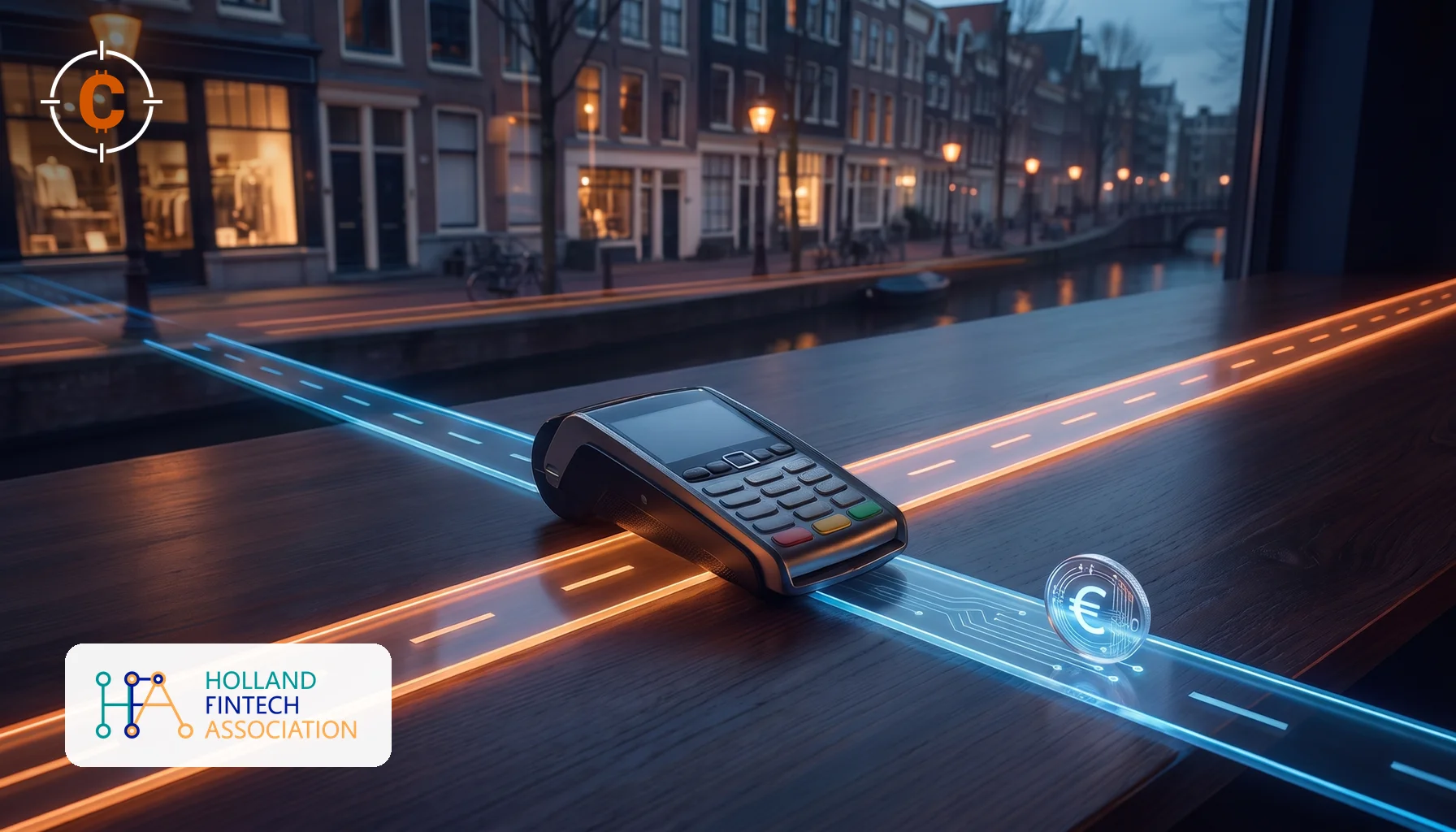

Ahead of Amsterdam Fintech Event 2026 I asked whether the euro stablecoin moment has arrived. The next question is where you would spend one in the Netherlands, and the most practical answer today is: with a card. Visa counts more than 160 programmes that let people spend stablecoin balances on its network, and to the shop such a payment looks like any other. Meanwhile the Dutch checkout itself is changing: by October every Dutch bank is due to be connected to Wero, which is set to replace iDEAL by the end of 2027.
| What you need to know |
|---|
| 1By October 2026 all Dutch banks are due to be connected to Wero, after which iDEAL payments move onto its infrastructure step by step. Banks and payment providers aim to finish by 31 December 2027 at the latest. |
| 2Cards handled 83 percent of the 7.1 billion payments at Dutch tills in 2025, according to DNB and the Dutch Payments Association. Online, iDEAL and cards together cover about 85 percent of e-commerce. |
| 3Stablecoins reach the checkout mostly through the card networks, as cards linked to stablecoin balances and as settlement between the networks and their banks. Visa counted more than 160 stablecoin-linked card programmes in April. |
| 4My read: several ways to pay will keep working side by side at the Dutch checkout, and a euro stablecoin will most likely reach it through the card networks, the route stablecoins already use. |
AFE26 runs on 7 and 8 October at the World Trade Center Amsterdam, and payments are one of its five themes. This is the promo we made for it, cut from last year’s crowd and this year’s empty auditorium.
How the Dutch pay today
In 2025 people in the Netherlands made 7.1 billion payments at the till, worth 185 billion euros, and 83 percent of them were by card, up from 80 percent a year earlier, according to the annual study by DNB and the Dutch Payments Association. Cash fell to 17 percent. Of debit card payments at the till, 95 percent were contactless. Tapping a physical card was still the most common way to pay, but phones and watches already carried 39 percent of all till payments, up from 34 percent in 2024, according to DNB.
Online, iDEAL has been the local habit for years. iDEAL and payment cards together cover roughly 85 percent of Dutch e-commerce, the Dutch Payments Association says. The debit card itself has changed too. Since 2023 banks have been replacing Maestro and V PAY debit cards with Debit Mastercard and Visa Debit, and unlike the old cards, the new ones also work for online payments.
A survey that EPI, the company behind Wero, published in September shows how mixed the habits already are. Of the 1,061 Dutch consumers it asked, 42 percent use a mobile payment app such as iDEAL every week to pay online, against 41 percent who pay by card. In shops, 64 percent tap a contactless card every week, 44 percent use a phone wallet and 30 percent pay with a smartwatch. EPI’s own reading is that people pick “the one that works best for each moment.”
iDEAL becomes Wero, one phase at a time
EPI, which is owned by European banks and payment firms, announced in October 2025 that iDEAL would phase into Wero, its wallet for instant account-to-account payments. In July EPI, the Dutch banks and payment providers such as Adyen and Mollie agreed the next phase, and the Dutch Payments Association set out what it means: by October 2026 all Dutch banks will be connected to Wero, and from then on iDEAL|Wero payments move gradually onto Wero’s own infrastructure. Consumers keep paying through their own bank. For banks, payment providers and web shops, the association writes, “a lot will change”, and some of them will have to make significant adjustments to their systems.
Arjan Bol, managing director of the association, who moderates the AFE26 panel on Dutch payment infrastructure, said the full migration “will benefit from close consultation and cooperation between EPI Company, merchants, consumers, PSPs and regulators.” The target is to finish by 31 December 2027 at the latest.
EPI said on 16 September that Wero, live for payments between friends in Belgium, France and Germany since 2024, now serves 60 million users. More than 48,000 merchants in Belgium, France, Germany, Luxembourg and the Netherlands have already taken Wero payments. In Belgium it has started to work at the till, with shoppers scanning a Wero QR code on a payment terminal, and wider use in shops in France and Germany is planned from 2027.
Ivo Broeren, who leads EPI’s relationships with the Dutch market, sits on the Dutch payment infrastructure panel on 7 October at 14:55, with Sarah Pilcer, Worldline’s market head for the Netherlands, and Silvia Mensdorff-Pouilly, head of business development for EMEA at Worldpay. In EPI’s September survey release he called the switch “an evolution of a strong Dutch foundation into a broader European payment experience.”
Wero runs on instant account-to-account payments. In the Netherlands those have been widely available since 2019, and since October 2025 an EU rule requires banks across the euro area that offer ordinary euro transfers to offer instant ones to every customer, for no higher fee. They must also let the payer check the payee’s name against the IBAN before the money leaves. Much of the pay by bank that fintechs are building into European checkouts runs on the same instant payments.
The programme picks up that thread on 7 October at 13:15, when Edy Bruinooge, co-founder and chief commercial officer of the Dutch open banking firm IBANXS, leads “Pay by Bank: Who Will Capture the Value?” The session description lists the candidates as “banks, PSPs, schemes or merchants.” iDEAL made paying straight from a bank account the norm for Dutch online shoppers years ago, so the session starts from a market where pay by bank is already the habit.
Where a euro stablecoin fits
The iDEAL-to-Wero roadmap does not involve stablecoins. Where they reach Dutch checkouts today, it is mostly through the card networks, in two ways.
One is the card itself. Visa reported more than 160 stablecoin-linked card programmes in April, up from more than 130 in over 50 countries earlier in the year, and said it expected the number to roughly double in 2026. Mastercard carries such cards too: the MetaMask Card, built with Mastercard and Baanx, began a limited rollout in the EU and the UK in August 2024, spending stablecoins such as USDC. The stablecoin is converted before the shop is paid, and in Visa’s words, “to the merchant, it looks identical to any other Visa transaction.” A Dutch shop can take such a payment without changing anything at its till.
The other is settlement, the money that moves between the networks and the banks behind a card payment. Visa’s stablecoin settlement reached a 7 billion dollar annual run rate in April, up 50 percent in a quarter, and its settlement platform has supported Circle’s euro coin EURC since July 2025. Mastercard announced in June that it would settle in regulated dollar stablecoins such as USDC, and in September SoFi moved its entire debit and credit card programme onto that route, which it expects to carry more than 25 billion dollars a year. A bank-issued euro stablecoin, such as the one the Qivalis consortium plans, could give European card issuers and acquirers another euro option on the same route.
On the first day of AFE26 at 11:20, Desiree Dijkstra Klingenberg, Visa’s head of product and solutions for Central Europe, talks with Shimon Newman, founder and chief executive of Moto, about the next premium card. The session description talks about “connecting digital asset wealth with everyday and cross-border spend.” Visa itself described Moto’s card in September as a credit programme that lets users hold their assets until the monthly bill comes due, instead of funding every purchase up front.
At the same hour as the pay by bank session, FinFlag looks at card fees from the issuer and acquirer side. The Brussels fintech’s software includes monitoring of card scheme invoices, and Alain Cauwenberghs and Geoffroy Dupuis will discuss how AI can help issuers, acquirers and BIN sponsors handle “increasingly complex card scheme and payment fees.”
When I walked through the venue with Rosalie Suurmeijer of Cognito, which organises AFE26 with the Holland Fintech Association, I asked about having both Visa and Mastercard on the programme. Visa opens the first day and Mastercard the second, and she called them “really equal partners” of Cognito and the association. On what the two networks bring, she said:
They are really big companies, of course. But they share their knowledge and their insights about what’s happening right now.
Rosalie Suurmeijer, Project Manager Events, Cognito
The exchange is in this one-minute clip, together with the speaker who stands out for her.
The ECB wants a place at the checkout too
The ECB is building an option of its own. On 15 September it opened applications for online and mobile merchants in the euro area to join a 12-month pilot of a “beta digital euro”, expected to start in the second half of 2027. The beta version will be close to the digital euro in the draft legislation, but it will not be legal tender. Web shops can apply until 17:00 CET on 27 October, and the ECB holds an information session on 6 October, the day before AFE26 opens.
The law behind the digital euro is still in trilogue negotiations between the Commission, the member states and the European Parliament, and the Eurosystem is working towards a potential first issuance in 2029. For a Dutch web shop, that is one more option to plan for during the same years as the Wero migration.
Five questions for the payment sessions
If you are at the WTC on 7 and 8 October, these are the questions I would take into the payment sessions, in the order they run.
- At the premium card fireside with Visa and Moto, 7 October at 11:20: how does a credit card backed by crypto holdings handle price swings before the bill is due?
- At the IBANXS session on pay by bank, 13:15: with iDEAL already the Dutch default for paying from a bank account online, what can other pay by bank services add as iDEAL becomes Wero, and who captures that value?
- At FinFlag’s session on card fees, also 13:15: where can AI find savings in scheme and payment fees for issuers and acquirers, and what does that mean for the merchants they serve?
- At the Dutch Payments Association’s panel on Dutch payment infrastructure, moderated by Arjan Bol, with EPI, Worldline and Worldpay, 14:55: what changes for a Dutch web shop between October 2026 and the end of 2027, and when can Dutch shoppers expect to pay with Wero at a till?
- At the partnering panel with Mastercard, Mollie, Just Eat Takeaway and Currensea, 8 October at 10:00: what does a new way to pay, a euro stablecoin included, have to prove before it gets a place at a large checkout?
When does iDEAL become Wero?
In phases. By October 2026 all Dutch banks are due to be connected to Wero, after which iDEAL|Wero payments move gradually onto Wero’s infrastructure. Banks and payment providers aim to complete the migration by 31 December 2027 at the latest, and consumers keep paying through their own bank.
Can you pay with a stablecoin in a Dutch shop?
Most Dutch checkouts do not take stablecoins directly. A card linked to a stablecoin balance does work wherever that card is accepted, because the stablecoin is converted and the shop is paid as for any other card payment.
When are the payment sessions at AFE26?
On 7 October the premium card fireside starts at 11:20, the pay by bank and card fee sessions run in parallel at 13:15, and the Dutch payment infrastructure panel starts at 14:55. On 8 October Mastercard opens the day at 09:30, and the partnering panel starts at 10:00. The full programme and tickets are on the Holland Fintech Association site.
Read next
The first piece in this series, on the stablecoin sessions: Is the euro stablecoin moment here? What to ask at AFE26.
In Dutch, on why paying with a stablecoin card still needs explaining: Stablecoinkaartbetalingen groeien, maar uitleg blijft achter. And on Dutch banks, Wero and the digital euro: Nederlandse banken weg van US-tech, digitale euro tegen stablecoins.
All our AFE26 videos, including the full walk-through with Rosalie, are in this YouTube playlist. Cognito is at cognitomedia.com and the Holland Fintech Association at hollandfintechassociation.org.
I recorded the interview with Rosalie Suurmeijer at the World Trade Center Amsterdam on 23 September 2026. Quotes are verbatim, with filler removed. Payment figures come from DNB, the Dutch Payments Association, EPI and the card networks, as dated and linked in the text. Cryptofocus is a media partner of Amsterdam Fintech Event 2026. Nothing here is financial advice.


