



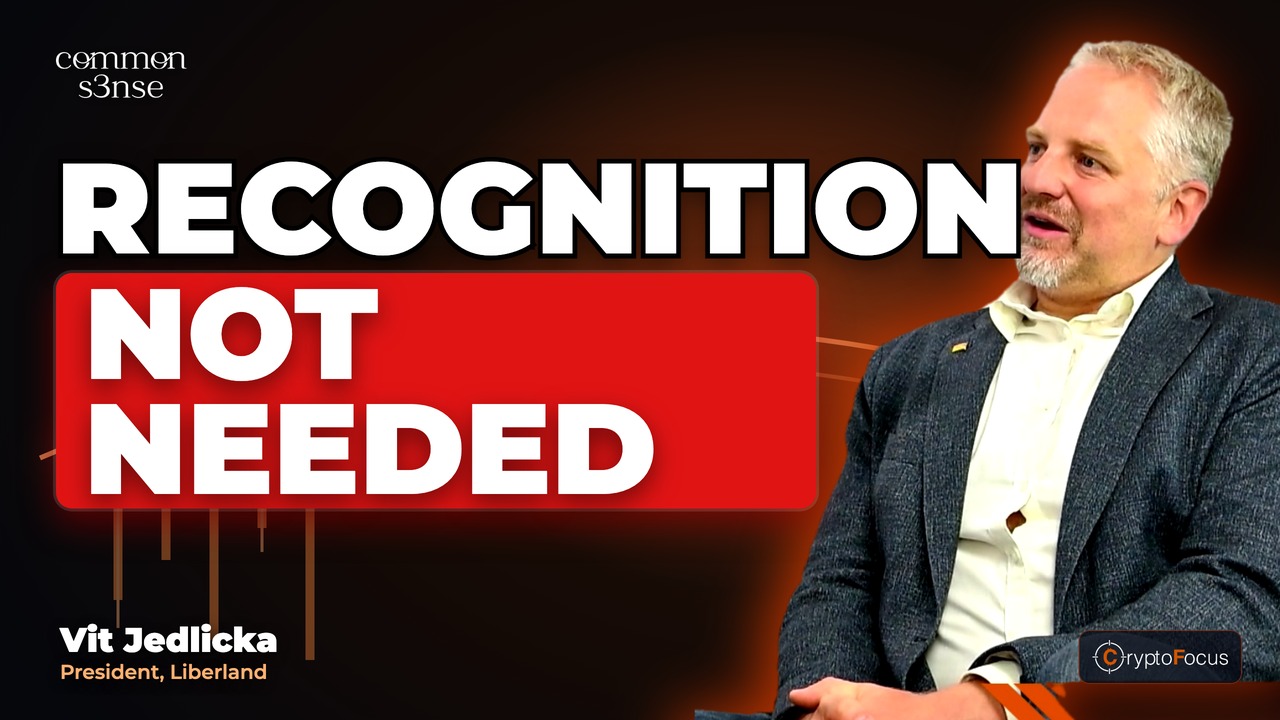
I have interviewed founders who want a licence, a listing or a seat at a regulator’s table. Vit Jedlicka wants a border. He is the president of Liberland, the seven square kilometres of Danube floodplain he and a small group claimed in 2015, and the line he gave me is the one I have been turning over since: a country does not need anybody’s permission to exist. He is not arguing that in a bar. He is arguing it from a treaty signed in 1933, and he says 800,000 people have applied to join him.
| What you need to know |
|---|
| 1Jedlicka founded Liberland in 2015 on Gornja Siga, an uninhabited stretch of the Danube's west bank that neither Croatia nor Serbia claims. He told me 800,000 people have now applied for citizenship, more than 12,000 of them from Croatia and Serbia. |
| 2His legal argument rests on the Montevideo Convention of 1933, whose Article 3 says the political existence of a state does not depend on recognition by other states. He also told me Croatia has officially described Liberland as a parastate. |
| 3He told me Liberland's governance is being rebuilt as a DAO, with the smart contract written in Solidity, ready to deploy on Ethereum and under audit now. Justin Sun, who he says was the first prime minister elected by Liberland's merit holders, is the one who pushed for moving to an established chain. |
| 4My read: the territory is the least interesting part of this. A self-declared state has picked Ethereum over its own chain and is putting its constitutional limits into code, which makes this the first version of the idea a sceptic can read line by line instead of taking on faith. |
The full conversation runs twenty-two minutes.
How Liberland claims to be a country already
I asked him the question every sceptic asks first. How do you get other countries to accept you? He did not reach for a lobbying strategy. He reached for the law.
People believe that in order to be country you have to be recognized. Montevideo criteria is very specific about the fact that the country doesn’t need recognition by other countries to be country. It only needs to follow certain criteria.
Vit Jedlicka
He is pointing at the Convention on the Rights and Duties of States, signed in Montevideo in December 1933 and still the standard reference in the textbooks. It lists four qualifications for a state: a permanent population, a defined territory, a government, and the capacity to enter into relations with other states. Article 3 then does the work Jedlicka is leaning on. It says the political existence of the state is independent of recognition by the other states. That sentence is ninety-three years old and it takes about two minutes to look up.
Then he told me what Croatia, the neighbour that has policed the crossing for a decade, has said about him on the record.
They see us as a parastate, meaning a state structure without enough international recognition, which is recognition in itself.
Vit Jedlicka
That last clause is the whole pitch in six words, and it is the sort of line that gets screenshotted. Call a thing a parastate and you have conceded it is a structure. He knows it, and he says it with a straight face.
The flag, and the quarter of a million who answered
I wanted the origin, because everything else follows from a decision that sounded absurd at the time. He was working on a project in Switzerland, running a YouTube channel, and he told a PR firm what he was doing the next morning.
Tomorrow we are actually leaving to this territory between Croatia and Serbia. We’re going to stick the flag there. It’s unclaimed by any country for more than 20 years.
Vit Jedlicka
The land is Gornja Siga, a floodplain on the west bank of the Danube that sits in a gap opened by the Croatia and Serbia border dispute. Serbia’s position leaves the pocket outside Serbia. Croatia’s position leaves it outside Croatia. Jedlicka planted a flag in the gap on 13 April 2015 and waited for the internet to notice.
We never expected that quarter of a million people would apply for citizenship in following a couple of weeks.
Vit Jedlicka
Eleven years on he puts the figure at 800,000 applications, and he is careful about what that number is and is not. An application is a form, not a household. He said it plainly: one thing is applying online, the other thing is actually moving your body to Liberland. The number he seemed happiest about was smaller and much closer to home.
There is more than 12,000 people from these two countries that applied for citizenship.
Vit Jedlicka
Twelve thousand Croats and Serbs signing up to a state on their own doorstep is a different signal from a hundred thousand libertarians on another continent. It is also the constituency that decides whether the project ever gets a road.
Access took most of a decade.
It took us eight years to actually get physical access to Liberland.
Vit Jedlicka
The turn came during the Floating Man Festival, the annual summer gathering Liberland runs on the river. Too many people showed up and too many cameras came with them.
They opened the border crossing from Croatia to Liberland. That was a very important stepping stone on the 6th of August 2023.
Vit Jedlicka
What he described on the ground today is modest and concrete: a visitor centre in the Croatian village of Batina, a construction material depot, a camping equipment point, and a food operation to supply people who stay. Thirty young scientists, he said, are booked for a research camp around the solar eclipse of 2 August 2027. He asked for one thing from the 800,000, and it was not money. If one in ten of them visited even once, he said, the infrastructure would follow.
A constitution written in Solidity
This is the part that made the interview worth doing for a crypto audience, and it is the part almost nobody covers. Liberland is putting the machinery of government into a contract rather than selling a token with a country attached.
Liberland is a meritocracy. We really believe that people that contribute more should have more votes than the people that for example don’t contribute at all.
Vit Jedlicka
He described merit as something you earn by contributing to the state, with merit holders electing a congress of seven every three months. That is a fast clock for a legislature. It also means the design has to answer the obvious objection, which is that a system where money buys votes is a shareholder register with a flag. His answer is that the votes are bounded by things the congress cannot touch.
We never really had a meritocracy in the world. For some strange reason, no country was ever established as a corporation. But in Liberland we believe it’s a time for it.
Vit Jedlicka
We have a strong constitution which says what this corporation, this Liberland congress, what it can do and cannot do to the people. We have learned that from American constitution.
Vit Jedlicka
On top of that, he said, sits a second chamber he called a monarchical element, a senate that can veto the congress, and a veto the merit holders themselves can use against a decision they dislike. His stated principle is that the fewer institutions able to make law the better, and the more institutions able to block it the better. Read that as a design constraint rather than a slogan and it is a coherent one: he is optimising for the number of ways a bad rule can be stopped.
Then he told me where it runs.
We create a DAO. The smart contract, which is in Solidity, ready to be deployed on the top of Ethereum, is ready. It’s being audited right now. We found great partners for audit right on this conference.
Vit Jedlicka
Liberland has run its own chain for years. Moving the governance to Ethereum is a concession, and an interesting one, because the argument for a sovereign state running a sovereign chain is exactly the argument the project was founded on. The person who talked him out of it is the last person you would expect.
The prime minister who went to space
The first elected prime minister was Justin Sun, also the wealthiest prime minister ever elected on planet Earth, but also the first prime minister to ever fly to space.
Vit Jedlicka
Sun founded TRON, and he flew to space with Blue Origin in 2025, which is the detail Jedlicka enjoys most. By his account, the founder of one layer one then told the president of a new country to build on a different one.
He also pushed strongly for moving Liberland to an established blockchain. He actually suggested moving Liberland governance to Ethereum. We are now following this path. We want to avoid all the bridges for higher security.
Vit Jedlicka
Avoiding bridges is the sentence a security engineer would underline. Cross-chain bridges have been the single most reliably drained piece of infrastructure in this industry, and a state that holds its treasury and its voting record behind one is a state with a smart contract for a border guard. Putting the whole thing on one settlement layer removes that surface. It also means Liberland’s constitutional limits become public bytecode that anyone can read before they apply for a passport.
The citizen list is doing diplomatic work too. He named a sitting president and a sitting foreign minister without being asked twice.
Javier Milei, president of Argentina, was supportive of Liberland long before he ran for presidency. He was running under the banner that he’s a general coming from Liberland to fix Argentina. And then later he officially became citizen of Liberland.
Vit Jedlicka
Right now we’ve got 800,000 people that applied for citizenship of Liberland, and many of them are people like Justin Sun and Vitalik Buterin.
Vit Jedlicka
His theory of recognition is that it arrives sideways. Not through a UN vote, but through enough people in enough governments who already carry the document. He put it as opposition figures and ministers who cannot reform their own systems from inside and see a smaller one as the demonstration. Whether that ever converts into a seat anywhere is unproven. As a strategy for an entity with no army and no tax base, it is at least cheap.
Why he thinks the banks bring the next wave
I asked whether building the whole monetary system inside crypto was the smart move, or a constraint he had talked himself into. He answered with the state of the alternative.
The banks are a bit deranged, I have to tell. In general it’s all very shaky. It can also fall down quite quickly.
Vit Jedlicka
I think that will create another wave for crypto adoption because people are really trying to find alternatives. The banking world is going to choke itself to some degree.
Vit Jedlicka
For a state with no correspondent bank, that reads less like a market view and more like an operating requirement. Liberland cannot open an account at a clearing bank in Frankfurt, so the only treasury it can run is one that settles on public infrastructure. That is also the frame the rest of this conference is speaking into. From 10 July 2027, Article 79 of the EU’s anti money laundering regulation bans anonymity-enhancing coins at licensed crypto service providers, while the recitals leave self-custody wallet software alone. A polity that never had access to the regulated rails is unusually indifferent to which way that goes.
I closed by asking what he would say to everyone who told him this could not be done.
If you can imagine it, it’s possible. I would advise people that have doubts about something being possible, if you really can imagine it, it can become a reality.
Vit Jedlicka
Eleven years in, the thing worth watching is the audit rather than the flag. If the constitution ships as a contract on Ethereum and holds, Liberland becomes the first place where you can read a country’s limits on its government before you decide whether to join it. That is a genuinely new object, and it will be public.
Frequently asked questions
Is Liberland a real country?
No United Nations member state has recognised Liberland. Jedlicka’s position is that recognition is not the test. He points to the Montevideo Convention of 1933, whose Article 3 states that the political existence of a state does not depend on recognition by other states, and he told me Croatia has officially described Liberland as a parastate.
Where is Liberland?
On Gornja Siga, roughly seven square kilometres of uninhabited floodplain on the west bank of the Danube between Croatia and Serbia. The pocket exists because the two countries disagree about where the border runs, and each of their positions places the land outside its own territory.
How does Liberland’s government work?
He described it this way. Merit holders elect a congress of seven every three months, a senate can veto the congress, a constitution sets what the congress may and may not do, and merit holders can veto a decision themselves. Jedlicka told me the governance contract is written in Solidity, is ready to deploy on Ethereum and is being audited now. Those are his figures and his timeline.
How many people have applied for Liberland citizenship?
Jedlicka told me 800,000 applications, of which more than 12,000 come from Croatia and Serbia. He drew the line himself between filling in a form and turning up: applying online is one thing, moving your life to the Danube is another.
Read next
- Every Common S3nse 2026 interview we published, the hub that keeps filling up as each conversation goes live.
- Our preview of Common S3nse 2026, for why a small privacy conference in Amsterdam-West drew this line-up.
- The speakers we went to Amsterdam for, if you want the rest of the programme.
- The Montevideo Convention of 1933, the full text, if you want to read Article 3 for yourself.
- Liberland’s constitution, the project’s own founding document.
- Regulation (EU) 2024/1624, the anti money laundering regulation whose Article 79 applies from 10 July 2027.
- The Common S3nse speaker list, published by the organiser.
- Vit Jedlicka on X: @JedlickaVit. Liberland: @Liberland_org.
Recorded at Common S3nse 2026, De Hallen Studio’s, Amsterdam, on 5 September 2026, during Cypherpunk Week. Quotes are verbatim from the recording with filler removed. Cryptofocus is a media partner of Common S3nse. Nothing here is financial advice.


