



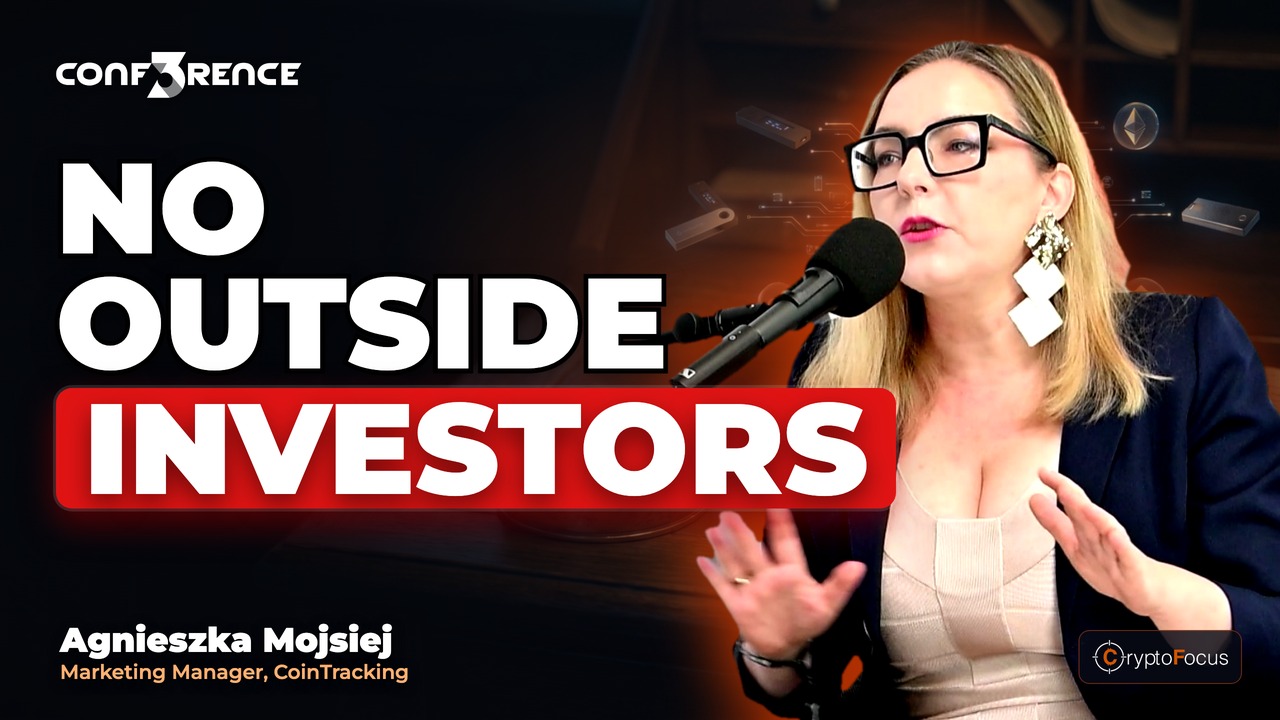

CoinTracking has been counting other people’s coins since 2012, and today it is fully bootstrapped, with no outside investors and only its clients to answer to. Agnieszka Mojsiej, marketing manager at the Munich company for more than four years, told me that on day two of CONF3RENCE at Kokerei Hansa, after I had seen a crowd gather at her booth. I asked why a coin tracker matters at all. Her answer started with a number most crypto investors will recognise in themselves.
| What you need to know |
|---|
| 1Agnieszka Mojsiej is marketing manager at CoinTracking, the Munich crypto portfolio and tax software company founded in 2012; she has worked there for over four years. |
| 2CoinTracking says it offers more than 400 imports from exchanges, blockchains and wallets, and a free account needs only a username and a password, no email address. |
| 3The company is fully bootstrapped, with no outside investors, and uses AI to point users to tax-saving moves such as realising a loss before the end of the year. |
| 4My read: in a market that has buried plenty of venture-funded tools, answering only to its paying customers is the strongest argument CoinTracking has. |
The full conversation runs just over eleven minutes.
Three exchanges, and that is the minimum
Mojsiej sees two big problems for people who invest in crypto. The first is simply knowing what you own.
So the average investor in crypto uses at least three exchanges.
Agnieszka Mojsiej, marketing manager at CoinTracking
Many use five, ten or twenty, she added, plus DeFi protocols and a few wallets on the side, because diversifying is exactly what they were told to do. The result is a portfolio you can only check by logging into half a dozen places. CoinTracking’s answer is one dashboard that pulls in wallets, blockchains, DeFi protocols and exchanges, the popular ones and the obscure ones.
What struck me more was the privacy line. A tool that sees your whole portfolio sounds like a tool that wants your whole identity. She says it does not.
We don’t even need an email from you.
Agnieszka Mojsiej
A free profile takes a username and a password you choose, and nothing else: no email address, no credit card. I put it to her that this much anonymity shifts the responsibility onto the person behind the dashboard.
Read the thread on X
You are still your own custodian
She agreed without hesitation. Few people standing at a booth say this about their own product.
This is a great tool but it’s still crypto, you’re still your own custodian, you need to be responsible for your coins.
Agnieszka Mojsiej
What the software can do is ask awkward questions. Once a user connects two or three sources, CoinTracking checks whether funds flow somewhere it cannot see, and it says so. Her version of that prompt is one I suspect plenty of readers need to hear from someone.
Are you sure that you don’t have a wallet that you forgot about?
Agnieszka Mojsiej
The fix still has to come from the user, and she was clear about why.
We’re not taking your keys. We’re not taking your passwords. We’re not taking your access.
Agnieszka Mojsiej
For a tax report, that division of labour matters. A missing wallet is a missing cost basis, and a missing cost basis tends to cost you money when the numbers are added up. The software can flag the gap. Only the owner of the keys can close it.
Dinosaur age and no investors to please
I asked why she calls CoinTracking the best at this. Her first reason was the number of connections that actually work, more than 400 of them, each built for that specific platform’s data rather than a generic spreadsheet import. Her second reason was age.
We’ve been around since 2012, which is for crypto like dinosaur age really.
Agnieszka Mojsiej
Then she turned to who the company answers to.
We’re fully bootstrapped. We do not have any outside investors. So the only obligation we really have as a software, as a company is to our clients.
Agnieszka Mojsiej
She framed it as a promise to make the best product possible without trying to satisfy investors, in her words, “to prove growth or to create growth that’s just not sustainable.” For software that holds years of someone’s transaction history, that matters. A tax tool you depend on for a decade needs to still exist in a decade, and a company that answers only to its paying customers has one less reason to disappear. CoinTracking’s country tax guides show how much of that knowledge sits in plain sight.
Her third reason was support: staff who know national tax codes and the details of DeFi, spread across time zones so an urgent question does not wait for days.
Where the tracking turns into a tax report
The second problem Mojsiej named is the tax report itself. Rules differ by country, and classifying every transaction is the hard part. Because the software already holds the dates, the values and the cost basis, and the user picks a country when setting up the account, those national rules run in the background from day one. The newer layer is AI that points out savings before the year closes.
If you sell that coin, like by the end of the year, you’re going to realize the loss and that’s going to offset your taxes.
Agnieszka Mojsiej
That is tax-loss harvesting, and whether it works depends on the rules where you live, which is exactly why the country setting comes first. The data side is getting stricter too. Under the EU’s DAC8 directive, crypto service providers collect their customers’ transaction data from 2026 and report it to national tax authorities, so the tax office will increasingly hold its own version of your history. Having yours in order first is the sensible side of that exchange.
She did not pretend it is effortless.
But normally you still need to do some work, but we’re trying to make it as human and as simple and quick and easy as possible.
Agnieszka Mojsiej
For people who want it off their plate entirely, CoinTracking sells a full-service option where its team handles the import and the review. The goal she described is a painless tax season, or as painless as a tax season gets.
Why a booth and not just a badge
I closed by asking why CoinTracking took a booth at CONF3RENCE rather than just walking the halls. Her answer was about presence: with a booth, you have your name above what you do, and people stop who had never thought about the problem at all. Given the crowd I saw there, it worked. The question she leaves every visitor with is the one worth asking yourself tonight: do you know where all of your coins are?
Read next
- Where the risk sits: CONF3RENCE 2026 in thirteen interviews, our complete article on the thread connecting all thirteen conversations.
- All our CONF3RENCE 2026 interviews, added as each conversation from Kokerei Hansa goes live.
- Blockpit CEO Florian Wimmer on why crypto cannot be a tax loophole, the reporting side of the same tax season.
- Our CONF3RENCE 2026 preview, written before the doors opened.
- CoinTracking at cointracking.info and on X.
Recorded at CONF3RENCE 2026, Kokerei Hansa, Dortmund, on 16 September 2026. Quotes are verbatim from the recording with filler removed. Cryptofocus is a media partner of CONF3RENCE. Nothing here is financial advice.


