



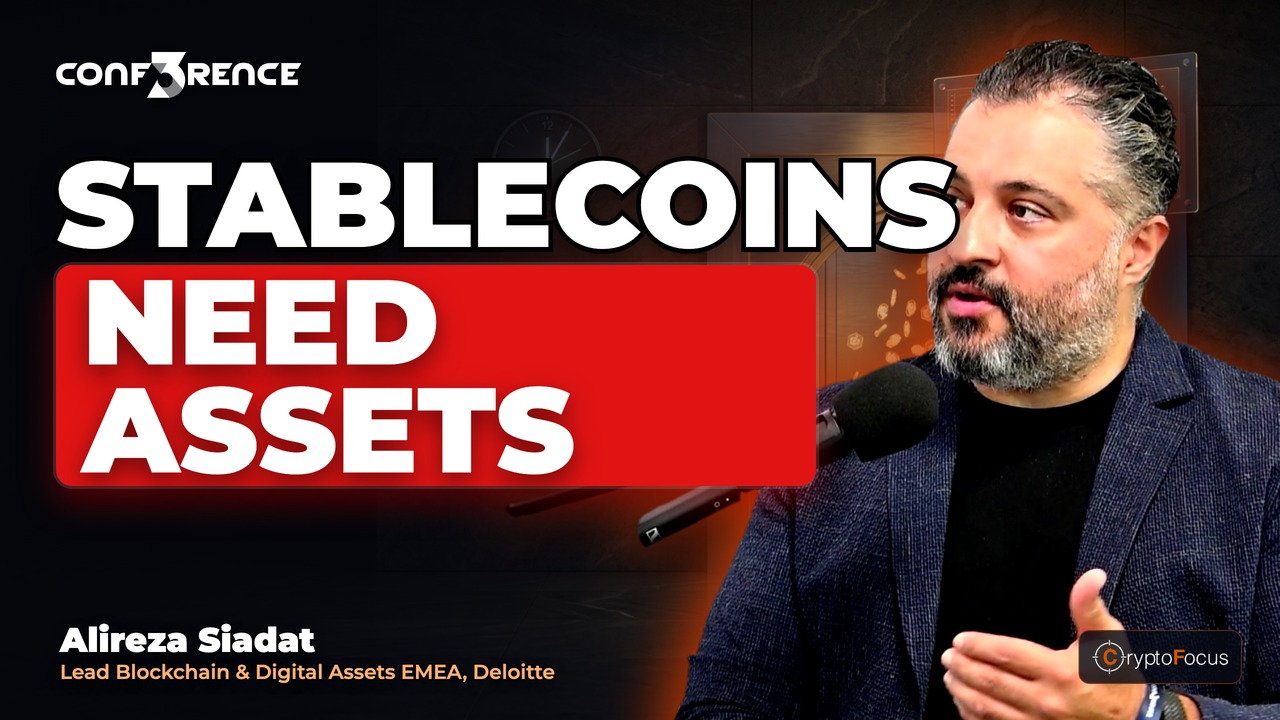

Alireza Siadat opened my first interview at CONF3RENCE with a line I did not expect from the man who leads blockchain and digital assets for Deloitte across EMEA: a stablecoin on its own has no use case in Europe. We sat down at the Cryptofocus booth in Kokerei Hansa before the doors opened. Over twenty minutes he explained what does work, from corporate cash that earns overnight to exchanges that will soon hold your Bitcoin and your tokenised shares on one screen.
| What you need to know |
|---|
| 1Alireza Siadat is Lead Blockchain and Digital Assets EMEA at Deloitte and a partner in Banking and Finance at Deloitte Legal since February 2025. He is a regulatory lawyer and has worked in this market since 2014. |
| 2His core use case: a company swaps idle cash into an e-money token after banking hours, moves it into a tokenised money market fund within minutes, and swaps back when the working day starts. |
| 3He expects exchanges to offer crypto and tokenised stocks on the same account within two to three years, and points to Kraken buying Backed, the Swiss issuer of xStocks, as the early sign. |
| 4My read: in Europe the stablecoin question is really a settlement question, and a regulatory lawyer who advises banks and corporates on both legs is the right person to frame it that way. |
The full conversation runs just over twenty minutes.
In Europe a stablecoin needs a second leg
Siadat has been saying the same thing for years, and he said it again to me with a smile, because he thinks the market has finally caught up with him. I had asked what he saw coming that actually arrived. He answered with payments, and with a claim that will surprise anyone who reads the stablecoin headlines every morning.
A stablecoin standalone, there’s no use case behind it. No one in Europe is using a stablecoin for remittance service or for payment because we have a strong payment infrastructure in Europe.
Alireza Siadat, Lead Blockchain & Digital Assets EMEA, Deloitte
A European treasurer will recognise the point. SEPA Instant already moves euros between accounts in seconds, so a token that only replicates a bank transfer solves a problem most companies here do not have. The value, in his view, shows up somewhere else entirely.
At a point when it comes that you can take the stablecoin, like the digital money, and swap it against an asset, so you have payment versus delivery, and this works, then it becomes very interesting.
Alireza Siadat, Lead Blockchain & Digital Assets EMEA, Deloitte
Payment versus delivery is the old settlement principle that the cash only moves when the security moves. Put both on a blockchain and they can settle in the same transaction. He calls them the two legs, the cash leg and the instrument leg, and his point is that tokenising one without the other leaves you standing on one foot. Europe spent years arguing about the cash leg. The instrument leg is where the work is now.
Read the thread on X
What company cash does after 5 p.m.
The most practical minute of the interview came when I asked how DeFi could ever match the margins traditional finance is used to. He did not reach for yield farming. He started with the settlement cycle most investors have heard of and few have thought about: T plus two, the two banking days it takes for a trade to land in your account. Then he described a company with 50 million euros sitting in its account, earning nothing, needed only during office hours.
So what do you do in the time between, like after 5 p.m., before 8 a.m. and on the weekends? You can take that money, you can tokenize it, you can swap it to e-money token, for example.
Alireza Siadat, Lead Blockchain & Digital Assets EMEA, Deloitte
An e-money token is the MiCA category for a token that tracks a single official currency, which makes it the regulated form of a euro stablecoin. The second step is the one that turns an idea into a treasury product.
If you have this e-money token which runs on the EVM, on an Ethereum blockchain, you can swap it against a tokenized money market fund
Alireza Siadat, Lead Blockchain & Digital Assets EMEA, Deloitte
He described that swap as T plus zero, done within ten minutes, with the position unwound automatically when the bank day begins or when month-end payments come due. The smart contract that runs it is a DeFi invention. The fund, the e-money licence and the corporate client all come from traditional finance. That combination is the thread running through everything else he told me.
It also explains why he is relaxed about DeFi’s future. What finance has done for thirty years, he argued, can be done on-chain at lower cost, because a protocol takes over the work that a row of intermediaries used to bill for.
So what we did or do in TradFi for the last 20, 25, 30 years, we can do the same in DeFi. But you can do it for lower cost.
Alireza Siadat, Lead Blockchain & Digital Assets EMEA, Deloitte
Tokenise for profit, or leave it alone
Siadat spoke on the real-world asset tokenisation panel that day, and before we started filming he had asked me the question he wanted the panel to answer: what is the point? You can tokenise a lamp, a building or a person’s time. He has seen the ICO wave, the security token offerings that followed and the projects that are still standing, and his filter is blunt.
Whatever you can tokenize where you see a real value when it comes to making profits or saving costs. This is really a project where you say, this makes sense to tokenize it, not to tokenize something just for proof of concept and then never going to launch it
Alireza Siadat, Lead Blockchain & Digital Assets EMEA, Deloitte
He was generous about the pilot years, which he dates to roughly the last five or six. Somebody had to prove the technology could carry a bond or a fund. His point is that the proof is in, and the last eighteen months, since the United States opened up to the industry, have shifted every conversation he has with banks, asset managers and corporates to one question: where does this make or save money?
It’s maybe good for the theory, for proof of concept to show it is possible, but we moved ahead of that.
Alireza Siadat, Lead Blockchain & Digital Assets EMEA, Deloitte
That is a useful test for any tokenisation announcement you read this week. Ask who earns more or spends less once it goes live. If nobody can answer, it is still a pilot, whatever the press release calls it.
The market follows the regulation
Siadat is a regulatory lawyer by training, and it shows in how he forecasts. He does not read charts. He reads legislative calendars, and he told me that habit has served him better than any price model.
I always said the market is going to follow the regulation. And so if you want to know what is happening in the next three, four, five years, you have to see what the political and legal decisions are right now.
Alireza Siadat, Lead Blockchain & Digital Assets EMEA, Deloitte
His example was the Financial Action Task Force, which issued guidance on cryptocurrencies long before most regulators took the sector seriously, then widened its lens to virtual assets as tokenised securities and stablecoins arrived. The instruments grew into the rules that were written for them. Today he watches Washington just as closely. From his seat at Deloitte, which works closely with the US government side, he follows the GENIUS Act, signed in July 2025, and the CLARITY Act, and asks what they mean for Europe.
So MiCA 2.0 may come. And we’re looking left and right what is happening to see if there are some changes needed to keep the European market being attractive, not just to Europe but to the international community.
Alireza Siadat, Lead Blockchain & Digital Assets EMEA, Deloitte
He also reminded me that Europe is harmonised on paper and still varied in practice. The Czech central bank and the Austrian market have long been open to Bitcoin, e-money tokens are gaining ground in some member states, and Germany leans towards tokenised commercial bank money, while the digital euro, wholesale and retail, will take time. His team does not pick a winner among those models. It maps all of them, because clients in every one of those markets call him.
Alireza Siadat on where DeFi and TradFi meet
For the next two to three years, his focus is the ground between decentralised and traditional finance. He gave a concrete example first. Kraken agreed to acquire Backed, the company behind the xStocks tokenised equities, and Robinhood and eToro already sell crypto next to traditional securities.
I can imagine that we will see in the next two to three years more and more exchanges offering lots of instruments like a mix between cryptocurrencies and traditional assets, but most likely tokenized.
Alireza Siadat, Lead Blockchain & Digital Assets EMEA, Deloitte
Picture one account where you borrow against your Bitcoin to buy a stock, or the other way round. I put the obvious question to him: Bitcoin maximalists want the two worlds kept apart, and bankers want them joined, so where does he sit? He said he leaned towards DeFi four or five years ago and now works closer to TradFi, without leaving DeFi behind. The reason is that both sides are removing what used to scare the other off.
So what we now see is that the DeFi industry is getting more and more mature because they pay attention to combating money laundering and terrorism financing and sanctioned issues.
Alireza Siadat, Lead Blockchain & Digital Assets EMEA, Deloitte
He named DeFi teams founded by former bankers who bring investment policies into on-chain vaults, and the 1inch founders, who have said for two years that they want to move closer to traditional finance. On the other side of the old wall, banks have discovered what a protocol can do to their cost base.
they appreciate, as I said, for example, the smart contracts and the protocols, that with them you can eliminate or limit the numbers of intermediaries. And that is why both industries are getting closer together.
Alireza Siadat, Lead Blockchain & Digital Assets EMEA, Deloitte
I teased him on camera that this was a very political answer, a man with a foot in both camps. It is also the most honest description of his job. The corporate treasurer and the protocol founder are both his clients now, and the rules he helps them read are the same rules.
Frequently asked questions
Who is Alireza Siadat?
Alireza Siadat is Lead Blockchain and Digital Assets EMEA at Deloitte and a partner in Banking and Finance at Deloitte Legal, which he joined in February 2025. He is a regulatory lawyer who has worked in this market since 2014 and is a founding and board member of INATBA, the International Association for Trusted Blockchain Applications.
Why does Siadat say stablecoins alone have no use case in Europe?
Europe already has fast, cheap payment rails, so a token that only moves money adds little. In his view a stablecoin becomes useful when it settles against a tokenised asset in the same transaction, a model known as payment versus delivery.
What is a tokenised money market fund used for?
Siadat describes companies swapping idle cash into an e-money token after banking hours and then into a tokenised money market fund, so the money earns a return overnight and at weekends. The position is swapped back when the cash is needed for payments.
Will exchanges offer crypto and tokenised stocks together?
Siadat expects more exchanges to offer cryptocurrencies and tokenised traditional assets on the same account within two to three years. He points to Kraken’s acquisition of Backed, the issuer of xStocks, and to platforms such as Robinhood and eToro.
Read next
Where the risk sits: CONF3RENCE 2026 in thirteen interviews is our complete article on the thread connecting all thirteen conversations.
All our interviews from Dortmund land on the CONF3RENCE 2026 page as they go live. For the programme, the venue and how the free tickets work, start with our CONF3RENCE 2026 preview.
Alireza Siadat at Deloitte Legal and on LinkedIn.
Recorded at CONF3RENCE 2026, Kokerei Hansa, Dortmund, on 15 September 2026. Quotes are verbatim from the recording with filler removed. Cryptofocus is a media partner of CONF3RENCE. Nothing here is financial advice.


