



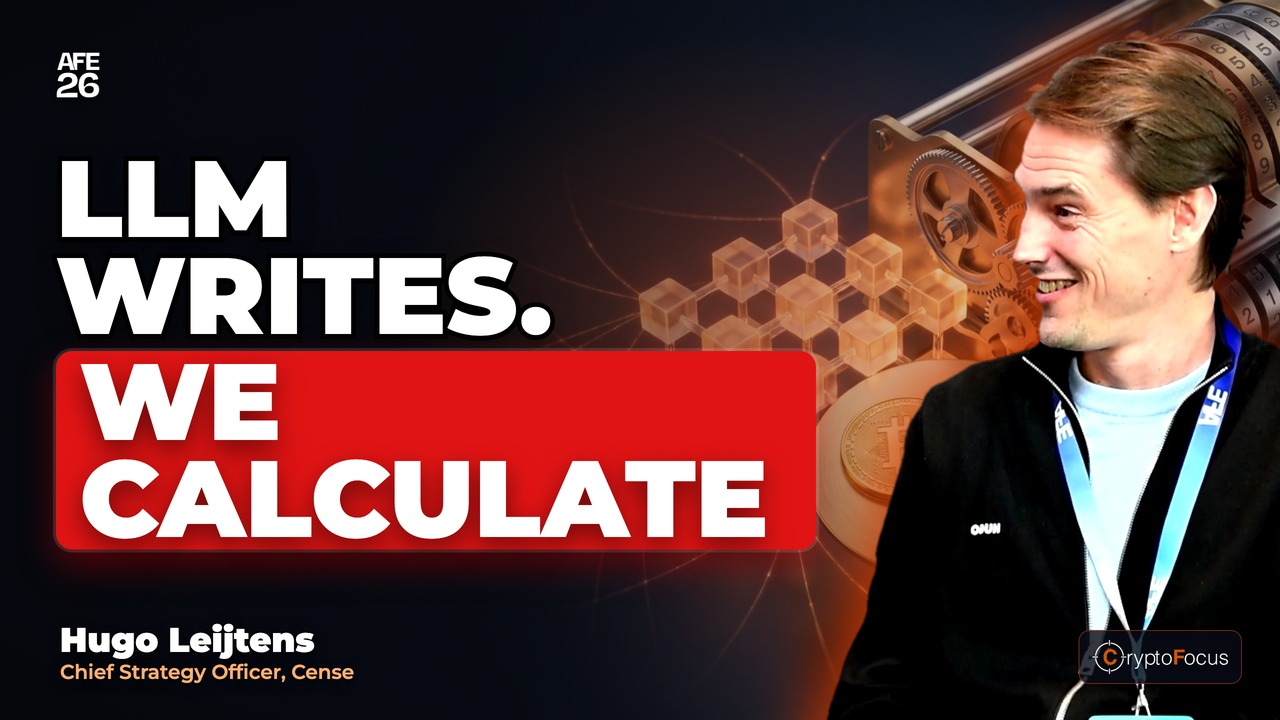

Hugo Leijtens told me Cense looked at agentic AI for its crypto compliance product and decided against it. At an event where Agentic Fintech is one of the five tracks, the chief strategy officer of the Glassnode spinout gave me the reason in five words: an LLM writes, Cense calculates. His company sells that position to banks that want to serve crypto clients without losing track of where the money came from.
| What you need to know |
|---|
| 1Cense builds crypto compliance software for banks. Glassnode calls it its first spinout, set up in 2023, and in June 2026 it announced a 6.5 million euro seed round co-led by Rabo Investments and G+D Ventures. |
| 2According to Leijtens, Cense tried agentic AI and declined it. He says its checks run on deterministic algorithms that, in his words, will give exactly the same outcome five years from now. |
| 3Cense won the European final of Mastercard For Fintechs 2025 after entering through the Dutch round. Leijtens told me he did not expect to win either time. |
| 4My read: what Leijtens is selling to compliance teams is reproducibility, a decision a bank can rerun and explain years later, and that is the test a regulator applies first. |
We spoke for just under sixteen minutes, shortly after his session in the Auditorium.
Why Cense said no to LLMs
I asked him how Cense scales as the volume of crypto running through banks grows. I expected a pitch about automation. He told me what the team had tried and dropped.
So LLMs and crypto compliance are not a great match. The reason for this is also very simple. An LLM writes. We calculate.
Hugo Leijtens, chief strategy officer, Cense
The distinction matters because a language model produces the most plausible next answer, and a compliance file needs the same answer every time someone opens it. Leijtens put the weight on that second property, and he framed it as something that counts for more than the compliance check itself.
So what we are doing and building every day is we’re building traditional algorithms that are very deterministic and that can exactly say what happens. But even more important than compliance, five years from now, that algorithm will give exactly the same outcome.
Hugo Leijtens
The EU anti-money laundering directive asks banks to keep customer due diligence records for at least five years after a relationship ends, so the horizon he picked lines up with the one an auditor works to. Then he gave the version a customer understands.
at the end of the day right you don’t want to lose your bank account because the AI says so
Hugo Leijtens
Our preview on agentic AI at AFE26 looked at where agents are going into production in finance. Leijtens marks out a part of the stack where his team decided they should not, and he says the Glassnode background is what lets them build it the other way.
So we built with the same people on the same tech stack just for compliance right now.
Hugo Leijtens
Read the thread on X
Start with a little data, then look further
The word he kept returning to was proportionality. He admitted it sounds heavy, and then made it simple with a customer most Dutch readers will recognise.
So I do crypto. I have an ABN AMRO bank account. I send money to Bitvavo, I buy crypto there, and I send it back. Okay, do I need a lot of data to understand this? No.
Hugo Leijtens
Only when that small picture does not explain the flows does the check widen. The first filter is whether the amount is material at all.
if we’re talking about 500 bucks nobody wants to do a check no if this is 5 million bucks the answer is yes
Hugo Leijtens
After materiality comes behaviour, and after behaviour the wallets around the customer’s wallets. Cense packages this as two stages. Detect is the risk-based part. Decode reconstructs the whole portfolio, every wallet and exchange account, into what he called a 360 degree profile.
But decode is not a risk-based approach. It’s a full evidence layer.
Hugo Leijtens
He also told me Cense is a Chainalysis technology partner and pulls Chainalysis risk data straight into the product. For a bank, the practical effect of the staircase is that most customers never have to hand over a full exchange export, and the ones who do are the cases where the money justifies it.
Crypto as normal as euros in the bank app
I asked where he sees crypto compliance in five years. He narrowed it to Europe, which he described as one of the strictest regions on compliance, and gave a concrete picture.
So whether you’re in your bank app, I expect in about five years to be able to get a euro, get a stablecoin, get a bitcoin, with a push on a button.
Hugo Leijtens
He pointed to Switzerland as a little ahead of the Netherlands, with crypto already integrated into banks there. His view on timing was blunt.
So it’s not a question of if this is going to happen, it’s more when it’s going to happen.
Hugo Leijtens
What stands between banks and that button, in his telling, is the compliance work. He said the technology to build crypto products already exists, and that banks are asking how to keep criminal money out while growing the business at the same time. That is the gap Cense was built for, and it connects to the question in our piece on whether the euro stablecoin moment has arrived: a stablecoin in a bank app still needs someone to explain where each incoming wallet’s money came from.
From Glassnode to a product for banks
Leijtens traced Cense back to a blockchain journey that, by his account, started in 2016 with a group of sister companies: Swissblock, the founders’ trading operation; Glassnode, the on-chain analytics firm built first to support that trading; and Accointing, a crypto tax platform. He joined Glassnode around 2022 and 2023 with the job of defining the next product, and the next problem turned out to be the questions banks asked whenever a trader wanted to cash out.
Winning Mastercard For Fintechs changed the pace. He described the effect without false modesty about the attention, and without pretending the investors had been unreachable before.
So one of the things that you achieved there is that every single VC is now willing and ready to talk to you.
Hugo Leijtens
A few months after the win, he said, Cense closed its first seed round. Glassnode’s announcement puts it at 6.5 million euro, co-led by Rabo Investments and G+D Ventures with angel investors alongside, and Banken.nl reported that the money goes into European growth and further development of the platform.
Winning without trying to win
Cense entered Mastercard For Fintechs 2025 through the Dutch round and went on to win the European final. I asked him what founders should copy from that. His first answer was an admission.
To be honest, I didn’t expect to win. Both of them I didn’t expect to win, to be honest.
Hugo Leijtens
His advice to the next pitching founder follows from it.
if you try to win it you probably won’t win it
Hugo Leijtens
He told that story on stage this morning, in the day-two session “From Pitch to Progress: The Cense Story” in the Auditorium. When I asked why he comes to this event at all, his answer had nothing to do with prizes. He talked about meeting other founders, swapping what failed and what worked, and the relief of a room that follows the conversation.
because I can promise you there’s nobody in my neighborhood that even understands a little bit what I’m doing.
Hugo Leijtens
The question I would put to any bank now planning a crypto offer follows from his argument: when a compliance officer reopens a decision in 2031, will the system give the same answer it gave today?
Read next
- Agentic AI at AFE26, the theme Leijtens deliberately steps away from for compliance decisions.
- Is the euro stablecoin moment here? The product he expects in every bank app, and the compliance question it brings with it.
- Devan Moorthy of Paxos on the stablecoin side of the same conversation at AFE26.
- How Cognito builds the Amsterdam Fintech Event, our preview with the people who put this room together.
- Every interview we recorded at the event sits on the Amsterdam Fintech Event hub.
- Cense is at cense.com, and Hugo Leijtens is on X.
I recorded the interview with Hugo Leijtens at the World Trade Center Amsterdam on 8 October 2026. Quotes are verbatim, with filler removed. Cryptofocus is a media partner of Amsterdam Fintech Event 2026. Nothing here is financial advice.


