



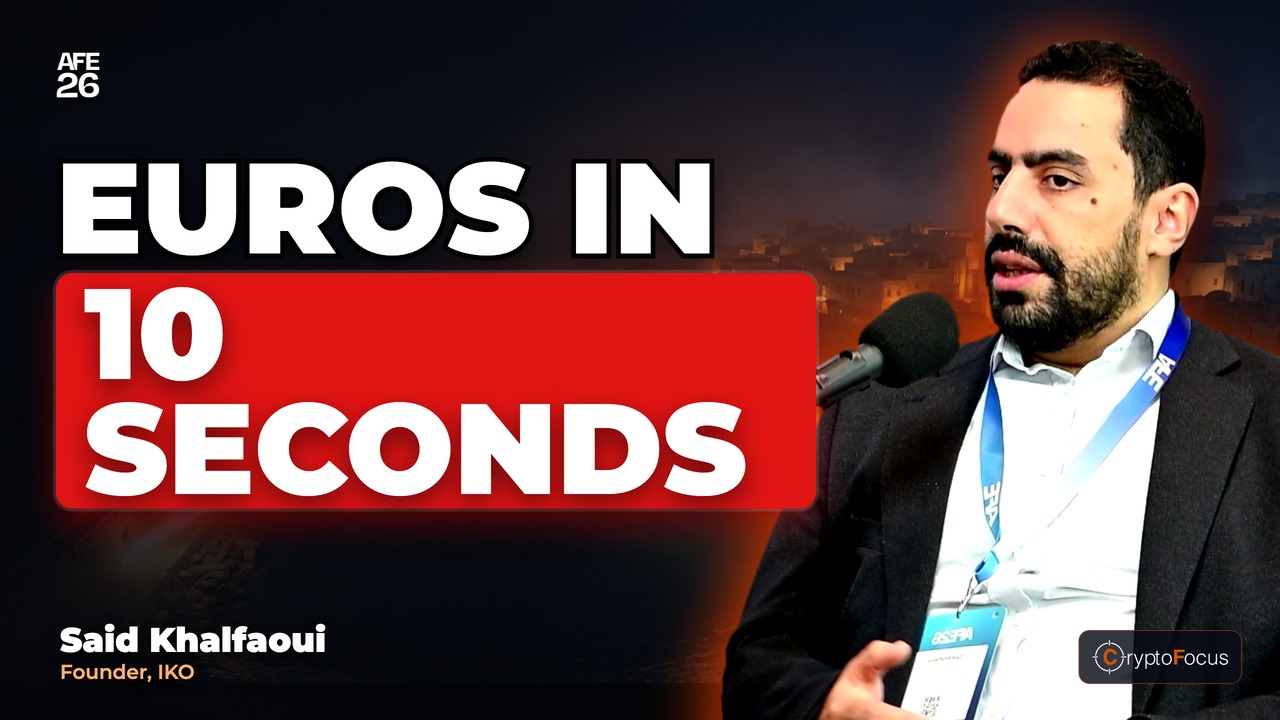

Said Khalfaoui has worked in fintech for twelve years and still cannot reliably get money to his own family. That is how he opened when I sat down with him at the World Trade Center on Wednesday, and it is the part I keep coming back to. The fee is the smaller half of it. What stays with him is that the money sometimes fails to arrive at all. His answer is a virtual IBAN for people living in Algeria, backed by stablecoin wallets, settling in about ten seconds.
| What you need to know |
|---|
| 1IKO gives someone living in Algeria a virtual IBAN, backed by stablecoin wallets, that receives euros as an ordinary SEPA payment. Khalfaoui says the money arrives within ten seconds. |
| 2The app launched in September 2026 and has around 700 active users. It runs on another company's money transmitter licence for now. Its own licence is targeted for the first quarter of 2027 if IKO raises money, the third quarter if it keeps bootstrapping. |
| 3The downloads are not only Algerian. Khalfaoui named users in Lebanon, Indonesia and the United Kingdom, all people without easy access to Europe's payment rails. |
| 4My read: the stablecoin is the least interesting part. What makes this work is that IKO pays Algeria's existing informal currency network to be its cash-out layer instead of trying to replace it, which is where most remittance startups burn their first two years. |
The full conversation runs nine minutes.
The rails that lose the money
I asked him to start with the problem rather than the product, because Algeria is not a corridor that comes up often at a Dutch fintech conference. He did not reach for a market-size figure. He described sending money to his father and his brother.
The current official banking rails are way too slow, way too expensive, and most of the time you don’t even find your money when you get there.
Said Khalfaoui, Founder, IKO
That last clause is the one that separates this from an ordinary pricing complaint. A slow transfer is an inconvenience you can plan around. A transfer whose value has moved by the time somebody collects it is a different kind of problem, and no amount of fee compression fixes it.
It is worth sitting with how far that is from the experience of anyone paying inside the euro area. Under the EU’s Instant Payments Regulation, a payment provider has to make the money available on the recipient’s account within ten seconds, and euro-area providers have had to be able to send instant transfers since 9 October 2025. The ten-second euro payment is now a legal baseline on one side of the Mediterranean and a startup pitch on the other. Cutting the cost of sending money across borders to under three percent is still a United Nations development target rather than a solved problem, and the World Bank’s remittance data is the place to watch it move.
Khalfaoui did not arrive at this from the outside.
I worked in the fintech for more than 12 years.
Said Khalfaoui
Read the thread on X
A virtual IBAN on stablecoin rails
The design is simpler than the components suggest. A user in Algeria goes through KYC and gets an account number that behaves like any European one. Whoever is sending from the Netherlands, France or Spain makes a normal SEPA transfer, which is the standard euro bank payment they already use every day. They never touch a wallet, a token or an exchange.
a virtual IBAN, backed by stablecoin wallets that will act exactly like a SEPA payment
Said Khalfaoui
The stablecoin sits underneath as the settlement layer, which is where it belongs and where almost nobody notices it. His own benchmark for the experience was domestic and deliberately unglamorous.
sending a Tikkie or sending money to a friend here in the Netherlands
Said Khalfaoui
Measuring yourself against Tikkie in a room full of payment companies is a useful piece of honesty. It sets the bar at the thing people already do without thinking about it, which is a far harder standard than any rival remittance app would impose.
The last mile runs on people
Here is the part that made me put my pen down. Getting euros into an account in Algeria is the easy half. What happens when the recipient wants cash in hand is the half that kills most of these companies, because the formal banking system is exactly the thing being routed around.
we basically decided to tap into the existing informal network of liquidity providers that are using currency locally and turn them into a scalable off-ramp solution
Said Khalfaoui
Read that again as an infrastructure decision rather than a workaround. Algeria already has a dense network of people who move currency locally, with their own liquidity, their own trust relationships and their own reach into neighbourhoods a bank branch will never serve. The usual startup instinct is to treat that network as the incumbent to be disrupted. Khalfaoui treats it as distribution he does not have to build, and pays for it. That choice is why a bootstrapped team can be live in one market in a month rather than in three years.
Seven hundred users and a borrowed licence
I asked what the launch actually produced, because a month-old app is usually described in adjectives.
we have already like 700 active users who are sending money and they are very happy with the solutions
Said Khalfaoui
He followed it with a pricing claim most founders would have left unsaid in front of a camera.
we can actually charge premium margins because we are the only ones in the market who are doing that
Said Khalfaoui
That is a statement with a clock on it, and he knows it. Premium margins in a corridor nobody else serves last exactly as long as nobody else serves it. Which is what makes the regulatory step the real question, and he was unusually plain about where IKO stands today.
we just use someone else’s license, which is great to prove the market, but the next step is to get our own license, cut the cost of a third party, and be able to offer a better user experience to our customers
Said Khalfaoui
Operating under another firm’s money transmitter permission is a normal way to prove a market without waiting eighteen months for paperwork. It also puts a ceiling on your margin and your product, since the licence holder sets the rules you live by. The timeline he gave for getting out from under it is the clearest signal in the interview of how the next year goes.
Today we are bootstrapping. If we continue to bootstrap, it’s going to be in Q3 next year. But if we can raise funds faster, then it can be done in Q1 next year.
Said Khalfaoui
Two quarters of difference, bought with capital. For anyone reading this as an investor rather than a sender, that is the whole pitch in one sentence.
Who else downloaded it
The thing he did not plan for is the part I would watch hardest. IKO was built for one corridor. The app store had other ideas.
People from Lebanon, people from Indonesia, even people from the UK, who don’t have easy access to SEPA rails
Said Khalfaoui
Unprompted demand from three unrelated countries tells you the product solved a more general problem than the one it was aimed at. The constraint turns out to be broader than geography. It is being someone a European bank finds expensive to serve, a population many times larger than any single corridor.
He made that concrete with an example that has nothing to do with family remittances, and it is the moment the interview stopped being about sending money home.
a lot of rounds of KYC, a lot of back and forth and 50 euro transaction costs just to pay one freelancer who is in Algeria
Said Khalfaoui
Fifty euro of friction to pay one person stops being a remittance story and becomes a hiring one. That is the reason a Dutch company with eight people does not open a role to candidates in Algiers even when, as Khalfaoui puts it, the person would be three times cheaper and perfectly competitive. Payment rails quietly decide who is employable across a border. That is a bigger idea than anything on his product roadmap.
that will also help people around the world, especially in the unbanked markets around in Africa and the Middle East to have financial access to the global markets
Said Khalfaoui
What he came to Amsterdam for
He was not speaking on the programme. He came to find suppliers and partners, and his reason for choosing this event over the circuit’s bigger names was refreshingly practical.
It’s a smaller event than Money 2020, for example, you get better quality connections while you come to the smaller events.
Said Khalfaoui
His shortlist was specific. He wanted the pay-by-bank session, so that a sender can fund a transfer straight from a bank account without being bounced into a separate app, a session the AFE26 programme ran on Wednesday afternoon under the title Pay by Bank: Who Will Capture the Value, powered by IBANXS. He was also hunting for a better crypto-card provider, because the ones available to him now cost too much, run their own KYC on top of his, and make the user top up a second wallet before spending. Both errands are the same errand: he is trying to remove the places where a user has to stop.
The broader instant-payments shift he is building on top of is documented in the European Central Bank’s work on retail instant payments, which is the European half of the rail. The Algerian half he had to build himself, out of people who were already doing the job.
Questions readers asked us about this one
Does the person sending the money need crypto? No, the sender makes an ordinary SEPA transfer from their normal bank account, and the stablecoin wallets sit behind the virtual IBAN as the settlement layer.
How does the recipient in Algeria get cash? Through local liquidity providers who already move currency in the market, contracted by IKO as its off-ramp rather than competed with.
Is IKO licensed? Not in its own name yet. It operates on a third party’s money transmitter licence and is working towards its own, which Khalfaoui puts in the first or third quarter of 2027 depending on funding.
Read next
- Every interview we are filming in Amsterdam this week sits on the Amsterdam Fintech Event category page.
- Bryan Verhage of Cognito built this event with the Holland Fintech Association. He walked me through how 300 people in one room is a deliberate design choice, which is exactly the thing Khalfaoui came for.
- The domestic version of the same payments question: what happens to the Dutch checkout as iDEAL moves to Wero.
- And the settlement layer underneath IKO, argued at the event: whether Europe needs a euro stablecoin at all.
I recorded the interview with Said Khalfaoui at the World Trade Center Amsterdam on 7 October 2026. Quotes are verbatim, with filler removed. Cryptofocus is a media partner of Amsterdam Fintech Event 2026. Nothing here is financial advice.


