



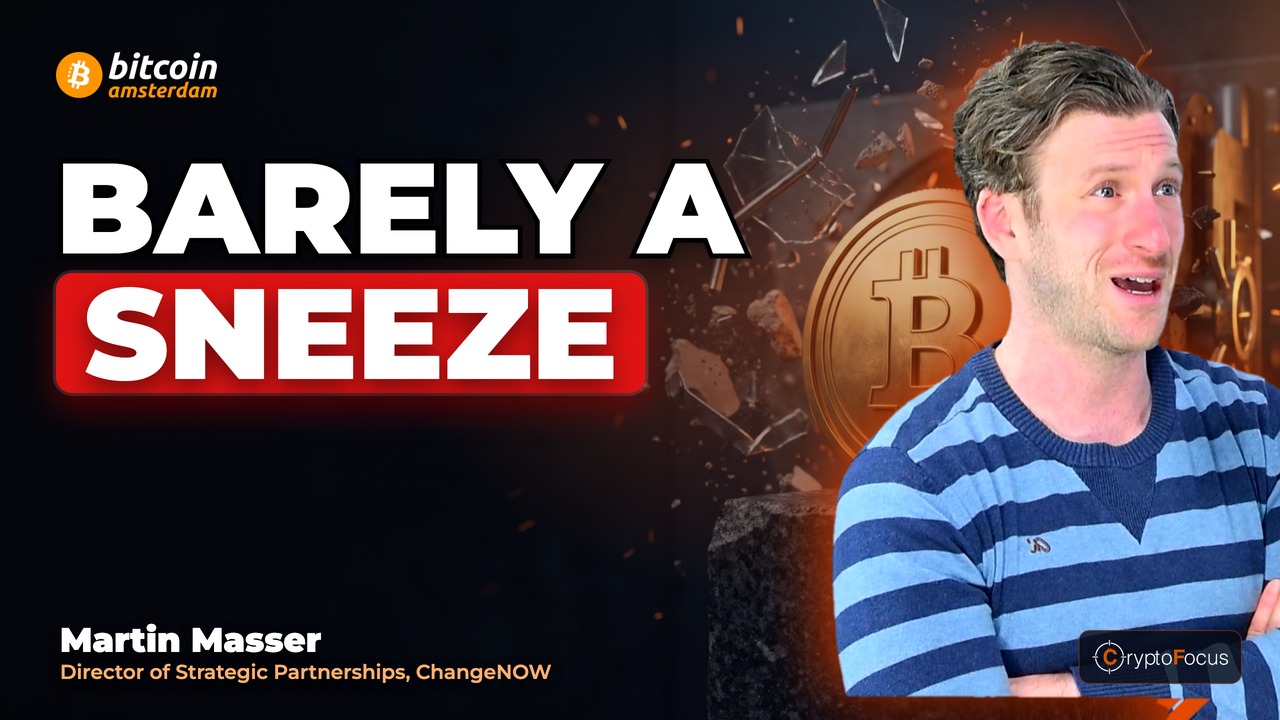
Martin Masser reads the calm after the Binance incident as a sign of how far the market has matured. A few years ago, the Director of Strategic Partnerships at ChangeNOW told me at Bitcoin Amsterdam, a shock like that could have pulled bitcoin down 10, 20 or 30 percent and the whole market with it; this time “there was not even much of a sneeze”. I sat down with him on day one at the SugarFactory in Halfweg, just outside Amsterdam, a week after Binance paused withdrawals during a security incident.
We have done enough interviews together over the years that the first minutes went on football and on whether I hype my guests too much. His role is new, though. ChangeNOW announced his appointment in August, after he had been Head of Growth at the TON Foundation, and earlier in his career he worked in banking. ChangeNOW runs non-custodial swaps, and he described its place in the market in one sentence: “We power a lot of the swaps within a lot of the wallets, the applications, even aggregators.”
| What you need to know |
|---|
| 1Martin Masser is Director of Strategic Partnerships at ChangeNOW, a non-custodial swap provider whose swaps run inside wallets, apps and aggregators. ChangeNOW announced his appointment in August 2026; he was previously Head of Growth at the TON Foundation. |
| 2Binance paused withdrawals on 29 October 2026 during a security incident it estimated at about 6.3 billion dollars, and began resuming them in phases on 1 November, TechCrunch reported. |
| 3Martin says bitcoin "did not really drop at all" after the incident, which in his view shows the maturity of the market and the confidence people have in it. |
| 4My read: the thread through his whole conversation is trust, and in his telling it is now earned in public, by an exchange that explains itself quickly and by people who still turn up in person. |
The full conversation runs 22 minutes, and the market update starts at 6:36.
What the Binance incident told him
I had asked how he sees the next six months. Martin went straight to the past seven days: “Obviously, the Binance incident”, and the US midterms. Binance paused withdrawals on 29 October while it dealt with a security incident it estimated at about 6.3 billion dollars, and it began reopening them in phases on 1 November, according to TechCrunch. What struck Martin was how the exchange handled the noise.
Binance, brilliant PR, how they came out, they topped it all out. That was brilliant. They did not go silent.
Martin Masser, Director of Strategic Partnerships, ChangeNOW
He pointed to Changpeng Zhao sharing earlier interviews in which Binance talks about doing “billions a day”, and said “that’s stopping a lot of the fears”. Then he made the argument he returned to later in the conversation.
Do you see Bitcoin did not really drop at all? If you imagined even the percentage, a few years ago, Bitcoin could have gone down by 10, 20, 30% brought the whole market down. There was not even much of a sneeze, which shows A, the maturity of the market, B, the confidence that they have in the market
Martin Masser
For anyone who holds bitcoin, the useful part of that argument is where the damage stayed. The incident hit one company’s withdrawals, and in his reading the asset itself barely reacted, which is what a market with deeper confidence should look like. Bitcoin had gone “above 80 again”, Martin noted as we talked, meaning 80,000 dollars, and Robert confirmed it from behind the camera.
Read the thread on X
Why an exchange has to talk first
I asked whether the way Binance spoke to its users is part of why the market has matured. He thinks the habit is spreading, and he gave Bitget’s chief executive Gracy Chen credit too: when her exchange went through its own incident this autumn, “she was very vocal as well”.
I honestly think coming to the market, explaining to people what’s happened, to show that you have the processes in place, to not worry the market, it’s just so key.
Martin Masser
His reason is that silence no longer buys anyone time. Transactions are public and investigators post as they go, so the story gets told with or without the company.
especially in the social media age, where you’ve got the on-chain, you’ve got ZachXBT, giving us all the updates. You want to control the situation. You’re a media.
Martin Masser
“You’re a media” is the sharpest thing he said in our conversation. In a crisis every exchange becomes its own newsroom, and the only choice left is whether it publishes first. Martin contrasted the calm of this week with a few years ago, when “people were like near enough daily trying to withdraw everything and putting it back on because people were really worried”. At ChangeNOW, he said, the mood runs the other way: “our clients, we’re seeing such a buzz, you know, a lot more with the integrations, a lot more volumes wanting to get involved”.
Two scenarios for crypto in the US
I asked whether the US midterm result could catch up with the industry later, even though the market had not reacted to it. He sees two options, and he started with the good one.
I think a lot of the narrative of what crypto was hasn’t come to fruition. You know, like strong companies are out there. You know, we’ve got Anchorage, Galaxy.
Martin Masser
His case is that policymakers can now see how strong those companies are, and that crypto firms, like fintechs before them, can move. “Do you really want to lose these companies?” he asked. The other option is the one he hopes to avoid.
The worst case scenario, and I don’t think it will be, is like, right, we’re gonna go back to where we were seven years ago where like, you can’t touch this, you can’t do this, anyone that does that is this.
Martin Masser
What keeps him optimistic is what is already in motion: he listed the bitcoin reserve, the CLARITY Act and the GENIUS Act, “so I’m still positive about that”. The US Strategic Bitcoin Reserve was set up by executive order in March 2025, and the GENIUS Act, the US stablecoin law, was signed in July 2025. He also wants something no law delivers: the return of “that hype and excitement about crypto” of about four years ago, “with the younger generation coming in”.
Why the room still matters to him
The rest of our conversation was about people. Martin writes about this a lot on LinkedIn, he told me, because his feeds are filling up with the same machine-made posts.
the AI slop, you know, just like getting churned out, and you’re seeing the same stuff, you’re seeing the same replies
Martin Masser
In his view that makes meeting in person worth more than ever, because there is one thing a model cannot do for you.
AI can’t validate, are you real? You know, I come to an event and I speak to you, you build up that connection. It’s more valuable than ever.
Martin Masser
He is acting on it tonight. On an evening with, as I put it on camera, roughly 17 after-parties, he is hosting a dinner, with help on the guest list from BCNL, which Cryptofocus is a member of. Robert and I are invited too.
For me, I just wanted to make sure we sort of sit next to the decision makers, have actual real conversations and a bit less pressured.
Martin Masser
When I asked what visitors should take home from Bitcoin Amsterdam, he started with the mix in the room: “we actually have retail, we have institutions”. The former banker had also noticed the dress code: “I used to work in banking, so I’m like, oh, wow. People are back to the suits and the shirts.” Then he turned to the host country.
I think the Netherlands has a very high concentration, especially considering its size of crypto companies and crypto adoption.
Martin Masser
The programme backs him up: the Dutch community has its own sessions on the Orange Stage this year, several of them in Dutch. For ChangeNOW, he expects the next quarter to bring more of what he described at the start, more integrations and more partners looking for liquidity across chains. “We’re seeing the market coming back as well,” he said, and the company’s NOWPayments arm handles crypto payments for merchants, a part of the business he had not mentioned until then.
The test of his argument will be the next incident, wherever it happens: how fast the company talks, and whether bitcoin again barely moves.
Read next
- All our Bitcoin Amsterdam 2026 interviews and coverage, updated as each conversation goes live.
- Fred Forsberg of Bitcoinist on why a mining app shows up in person, the same case for meeting face to face that Martin makes.
- Justin Doochin of BTC Inc, whose company runs the conference, on keeping bitcoin at its centre.
- Oleg Andreev of Safely on Flame, a network secured by burning bitcoin.
- In Dutch, on the incident itself: Binance legt aanval via sollicitatie en interne AI uit.
- ChangeNOW is at changenow.io and @ChangeNOW on X. Martin Masser is on LinkedIn.
I recorded the interview with Martin Masser at Bitcoin Amsterdam 2026, at the SugarFactory in Halfweg, on 5 November 2026. Quotes are verbatim, with filler removed. Cryptofocus is a media partner of Bitcoin Amsterdam 2026; I sit on a panel there on 5 November and am the MC of the Orange Stage on 6 November. Nothing here is financial advice.


