



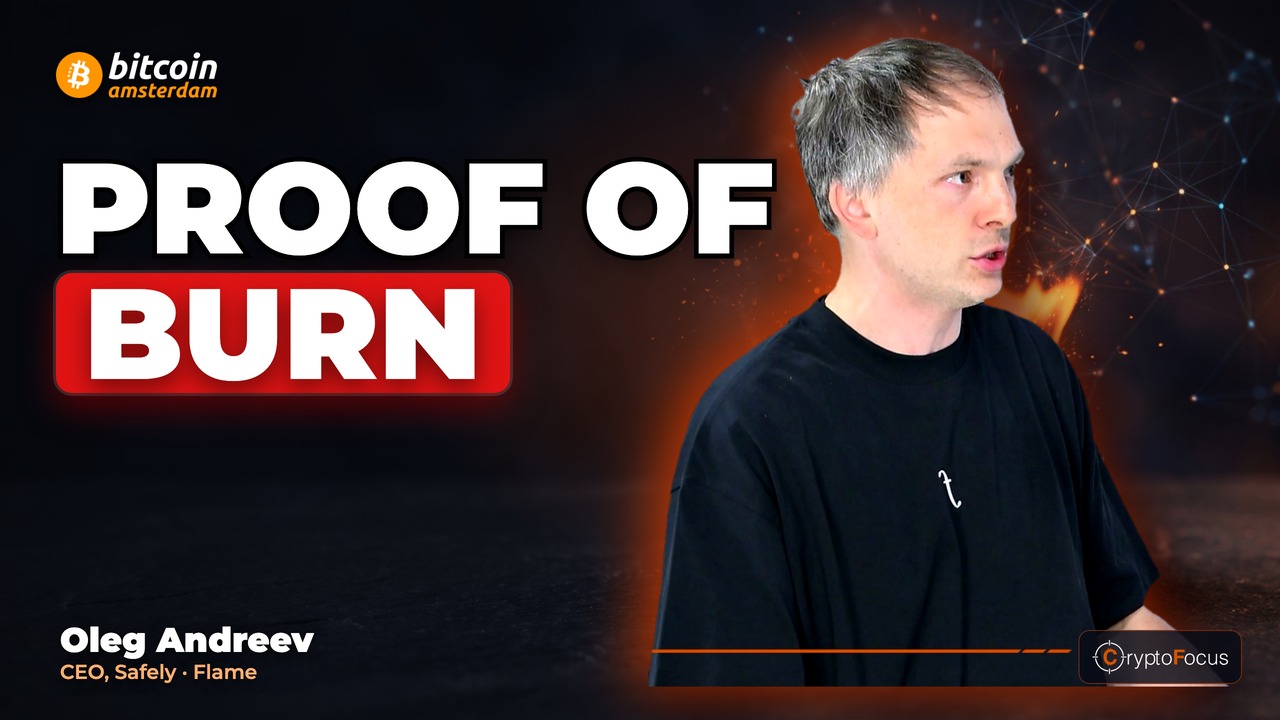
Oleg Andreev, the CEO of the self-custody wallet Safely, told me at Bitcoin Amsterdam that the network he is building will be protected by burning bitcoin. He calls the idea behind Flame “a second derivative of proof of work”, and when we sat down on day one at the SugarFactory in Halfweg, just outside Amsterdam, he argued that all that burning could even leave the bitcoin network itself healthier, with more fee income for miners and some coins taken out of circulation for good.
I had stopped at his booth because the sign joined up things I had only ever seen in separate projects: private payments, programmable transactions and faster settlement, all tied to bitcoin. Putting them together is the whole point, he said. Flame is “the complete network” that came out of “my research and development in Bitcoin space for the last 13 years”.
| What you need to know |
|---|
| 1Oleg Andreev is the CEO of Safely, an open-source self-custody bitcoin wallet for iOS and Android, and the builder of Flame, which its own site describes as an electronic cash network based on bitcoin with a proof-of-burn consensus. |
| 2Oleg says Flame is protected by burning bitcoin continuously, "a second derivative of proof of work": miners burn electricity to earn bitcoin, and Flame burns bitcoin to protect its own network. |
| 3Oleg says the network is not ready yet and hopes to have it in production in January. Flame's site and his October post to the bitcoin developers' mailing list both plan the mainnet for January 2027. |
| 4My read: his miner argument is the part to watch, because if Flame works the way he describes, its burns happen in bitcoin transactions that pay fees, and fees are what bitcoin's security will lean on as the block subsidy keeps shrinking. |
We talked for eight and a half minutes, and the whole interview is here.
Burning bitcoin as a second derivative of proof of work
The idea is easiest to follow the way he explained it, starting from mining. A miner spends electricity, a real cost, and gets bitcoin in return. In Flame, he said, “the consensus that’s governing, that protects the flame payments is based on burning Bitcoins continuously”. The cost moves one level up.
It’s a sacrifice based consensus. And then you do the next step, you burn bitcoins to make a sacrifice to protect the network that operates flames.
Oleg Andreev, CEO, Safely
Flame’s own site says the network periodically burns bitcoins to timestamp blocks of transactions and issues new units, called flames, as the incentive. In a post to the bitcoin developers’ mailing list on 1 October, Oleg describes Flame as a sidechain in which nodes continuously burn bitcoins to protect against double-spending, and he stresses that it needs no change to bitcoin’s own consensus rules. The technology overview on runflame.org goes deeper; the building blocks he names include Bulletproofs for confidentiality and Taproot-based predicates for programmable spending conditions.
What a user gets in return is the part he cares about as a product builder: payments that are private, fast and programmable, connected to bitcoin more closely than “any altcoin ever did”.
Read the thread on X
No foundation, no privileges
For a room full of bitcoiners, the first question about any new network is who controls it. Oleg answered that one in his first reply, before I could ask.
There is no privileges for miners, for developers. There is no foundation, no central point of failure. It’s a fully peer to peer network.
Oleg Andreev
He set that against the two models most new networks choose. Proof of stake, in his words, has “pitfalls” that Flame does not, and he sees security problems in alternative proof-of-work chains that a burn on bitcoin avoids. The cost of protecting Flame comes from bitcoin itself, and bitcoin does not have to change a single rule for it.
Fuller blocks and the security budget
The part of his answer aimed most squarely at this audience was about miners. Every burn is a bitcoin transaction, so Flame would add demand for block space.
operating flame fills up Bitcoin blocks, so improves the fees that mining operators are earning. And it also improves the scarcity of Bitcoins because some portion of Bitcoins is getting out of circulation.
Oleg Andreev
That lands on one of bitcoin’s long-running questions. The block subsidy halves roughly every four years, so over time miners have to earn more of their income from fees. Oleg described the reward as “programmed to be diminishing exponentially”, and he chose his words carefully about his own project: if it works out, he said, Flame offers an interesting answer to bitcoin’s security budget question in the long run. His summary was modest in the same way.
So it’s an interesting project that kind of improves the healthiness of Bitcoin network itself and complements it with the new functionality.
Oleg Andreev
The shortcuts he refuses to take
My one question was the obvious objection. Plenty of projects already offer privacy, or programmability, or speed, so why build all of it as one network, and does that not make it much harder to bring to market? He agreed at once that it is “incredibly challenging”, then explained that he has worked this way since the day he learned about bitcoin. He started out, he said, as “a web designer who learned cryptography”, and he concluded early that bitcoin would only change daily life if someone designed the full stack, from the lowest-level technology up to the user experience.
all the people who are not courageous enough to take on this whole stack they are making shortcuts so for instance you can always hear that okay for a safe and comfortable experience you have to give your bitcoins into someone’s custody
Oleg Andreev
The other shortcut he named is privacy that only works if “you have to be proficient in IT security”. It is the same trade-off that sat at the centre of the self-custody debate we covered after the Coldcard exploit. His answer to both:
we don’t believe that the progress can be made by just pushing the problem onto others we believe in inventing solutions that work for people without unreasonable compromises
Oleg Andreev
Safely is where that shows today. He calls it “the Bitcoin wallet that cares”, and its site explains Safely Sync, which backs up recovery phrases across your own linked devices with end-to-end encryption, so no custodian sits in the loop. The code is open source and was audited by Least Authority. Flame is being built into the wallet along the way, and the booth demo let visitors mint flames by virtually burning bitcoin and then use them in Safely.
Thirteen years of work and a January target
Oleg was open about where his confidence comes from. “People know me from work at Chain”, he said, where the team “pioneered confidential assets, a multi-asset network”, work that later became the Slingshot ZkVM project.
Before the word ZkVM was absorbed by the Ethereum community, that was the Slingshot ZkVM project that for the first time combined confidential transactions with smart contracts.
Oleg Andreev
After that he spent four years as co-founder and CEO of Tonkeeper, which he described as the leading non-custodial wallet in the TON ecosystem, and probably still is; it has since been renamed Keeper. “We were the first to pioneer gasless payments in the world”, he said, on TON, before Tron and before Ethereum.
For all that track record, he put no gloss on the timeline.
The network is not ready yet. It will be in production hopefully next January, next year. So a lot of work is underway.
Oleg Andreev
January 2027 is also the date on Flame’s site and in his mailing-list post. Until then, the minting demo is the way to try it, and the code is on GitHub. Later on day one, the live programme had him on the Orange Stage twice: a talk of his own, Burning Bitcoins into Flames, at 14:15, followed by the panel Building Consensus: The Future of Bitcoin Upgrades with Sjors Provoost, Paul Sztorc, Rob Hamilton and Vlad Costea.
The number to watch between now and January is how much bitcoin people actually choose to burn. In his design, that decides both how well Flame is protected and how much it adds to the fees miners collect.
Read next
- Every interview we have published so far from Bitcoin Amsterdam 2026 is on our event page.
- Fred Forsberg of Bitcoinist on a mining app that pays sats to your own wallet: the miner side of the same room.
- Justin Doochin of BTC Inc, whose company runs the conference, on why bitcoin is its central focus.
- For the custody trade-off Oleg describes: who profits from declaring self-custody dead.
- Safely is at safely.app, Flame at runflame.org, and Oleg Andreev on X at @oleganza.
I recorded the interview with Oleg Andreev at Bitcoin Amsterdam 2026, at the SugarFactory in Halfweg, on 5 November 2026. Quotes are verbatim, with filler removed. Cryptofocus is a media partner of Bitcoin Amsterdam 2026; I sit on a panel there on 5 November and am the MC of the Orange Stage on 6 November. Nothing here is financial advice.


