



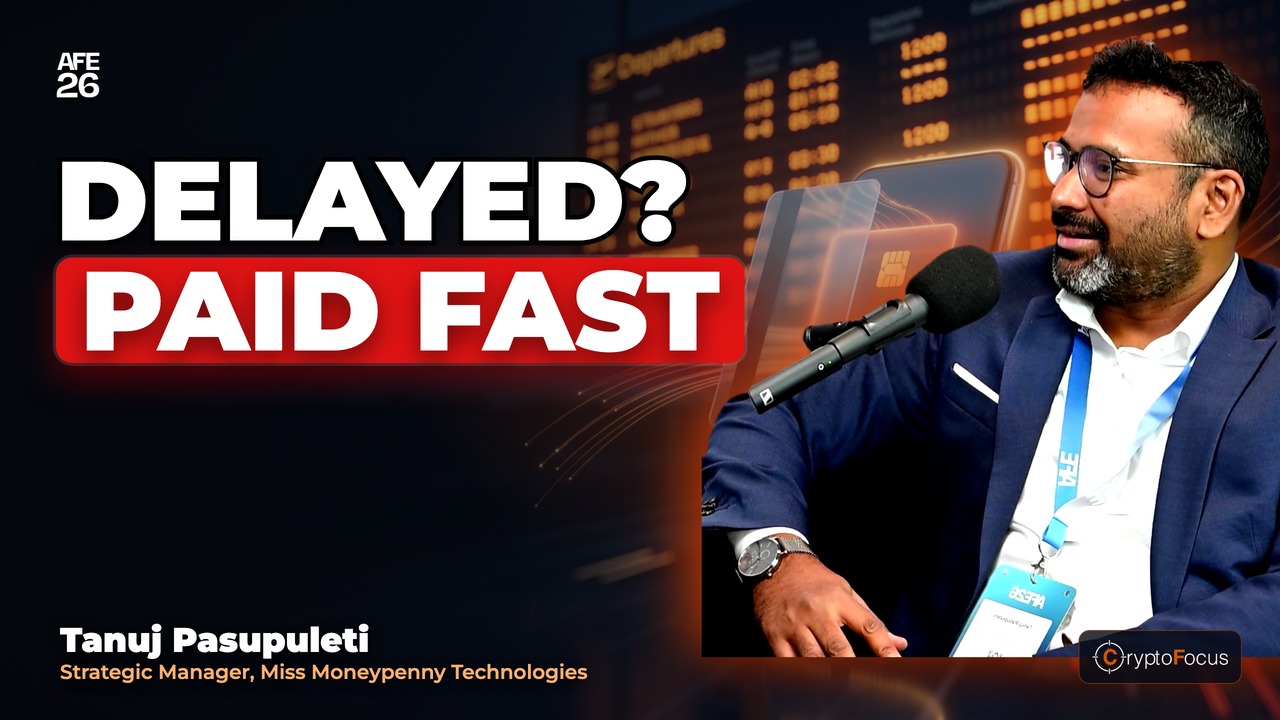

Tanuj Pasupuleti reached Amsterdam at one in the morning after a delayed train, and a few hours later he was explaining to me why a delayed flight should not cost an insured traveller a single anxious hour. The Strategic Manager for payments at Miss Moneypenny Technologies, a Berlin insurtech, wants the claim payout to land in the customer’s phone wallet the moment the claim is checked. “We immediately orchestrate the right payment methodology, whatever the customer is asking for,” he told me.
| What you need to know |
|---|
| 1Miss Moneypenny Technologies is a Berlin company founded in 2014. Its Wallet Studio platform lets insurers put policy cards straight into Apple Wallet and Google Wallet, and it raised about 8 million dollars in seed funding led by Earlybird in April 2025. |
| 2Pasupuleti spent over a decade at a large bank, then co-founded a payment startup that exited last year, and now runs payments strategy at Miss Moneypenny. |
| 3On day one of Amsterdam Fintech Event 2026 he speaks in "The Mouse & the Elephant: Making Fintech Partnerships Actually Work" with Boris Burkhardt, 14:20 to 14:50 in the Auditorium. |
| 4My read: the wallet pass is the quiet part of this story; once the insurance card already sits in the phone, paying the claim into that same phone becomes a payments problem, and that is the problem he was hired to solve. |
The full conversation runs just under twelve minutes.
From the elephant to the mouse
His afternoon session is about partnerships between big incumbents and small companies, and Pasupuleti has worked on both sides of that table. I asked him which one he prefers. He answered with his CV.
I was working for a brick and mortar big bank for over a decade. And then I joined as a late co-founder for a payment startup.
Tanuj Pasupuleti, Strategic Manager, Miss Moneypenny Technologies
That startup exited last year. He then joined Miss Moneypenny Technologies, which he described as a scale up building an operating system for insurers, with his job being to bring payments into it. The theme of his panel is a simple one, and he put it in one sentence.
Partnerships should always fuel the growth rather than fighting each other.
Tanuj Pasupuleti
For an insurtech the partnership list is concrete. He named the card schemes, Visa and Mastercard, both present at the event, and card issuers that can create virtual cards. An insurer does not want to become a payments company. It wants a claim paid in whatever form the customer can use right now, and that needs a scheme, an issuer and a wallet working together.
Read the thread on X
Three ways to pay a claim
Pasupuleti listed the routes a payout can take: straight into the customer’s bank account, onto a newly issued virtual card, or into a digital wallet. Which one wins depends on where the customer lives.
In some of the countries, the digital wallets are far ahead than the account to account payments.
Tanuj Pasupuleti
For a Dutch reader used to iDEAL, that line is worth sitting with. Account-to-account payments feel like the default here, and our earlier piece on iDEAL becoming Wero shows how much work goes into keeping them that way. An insurer operating across Europe cannot pick one rail and hope. It has to orchestrate, and the moment it matters most is the worst moment of the customer’s day.
So payments become one of the crucial factors in the customer journey, especially in the insurance when the customer is in high distress mode.
Tanuj Pasupuleti
Stranded on the highway, paid in the wallet
When I asked how the payout gets faster, he gave me a scene. Your car breaks down in the middle of a highway. You call the insurer, you wait for help, and on top of it you pay for everything yourself and claim it back later. In his version the customer opens the insurance wallet pass that already sits on the phone, applies for a claim, and the insurer can issue a virtual card straight into the wallet. The customer can order a taxi or book another way home.
He can stay in a hotel for the night until the entire situation gets a little bit streamlined over there.
Tanuj Pasupuleti
There is a second benefit he pointed to, and it matters for the insurer’s finance team. The virtual card is also a touch point that shows where the money is spent. A reimbursement after the fact arrives with receipts and arguments. A card issued for a specific claim carries its own record.
How a flight delay checks itself
Speed only works if the insurer trusts the claim. Pasupuleti framed security as two questions: is the person claiming really the customer, and is the claim legitimate? For the second, Miss Moneypenny uses an AI-based check, and he picked travel to show how it works.
The flight tracking data is readily available across the globe. It is public information.
Tanuj Pasupuleti
The customer enters the flight details, the system checks whether that flight was delayed or cancelled, and the payout is set in motion in the form the customer asked for, whether that is money for the next flight or a few hours in a lounge. This is the clip I would send to anyone who still thinks insurance claims have to involve a form and a fortnight.
Where AI stops and people start
I asked how AI, and soon agentic AI, keeps up as the company grows. His answer was more careful than most I hear at fintech events.
There is always a kind of a tug of war between where AI could be overused or underused.
Tanuj Pasupuleti
The sweet spot he described is one where the customer never feels a bot is handling the problem. Someone stuck on a highway wants to know that every step is covered. So the company automates the steps that can be automated and keeps people in the parts of the journey where reassurance matters.
We automate the path which is supposed to be automated and we keep the interaction quite lively over there.
Tanuj Pasupuleti
He added that even the payout can go wrong, so the job runs all the way from the insurance card in the wallet to the moment the money lands in the right account or wallet and the customer uses it. Our agentic AI preview asked where autonomous systems belong in finance. This is one practical answer: in the checking and routing, with a person still in view.
Why he came to Amsterdam
Amsterdam Fintech Event competes with many other fintech events this autumn, so I asked why Miss Moneypenny chose this one. His answer was about the people in the building: both card schemes are here, along with a lot of payment specialists, and the conversations go past today’s problem to where payments are heading.
But also interact with the peers in the payment industry to future-proof our solution, I would call it as.
Tanuj Pasupuleti
The company has been building toward this for a while. It shared the Guidewire InsurPitch win in Dublin with Kayna, its Wallet Studio already serves insurers, and Berlin Partner reported the seed round that funds its international growth. The question I will watch is how quickly the payout side catches up with the card side, because a policy card in the wallet is useful, and a claim paid into that wallet is the part customers will remember.
Read next
- All our Amsterdam Fintech Event 2026 coverage, interviews and previews in one place.
- One room, 300 visitors: how Cognito builds AFE26, the preview of the event itself.
- Job Mantz on who the Holland Fintech Association speaks for, the organiser’s view from day one.
- Tanuj Pasupuleti’s company: Miss Moneypenny Technologies.
I recorded the interview with Tanuj Pasupuleti at the World Trade Center Amsterdam on 7 October 2026. Quotes are verbatim, with filler removed. Cryptofocus is a media partner of Amsterdam Fintech Event 2026. Nothing here is financial advice.


