



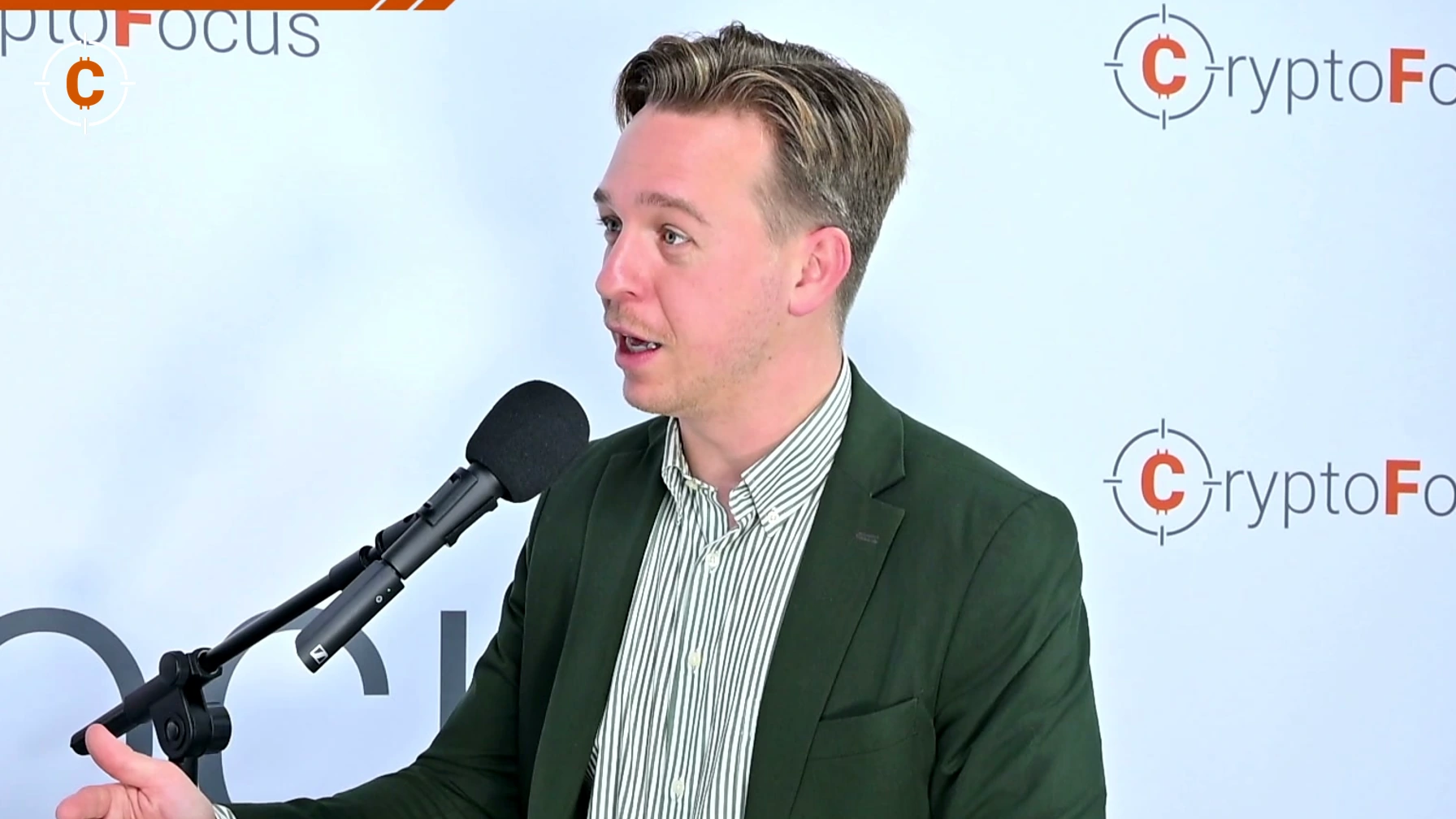
Mauro Lorenzo Halve told me at Bitcoin Amsterdam that the Dutch Box 3 plan treats crypto differently from shares: financial instruments move to a tax on gains you actually realise, while crypto and precious metals would still be taxed on gains nobody has cashed in. Halve is chairman of the NVC, the association of licensed crypto service providers in the Netherlands, and his association answered that split with a position paper of ten arguments.
Until September the NVC was called VBNL, Verenigde Bitcoinbedrijven Nederland, and the Bitcoin Amsterdam speaker page still lists him under the old name. Banken.nl reported the change on 10 September: the members approved the name Nederlandse Vereniging Cryptodienstverleners, and abroad it goes by Dutch CASP Association. We spoke on the morning of day one, before he went on stage for a panel about where regulation belongs.
| What you need to know |
|---|
| 1Mauro Lorenzo Halve is chairman of the NVC (Nederlandse Vereniging Cryptodienstverleners), the association of licensed crypto service providers in the Netherlands. It was founded in 2014 as VBNL and took its new name in September 2026; Halve names Bitvavo, Coinmerce, MoonPay and Zero Hash among its members. |
| 2Halve says the Box 3 plan moves financial instruments to a tax on realised gains but keeps crypto and precious metals on a tax on unrealised gains for now, a split the NVC called "a very bad idea" in a position paper with ten arguments. |
| 3The Council of State published its advice on the Box 3 amendment on 2 November: withdraw the bill and introduce the new system in one step in 2030. The Tweede Kamer votes on the tax plan and the amendment on 12 November. |
| 4My read: Halve's case is about proportion; he accepts the consumer-protection goal of MiCAR and fights the parts that tax unsold gains or price small firms out. |
The whole interview is just over ten minutes long.
Why crypto would be taxed on gains you have not sold
Box 3 is the part of Dutch income tax that covers savings and investments. Halve called it “the wealth tax in the Netherlands” and began with how it used to work: “we assume you have like four percent gains and we’ll tax 30-ish percent”, which in his sum came to about 1.2 percent of your wealth every year. In December 2021 the Dutch Supreme Court ruled that taxing an assumed return this way breached the right to property and the ban on discrimination in the European Convention on Human Rights, and the system had to be rethought.
The next plan, as he tells it, would tax unrealised gains at 36 percent: “you haven’t sold yet but we will tax you anyway”. The opposition was broad, he said: “We didn’t see pitchforks but everyone was against this plan.” In his telling, parliament then changed course towards a tax on realised gains, which he described as “what I think most of the world is doing and what is fair”. Then came the part that matters to anyone who holds bitcoin in the Netherlands.
The catch was that they said, okay, financial instruments, we want to do the realized capital gains, but we don’t have time just yet to also do realized capital gains on precious metals and on crypto. So we were still going to have the unrealized capital gains.
Mauro Lorenzo Halve, chairman, NVC
An unrealised gain is a rise in value you have not cashed in. Under that split, someone holding bitcoin would owe tax on a price rise in a year in which they sold nothing, while a shareholder pays on the gain when the shares are sold. The NVC put its objections on paper: “this is a very bad idea. We had 10 arguments. I won’t repeat them.” Halve took the paper to members of parliament, to the parliamentary groups and parties, and to the Council of State, “the highest advising institution independent from the government”. Cryptofocus covered the association’s warning about the plan in May, when it was still called VBNL.
The Council of State’s answer pleased him.
we were very happy last week that their formal advice towards the government was don’t do this. This has legal flaws, this has enormous implications for the industry, both for crypto and for precious metals.
Mauro Lorenzo Halve
The advice, published on 2 November, reaches beyond crypto. The Council told the government to withdraw the Box 3 bill, not to submit the amendment, and to introduce the new system in one step in 2030, keeping the current rules until then, Accountant.nl reported. Under the latest version of the amendment, dated 3 November, financial instruments would move to the realised-gains system on 1 January 2029, while direct crypto, bank balances and a few other assets would stay on the unrealised-gains system until the cabinet moves them over as well, which it expects to do from 2030, Taxence reported.
The advice is not binding, Halve pointed out, and in his reading the response so far has been to push the change back by a year: “But we’ll still see the unrealized capital gains in 2029. And hopefully it will end then in 2030.” So “a big part of my job is speaking to members of parliament on why this is a terrible idea”. If the plan stays, he warns, it is “probably going to lead to a lot of legal procedures, to lawsuits”.
Read the thread on X
Why the members speak with one voice
Before we got to tax, I had asked what the NVC actually does. Its members are the licensed firms themselves, and he named Bitvavo, Coinmerce, MoonPay and Zero Hash: “all of these that have their license in the Netherlands are members of ours”. The association’s website lists its board and members, 13 firms in all according to its homepage. His working weeks rotate, he said: “One week I’m spending time with regulators making sure that the regulation is applied proportionately.” That means making sure they are “not gold plating or over-regulating”. Gold plating is the habit of adding national requirements on top of an EU rule. “In another week I spend my days in The Hague with the members of Parliament making sure that Box 3 is proportionate.” The rest goes on shared compliance work, “so not everyone has to invent the wheel themselves”.
When I asked what a firm gets back for joining, he turned the question around. “So I don’t think there’s a return on investment to be measured.” People do not join a nonprofit for a commercial reason, he said, and some fights are risky for a company on its own.
You don’t want to take on the regulator with your own name because then they know they can focus on you.
Mauro Lorenzo Halve
Every licensed firm has its own legal and compliance teams, he said, but “the fighting against the regulation or helping a regulator improve regulation, that’s something you can do much better in a collaborative approach.” The return, as he put it, is stopping Box 3 from destroying the industry, or making regulation more proportionate together. “So it’s a joint approach and also a joint result.”
Not against regulation, only against overdoing it
I put it to him that four or five years ago, the word regulation alone would have had people reaching for pitchforks. His answer started with a principle: “regulation by itself is not bad, right? If you overregulate or if the regulation is poorly drafted, it could be harmful for innovation, for everything.” He accepts what MiCAR, the EU’s crypto rulebook, sets out to do. Protecting consumers is “a fair goal to have for your regulation”. The trouble starts when “the obligations are so strict that it’s not only protecting consumers it’s also harming the industry”.
We’re not against regulation, we actually see that it has helped adoption, it has protected consumers, it has probably prevented hacks because we also have cybersecurity regulations here in the EU, right? So it helps a lot, but it should be proportionate.
Mauro Lorenzo Halve
One of those cybersecurity rules is the Digital Operational Resilience Act, which has set requirements on IT risk and cyber incidents for EU financial firms since January 2025, crypto-asset service providers licensed under MiCAR among them.
Proportion matters most for the smallest firms. “Being compliant to regulation does involve a lot of cost,” he said, listing tooling and “all these systems you need to have” before the price of being supervised: “having a supervisor you have to pay every year, cost to get your license”. A large exchange absorbs those fixed costs; a start-up feels each one. He wants the rules to stay proportionate and the country “still attractive for smaller companies, for innovation, to settle here”.
Later that morning Halve was due on the Treasury Stage for “Waar Hoort Regulering Thuis Tussen Decentralisatie?”, roughly “where does regulation belong in a decentralised world?”, a panel with Jos Lazet, Tom van Lamoen and Simon Lelieveldt. The Tweede Kamer votes on the tax plan and the Box 3 amendment on 12 November, a week after we spoke.
Read next
- All our Bitcoin Amsterdam 2026 coverage, with every interview from the SugarFactory as it goes live.
- VBNL slaat alarm, box 3-crypto onder vuur per 2028 (in Dutch): our May report on the association’s Box 3 warning.
- Justin Doochin of BTC Inc on why regulation and policy take up so much of this year’s main stage.
- Laura Peijs and Lisanne Drost of Crypto Women Collective on why a trusted conversation beats a thousand ads.
- Lyudmyla Kozlovska of the Open Dialogue Foundation on why privacy tools are a plan B, even inside the West.
- Kelly Ann Collins of SheCrypto on why many women may already be in crypto without being seen.
- Martin Masser of ChangeNOW on the Binance incident and what it says about a maturing market.
- Oleg Andreev of Safely on Flame, a network protected by burning bitcoin.
- Fred Forsberg of Bitcoinist on mining from a phone app.
- The association is at nvc-nl.org, and Mauro Lorenzo Halve is on X and LinkedIn.
I recorded the interview with Mauro Lorenzo Halve at Bitcoin Amsterdam 2026, at the SugarFactory in Halfweg, on 5 November 2026. Quotes are verbatim, with filler removed. Cryptofocus is a media partner of Bitcoin Amsterdam 2026; I moderated a panel there on 5 November and am the MC of the Orange Stage on 6 November. Nothing here is financial advice.


