



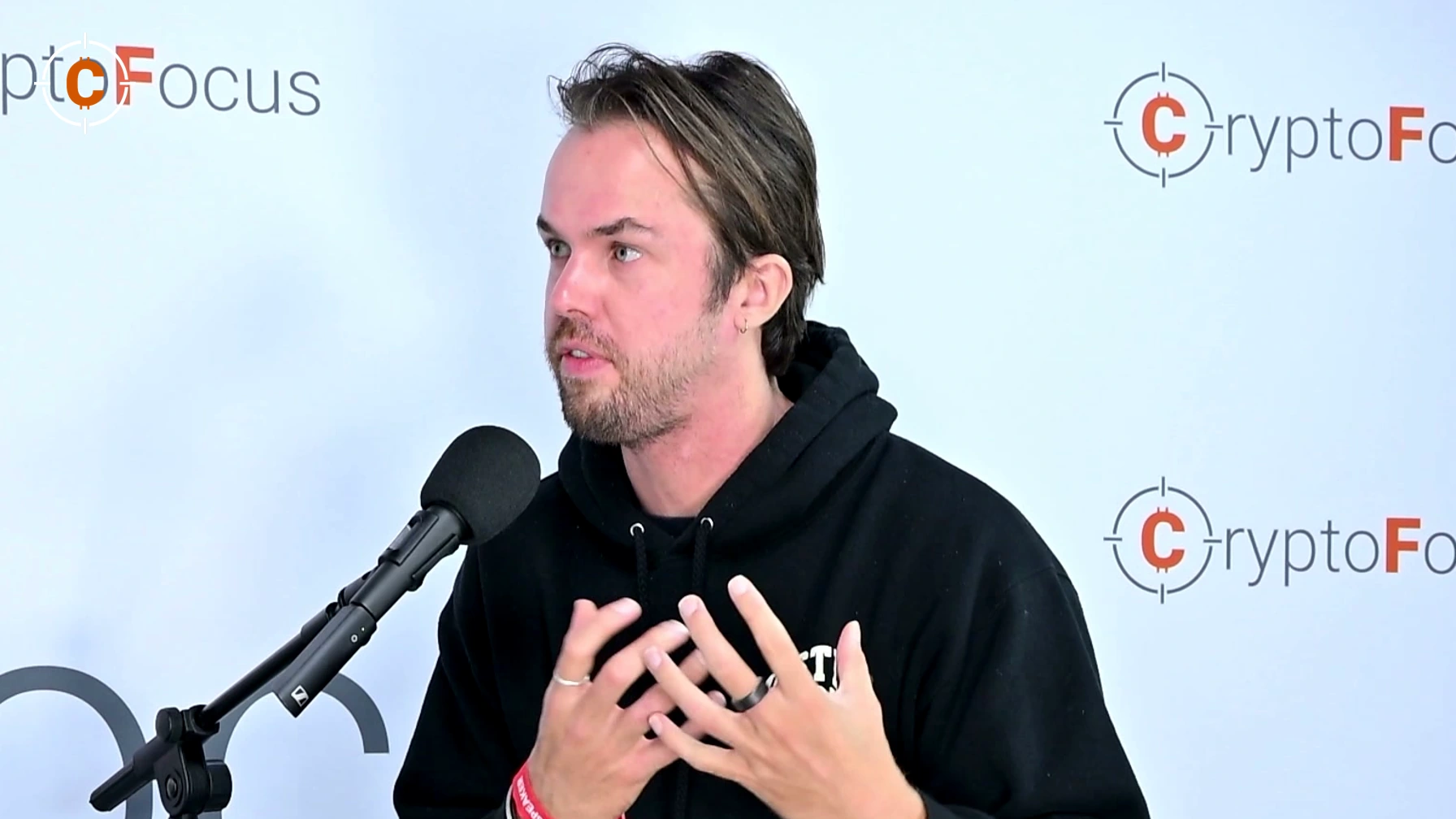
Michaël van de Poppe, CIO and founder of MN Capital, told me at Bitcoin Amsterdam that, for all the noise around exchanges this week, the more important story was in Paraguay, where, he said, “like 60% of the country” had been locked out of their bank accounts over the previous 24 hours. “That is the entire Bitcoin thesis and self-custody thesis that’s shown there,” he said, on the same day he sat on a panel on the Treasury Stage.
We sat down on day one at the SugarFactory in Halfweg, just outside Amsterdam. Michaël writes a regular column for Cryptofocus. We have done enough of these conversations that I skipped the introduction, and after a few words about his podcast we got to a rough week: the US midterms, a large exchange incident and a market that took a beating and stood back up.
| What you need to know |
|---|
| 1Michaël van de Poppe is CIO and founder of MN Capital, leads MN Fund, hosts the New Era Finance podcast and writes a regular column for Cryptofocus. On day one he spoke on the Treasury Stage panel "Will Capital Flow Back Into Bitcoin From AI?". |
| 2Van de Poppe says the bank lockout in Paraguay, which he put at "like 60% of the country", shows "the entire Bitcoin thesis and self-custody thesis". |
| 3Binance froze withdrawals after a breach that TechCrunch put at 6.3 billion dollars and began resuming them in phases on 1 November. Van de Poppe says Binance handled it "in a perfect way" and that the industry can safeguard itself without a government stepping in. |
| 4My read: his case for bitcoin this week rests less on charts and more on who holds the keys when a bank, an exchange or a government stops cooperating. |
The full conversation runs about eleven minutes.
Why Paraguay mattered more to him than Binance
I had asked him to compare two kinds of trouble: an exchange under pressure and a fintech bank that goes quiet for hours when its service breaks. He answered the question and then moved past it, to a country where, in his account, ordinary account holders had lost access to their own money.
I think what’s more important is what has been happening in Paraguay the past 24 hours, with like 60% of the country being locked out of their bank account. That is the entire Bitcoin thesis and self-custody thesis that’s shown there.
Michaël van de Poppe, MN Capital
For a room full of bitcoiners that is familiar ground, and his point is a practical one. A bank account is a promise that someone else will let you in; a key you hold yourself does not need anyone’s permission on a bad day. He tied that straight back to the industry he works in: “They are building products and if something goes wrong they are actually fixing it themselves.”
Read the thread on X
Why he thinks the industry can police itself
The exchange incident of the week was at Binance, which froze withdrawals after a breach that TechCrunch put at 6.3 billion dollars and began resuming them in phases on 1 November. Van de Poppe gives the exchange full marks for the response.
If you look at what happened with Binance, the way they handled it, there’s nothing else you could do. They did it in a perfect way.
Michaël van de Poppe, MN Capital
His only quibble was a tweet that went out about ten minutes in, which he put down to an intern. The bigger lesson, in his view, is about who does the protecting. “I think Binance is just an example that every company should use when they have a certain incident and it also shows that we don’t need a government stepping in to regulate or safeguard us. The industry can do it themselves.” He pointed to Circle and Tether freezing assets straight away, and accepted the trade-off that comes with it: a stablecoin is centralised, and in his words that is its purpose.
He also put the week’s pressure in a wider frame. “AI is showcasing how weak our financial structure is,” he said, which to him means safety has to improve, on a financial infrastructure that in his view cannot simply be updated for what is now arriving.
No single safe place to keep your coins
The most useful minute for an ordinary investor came when he admitted the choice is hard. Do you keep your coins on a Ledger, trust a centralised exchange or buy an ETF? He did not pick one.
I think having a basket of those is probably the best way forward because nothing is safe at this point, it feels like.
Michaël van de Poppe, MN Capital
That is a modest answer, and it sits well next to the Paraguay point. Self-custody protects you from a locked bank account; a spread across custody models protects you from any one of them failing. Which mix fits depends on how much you hold and how comfortable you are managing keys, and that part is your call.
What the US midterms change in his view
On American politics he was blunt. Of Donald Trump’s record on crypto he said: “If you really look at what he did for crypto, it’s been massively negative.” He reads the Democrats’ midterm result as positive in the short term, because the risks that came with Trump matter less now that, as he put it, Trump cannot do much anymore. In his telling oil and yields went down in response, investing became more predictable, and in that climate bitcoin is one of the best assets to invest in.
He was just as clear about the longer horizon. “If we get a Democrat as a president in 2028 and they want to pursue this, that’s going to be bearish,” he said, and he compared that scenario to 2022 and the bear market that followed it. When I asked him at the end of the conversation what the midterm result means for the market, he gave me two words: “Short term bullish.”
He also sees a shift in where money goes next. In his reading the Democrats want to regulate AI, which pushes liquidity elsewhere without stopping AI itself, and the financial system is not ready for what he calls the agentic economy, where software agents transact on their own. “So I expect the next narrative to be the agentic economy being built on top of blockchain so that we have safe payment rails,” he said, with stablecoins and self-custody along the way and bitcoin at the end of it. And he took some comfort from the tape: “the fact that we are higher now than last week and we had the biggest hack in between shows how resilient we are.”
Why he still calls it early
Near the end I pointed at the hall around us, busy on a Thursday afternoon after a month of hacks and bad actors. He read it the other way round. “We’re still early because there should be 50,000 people here,” he said. Plenty of people outside crypto, friends of his among them, are just living their lives, he explained, with kids, a nine-to-five job or a good career, and do not understand the risks they have.
The people that walk here are awake. They understand the risks that will come to them. They have taken responsibility for themselves.
Michaël van de Poppe, MN Capital
He expects the room to grow with the market: “once price picks up it’s going to be way bigger.” He has watched his own audience grow, too. He hosts the New Era Finance podcast, and said it had been “super frustrating” to get no numbers on episodes he thought were good. He quoted Simon Dixon on what changed that: “you need to get proof of reach on centralized platforms to get engagement and the audience.” Now the numbers are there, and with them bigger guests.
You can hear him again on Friday 6 November, when he joins the Dutch-language session “Je Bitcoinplan Opbouwen: Investeren, Belastingen & Meer” on the Orange Stage at 13:30, alongside Alyssa Gammoudy and Charlotte van Brabander. I am the MC of that stage, so I will be the one introducing them. The full programme is on the Bitcoin Amsterdam agenda.
Read next
- All our Bitcoin Amsterdam 2026 coverage, with every interview from the SugarFactory as it goes live.
- Martin Masser of ChangeNOW on why the Binance incident barely moved bitcoin.
- Lyudmyla Kozlovska of the Open Dialogue Foundation on why privacy tools are a plan B, even inside the West.
- Mauro Lorenzo Halve of the NVC on why the Dutch crypto industry is not against regulation, as long as it is proportionate.
- Justin Doochin of BTC Inc on how this year’s programme came together.
- Oleg Andreev of Safely on Flame, a network protected by burning bitcoin.
- Fred Forsberg of Bitcoinist on mining from a phone app.
- Kelly Ann Collins of SheCrypto on why many women may already be in crypto without being seen.
- Laura Peijs and Lisanne Drost of Crypto Women Collective on why a trusted conversation beats a thousand ads.
- Ik hou rekening met een kortere bitcoincyclus dan vier jaar (in Dutch): one of Michaël’s columns for Cryptofocus; all of them are on his author page.
- Michaël van de Poppe is on X, and MN Fund is at mnfund.nl.
I recorded the interview with Michaël van de Poppe at Bitcoin Amsterdam 2026, at the SugarFactory in Halfweg, on 5 November 2026. Quotes are verbatim, with filler removed. Cryptofocus is a media partner of Bitcoin Amsterdam 2026; I moderated a panel there on 5 November and am the MC of the Orange Stage on 6 November. Nothing here is financial advice.


