


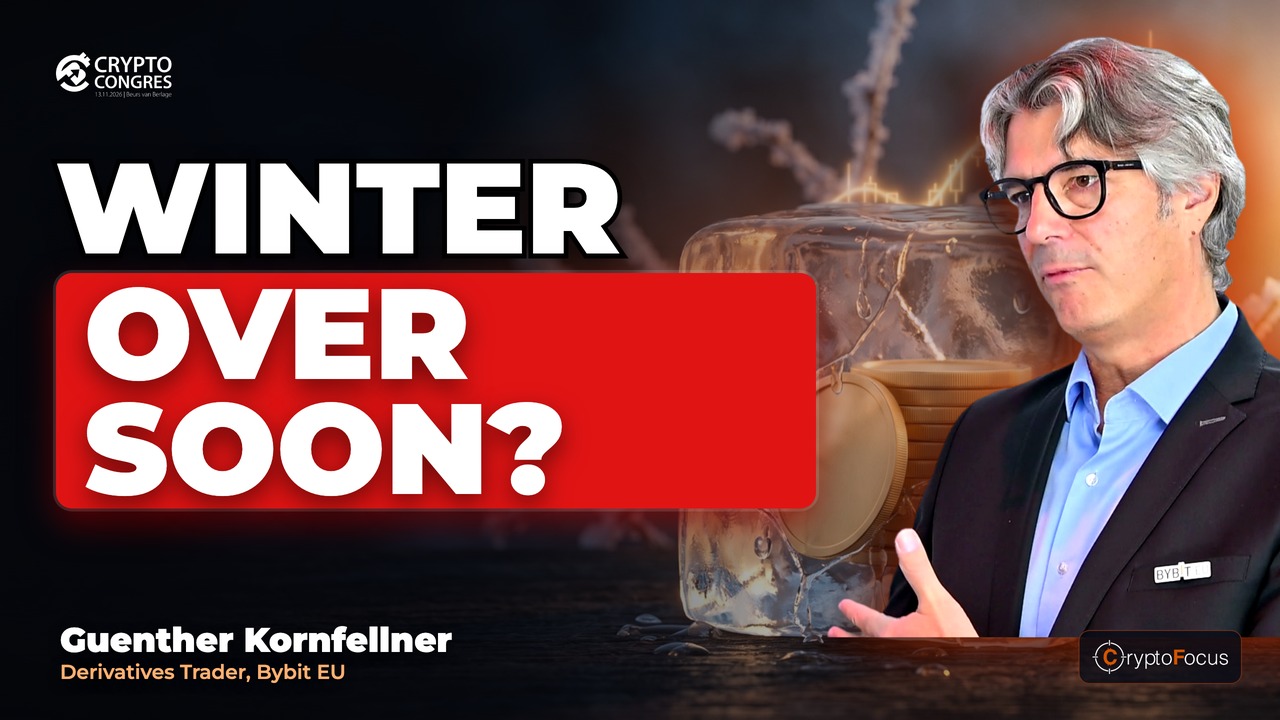

Guenther Kornfellner, a derivatives trader at Bybit EU, believes the crypto winter is supposed to be over soon, and he ended that sentence with “hopefully”. We spoke at Crypto Congres 2026 in Amsterdam, a few hours after he sat on the morning panel I moderated. When I asked what his first move would be, the answer had nothing to do with buying anything: stay safe, and be ready to lose everything you put in.
That panel, “Where is capital flowing?”, opened the Crypto Congres programme at 09:15 on 13 November, with Kornfellner next to Hein Tibosch of Flow Traders and Paul Noordam of Euronext. The congress ran together with BeleggersFair 2026 at the Beurs van Berlage, so most visitors had come for shares, funds and ETFs. Bybit EU, headquartered in Vienna, is the only sponsor the congress site lists. Bybit EU is a partner of Cryptofocus.
| What you need to know |
|---|
| 1Guenther Kornfellner is a derivatives trader at Bybit EU and says he has been a trader for 25 years. He spoke on the 09:15 Crypto Congres panel that I moderated. |
| 2He says that if you believe in the four-year cycle, the crypto winter is supposed to be over soon, "hopefully", and he expects drawdowns even in a good market. |
| 3His first move, he says, is to stay safe: invest only money you can afford to lose, and judge the whole portfolio rather than each asset. |
| 4My read: for an investor at the fair, the order of his answer is the useful part. Risk and position size came first, and the cycle call came with a hedge. |
The full conversation runs just over ten and a half minutes, in English.
A cycle call with a hedge built in
I asked how he is preparing for 2027 as a trader. He pointed first to the recent sell-off in tech stocks, then to crypto, which he called even more exciting because it moves in cycles:
So you have the four year cycle and if you believe in the cycle, which many people do, where you have three years of a very good market environment and one year of a bad one, it’s called crypto winter. And the crypto winter is supposed to be over soon, hopefully.
Guenther Kornfellner, Bybit EU
Two conditions sit inside that sentence. The call holds if you believe in the cycle, and it ends on “hopefully”. He kept both when I asked whether he had stopped trading through the downturn:
I’m trader for the last 25 years and it’s always easier to make money in a bull-market/" data-term-title="Bull Market" role="button" tabindex="0">bull market than in a bear-market/" data-term-title="Bear Market" role="button" tabindex="0">bear market. Of course you can make money in both markets but it’s much easier in a bull market.
Guenther Kornfellner, Bybit EU
Staying on the sidelines until the dust settles is a fair strategy too, he said, before adding a limit to his own advice:
of course you cannot time the market but at least you can try.
Guenther Kornfellner, Bybit EU
Read the thread on X
The first move is to stay safe
So where should people go first, I asked. He did not name a coin or a product:
The first move is of course to stay safe. That’s the most important thing, especially in crypto. It’s very volatile and you have to invest money which you can afford to lose.
Guenther Kornfellner, Bybit EU
He compared it with the shares most visitors to the fair already hold. Stocks fall heavily too, he said, but crypto falls further, and that changes what an investor has to be able to sit through:
So you have to prepare to lose everything. So you need a different set of emotional skill sets here.
Guenther Kornfellner, Bybit EU
For a beginner he would stay with the big and established crypto protocols, and he said twice that this was not investment advice. The second time he made a joke of it:
Maybe you should also take no investment advice out of me because I’m trading for 25 years and still working.
Guenther Kornfellner, Bybit EU
What he asked for instead was homework: your own strategy, your own research, and no buying a new coin because somebody told you it will make you rich.
AI for the research, judgment for the result
Research where, then? He called AI “a new game in town” and drew on his years analysing stocks, when due diligence meant working through a company’s valuation and a discounted cash flow model by hand. AI now does a lot of that work, he said, with a limit:
of course you cannot just put in five prompts and get a good stock investment but it helps you to cut corners
Guenther Kornfellner, Bybit EU
He wants the output treated as a starting point to build on, with the same caution as any other source. His words were “be critical what is the outcome”.
Not every asset has to win
I pushed on outcomes: how do you make sure yours is positive as often as possible? He rejected the premise first:
I think it’s not possible that the outcome of an investment is always positive.
Guenther Kornfellner, Bybit EU
His alternative is the portfolio view. Combine assets that are not perfectly correlated, accept that some of them will lose, and measure the total:
So don’t just look at the individual assets, look at the whole portfolio.
Guenther Kornfellner, Bybit EU
In his view that holds for crypto too. Even a very volatile holding, he said, could improve a portfolio’s overall performance while some of its assets do badly. That fits the question the organiser put to this year’s congress, the portfolio of the future, where crypto sits next to shares and bonds rather than instead of them.
Why Bybit EU chose Vienna
I also asked about Bybit EU itself. He said the company starts with crypto, “our natural field”, and wants to become a big player in Europe, offering its clients a broader range of investment opportunities over time, “not yet, but in the future”. When I asked how a growing platform keeps the human touch, he went to regulation:
We took Vienna as a headquarter because the regulator is very crypto native, understands crypto and regulation helps also the customer to feel more safe.
Guenther Kornfellner, Bybit EU
He named two rules that come with it: client assets must be kept segregated, and there is a set procedure for handling complaints. Those obligations come from the EU’s Markets in Crypto-Assets Regulation, which ESMA summarises here. His own summary was shorter:
I think it’s always clients first because the clients are our assets.
Guenther Kornfellner, Bybit EU
What he is watching for in 2027
My last question was what he looks forward to most as the first half of next year approaches. He hopes the market stabilises, the crypto winter is finally over and the cycle still holds, with a couple of good years to follow. Then he added the condition he had started with:
But still, also in a positive market environment, there could be drawdowns in a severe manner.
Guenther Kornfellner, Bybit EU
His closing words were about position size again: in crypto especially, invest only the money you can afford to lose. For anyone reading the cycle call as a signal, that is the part of the answer he repeated most.
Read next
- Lucas Wensing of Amdax on what clients forgive and what they do not, the drawdown question seen from a licensed Dutch provider.
- Our earlier conversation with Bybit EU’s Indy Rottier at Bitcoin Amsterdam, on AI in trading and who stays responsible for the result.
- Our Crypto Congres 2026 coverage, with the interviews from the day at the Beurs van Berlage added as they go live.
- Bybit EU: bybit.eu and @BybitEU on X.
I recorded the interview with Guenther Kornfellner at Crypto Congres 2026, held with BeleggersFair 2026 at the Beurs van Berlage in Amsterdam, on 13 November 2026. Quotes are verbatim, with filler removed; where a guest spoke Dutch, the quotes are my translation. Cryptofocus is a media partner of Crypto Congres 2026, and I moderated its two plenary panels. Nothing here is financial advice.


