



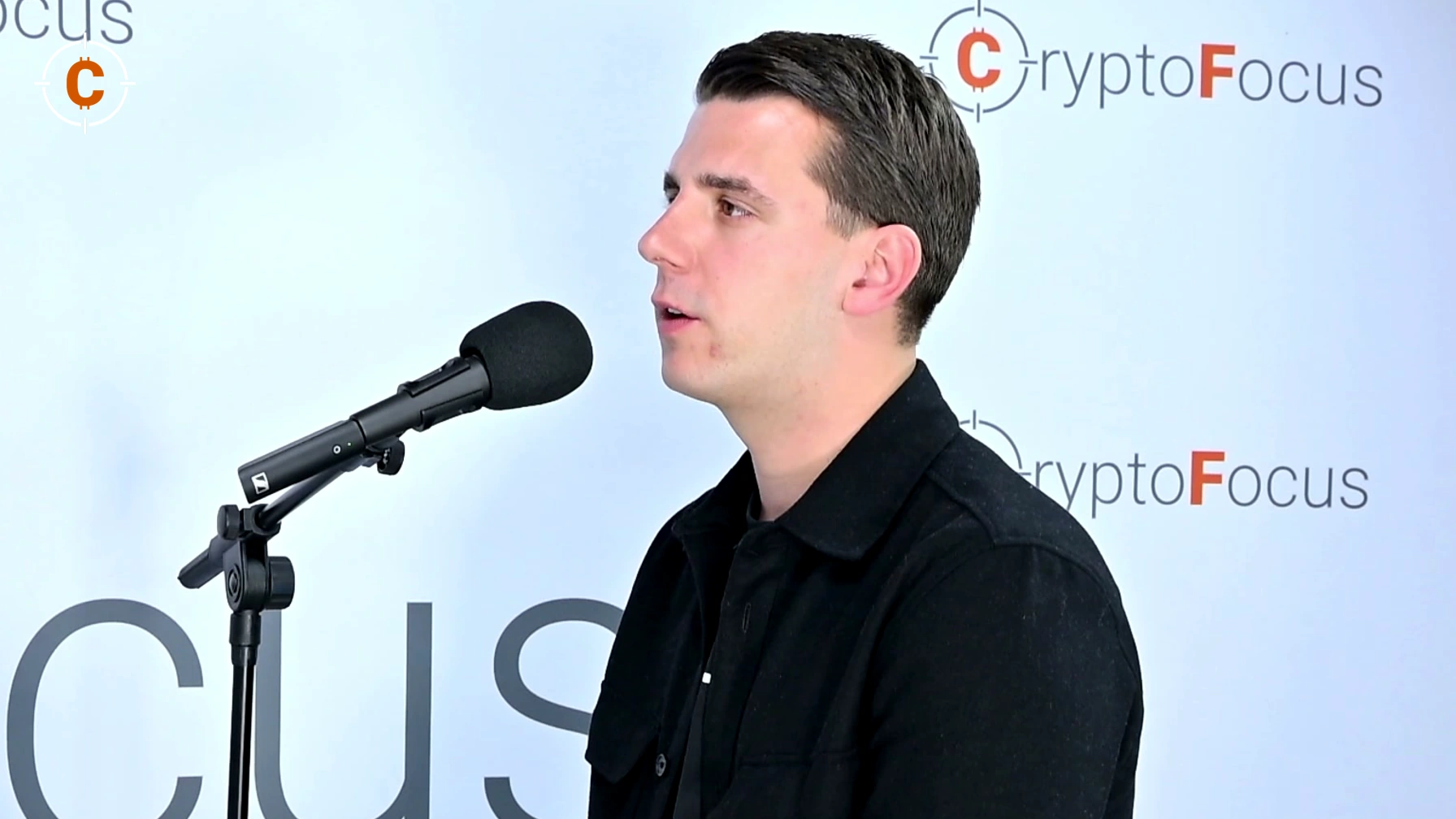

I pulled Indy Rottier, Lead Sales Executive at Bybit EU, away from his company’s busy booth at Bitcoin Amsterdam on Thursday to ask where the exchange goes from here. His plainest answer came when we got to artificial intelligence. Bybit EU customers can now connect assistants such as Claude, Codex and ChatGPT to their account, and Rottier was clear about who answers for the outcome: “It’s an AI, it can make mistakes. You are the end responsible person.”
It was my second interview with him this year. At Dutch Blockchain Week in June he told me Bybit EU was growing beyond a traders’ exchange. This time he talked about what that looks like in practice, from the card people pay with to the campaigns that bring them in. Bybit EU is a partner of Cryptofocus.
| What you need to know |
|---|
| 1Indy Rottier is Lead Sales Executive at Bybit EU, the European arm of the Bybit exchange, which obtained a MiCA licence from Austria's Financial Market Authority and set up its European headquarters in Vienna in 2025. |
| 2Bybit EU's open-source AI Trading Skill connects ChatGPT, Claude, Gemini and Codex to a customer's account through its trading API (Trending Topics, September 2026). Rottier's own caveat: "You are the end responsible person." |
| 3Rottier says card use differs per country: Polish customers use the Bybit EU card more for travel, French customers more for gasoline and groceries. Cashback packages per lifestyle are, in his words, "still in the works". |
| 4My read: the line to remember is his warning that an AI can make mistakes and that the customer stays responsible for every order it places. |
The full interview is just under 12 minutes long.
Six months of building, six months of launches
I started with growth. Bybit EU keeps growing, I said, so where does it grow in the next six months? Rottier went back to what the company set out to be six months ago, in his words “the one-stop shop” for people who want TradFi, day-to-day spending, trading or a yield on idle assets. That plan, he said, is now widening:
We’re becoming this one-stop shop for Europe. We’ve got this dedicated European platform and we’re growing that into not only trading people but also people who want to just touch crypto, start using crypto more and integrate it into their day-to-day lives.
Indy Rottier, Bybit EU
The dedicated European platform is what the licence set up. Bybit EU operates from Vienna under a MiCA licence that Austria’s Financial Market Authority granted in May 2025, so the products he describes are built for customers in Europe. He then gave me the timetable in one sentence:
What we have been doing for the past six months is building those projects and products and what we’re going to do in the coming six months is we’re going to launch those products.
Indy Rottier, Bybit EU
He did not name the products still to come. Most of the conversation was about pieces that are already running.
Read the thread on X
AI assistants on the account, the user in charge
I asked how customers had received the API connection that lets AI tools work with a Bybit EU account. He started from how ordinary these tools have become. We have all been using them for years, he said, and some companies even replace employees with them. For an individual the question is a different one:
But as a personal or as an individual you can have so many tools helping you in your day-to-day life. Why not use it to trade crypto? Why not use it to get some more insights?
Indy Rottier, Bybit EU
His examples were practical: asking an assistant what your portfolio looks like and where you could reduce risk, having it pull data from the platform and build a dashboard, or having it carry out a strategy “that the platform itself doesn’t per se allow”. Then, without being asked, he added the caveat:
It’s an AI, it can make mistakes. You are the end responsible person.
Indy Rottier, Bybit EU
It is a plain sentence. As Trending Topics reported in September, the Bybit EU AI Trading Skill is a package of instructions and scripts that the assistant loads and runs in its own environment. The assistant talks to the exchange’s REST interface directly and signs its requests with API keys the user holds locally, with no server run by the provider in between. Bybit EU’s own announcement covers the API itself. Rottier said customers had been asking for it for a long time:
People were requesting it already for months and months on, and now that we got the API connection we immediately launched it with Bybit EU skills through Claude, Codex, ChatGPT, the more famous and the more used ones.
Indy Rottier, Bybit EU
In practice the keys stay with the user, and so does the result of every order the assistant places. That is exactly where Rottier put the responsibility.
How card use differs from country to country
Next I asked about the Bybit card, and how the company keeps it relevant as more products arrive. Rottier answered with what Bybit EU sees in its own data. Some people use the card for the cashback without using crypto at all, he said, but most hold crypto on the platform and want to spend it. Where they spend it depends on where they live:
In the Netherlands we see the data, people are using it for all kinds of things. For instance in Poland they use it more for travel, in France they use it more for paying their gasoline or their groceries, and what we saw is there’s different needs for different markets or for different people.
Indy Rottier, Bybit EU
He added that the differences can even show up within the Netherlands. That observation is behind an idea he was careful to call unfinished: cashback packages a customer selects to match how they live, with more cashback on travel for someone who travels a lot, or on selected merchants for someone with a sports subscription. “It’s still in the works,” he said, and it “might take some time”.
It is a small window into what European customers do with crypto once it leaves the trading screen. In one country it goes on travel, in another on fuel and groceries.
Squads, campaigns and knowing when to stop
Bybit EU runs a lot of campaigns, often several at once, so I asked about the trading competition it is preparing now, EUSOT. It is built on squads: a KOL or, in his words, an “influential person” creates a squad, others join, and there are individual and team targets. What he enjoys watching is the national rivalry:
Very proud that Dutch squads were always in the winning teams. We see some competition now from other countries where for instance Polish squads have now started growing.
Indy Rottier, Bybit EU
The open question for him is whether “the existing Bybit EU user” stays “Dutch oriented” or turns more European. In June he called the Netherlands one of the company’s best markets, so a more European user base would be a shift worth watching.
Then I asked how Bybit EU makes sure people keep using all these campaigns. His answer was more candid than the question. Sometimes, he said, “it could be a maze”: European campaigns, Dutch campaigns from the Dutch team, others from the German or the French team. Someone has to check them against each other:
We as a team, as in the back end, we have to say, hey, are they not conflicting, right? Is it not rewarding the user too much, because then again we are giving away money.
Indy Rottier, Bybit EU
Different users need different reasons to come back, he said, from the hardcore trader to the person who only uses the Earn product, the card user and the one who likes to DCA. That leaves a balancing act, which he summed up himself:
It’s just the art of not launching too many, but still addressing every user with a dedicated campaign.
Indy Rottier, Bybit EU
It is also a fair way to read the launches he promised for the coming six months: the more of them there are, the more that balancing act matters.
Read next
- Our earlier conversation with Indy Rottier, at Dutch Blockchain Week in June, on Bybit EU growing beyond a traders’ exchange.
- All our Bitcoin Amsterdam 2026 interviews from the SugarFactory.
- Justin Doochin of BTC Inc on where AI fits at a bitcoin conference.
- Michaël van de Poppe of MN Capital on Paraguay, self-custody and what the US midterms change in his view.
- Nico Moran of Simply Bitcoin on bitcoin as a savings vehicle.
- Mauro Lorenzo Halve of the NVC on the Dutch Box 3 plan and proportionate regulation.
- Lyudmyla Kozlovska of the Open Dialogue Foundation on why privacy tools are a plan B, even inside the West.
- Laura Peijs and Lisanne Drost of Crypto Women Collective on why a trusted conversation beats a thousand ads.
- Kelly Ann Collins of SheCrypto on why many women may already be in crypto without being seen.
- Oleg Andreev of Safely on Flame, a network protected by burning bitcoin.
- Fred Forsberg of Bitcoinist on mining from a phone app.
- Bybit EU is at bybit.eu and on X.
I recorded the interview with Indy Rottier at Bitcoin Amsterdam 2026, at the SugarFactory in Halfweg, on 5 November 2026. Quotes are verbatim, with filler removed. Cryptofocus is a media partner of Bitcoin Amsterdam 2026; I moderated a panel there on 5 November and am the MC of the Orange Stage on 6 November. Nothing here is financial advice.


